
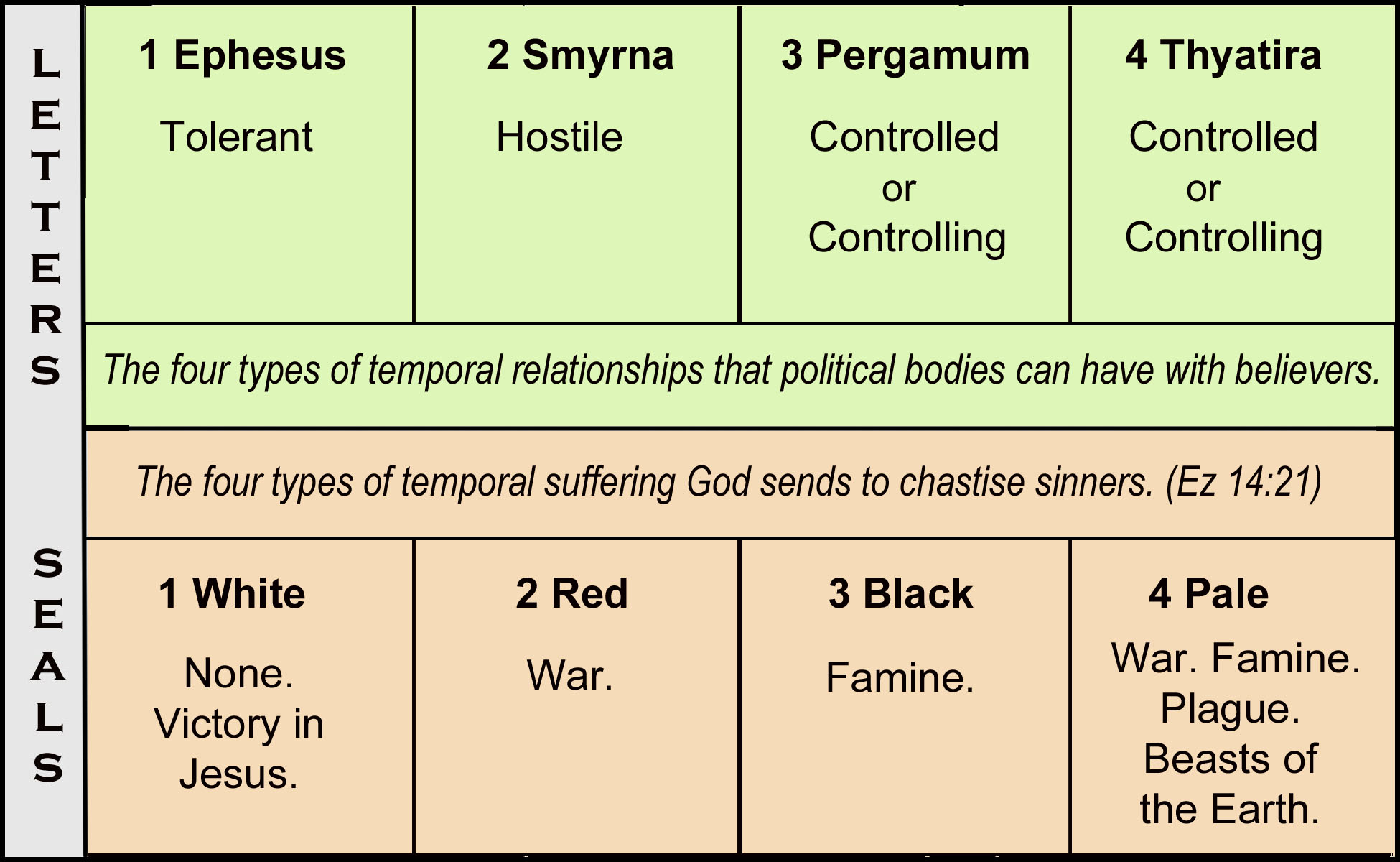
UPDATE: I added a chart of the first Fours.
If you’re new to this series, catch up @
I’ve talked about how, in the Book of Revelation, the first four of the seven Letters and the first four of the seven Seals work in parallel to describe the first 1500 years of Christian history, from the Age of the Apostles up to the Reformation. I’ve also shown how the four Seraphim, the four Horsemen and the interlude at the end of the fourth Letter suggest that these first four Letters/Seals are distinct in some way from the last three Letters/Seals.
In Scripture, seven is the number for completeness, because it is made up of four, the number for all that God created, plus three, the number for God Himself.
The first four Letters are about the four types of temporal relationships that political bodies can have with believers – tolerant, hostile, controlling and controlled.
The first four Seals are about the four types of temporal suffering God sends to chastise wayward believers – “sword, famine, wild beasts and plague” (Ezekiel 14:21).
I was stumped for weeks as to what the the second three Letters/Seals had to do with each other or with anything else. Then I noticed there is another interlude between the sixth and seventh Seals that could indicate the three is comprised of a two – for a matching and/or contrasting pair – plus a one – for God. This happens elsewhere in Scripture.
For example, there were three in the Garden of Eden, the two first humans (one male and one female) and one God the Father. Similarly, there were three crucified at Golgotha, two criminals (one lost and one saved), plus one God the Son.
Letters Five and Six
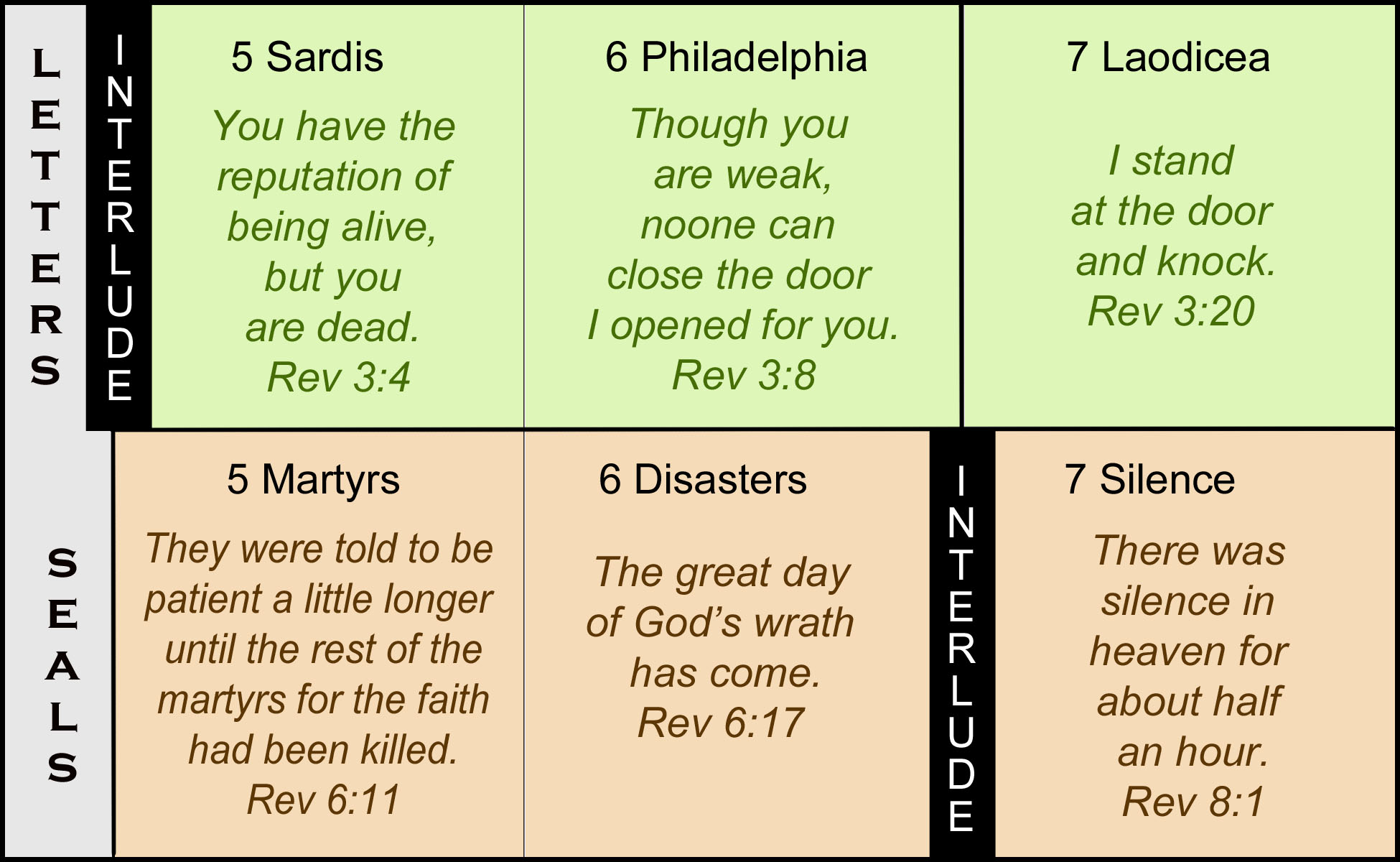
The first four Letters covered the ages of the church from Jesus to the Reformation, addressing the four types of relationships that can exist between political and religious institutions.
I think Letters Five and Six contrast the kind of relationships that can exist between individual believers and religious institutions.
Sardis is addressed to the insider in a church community, a person whose activities in the church give him a reputation as a good Christian. My mother always called this kind of person “a pillar of the church” (and not always in the nicest way).
Philadelphia is addressed to the outsider in a church community, a person who doesn’t fit in very well (or at all), but whose faith is true. Jesus promised to make this person into “a pillar in the temple of my God.”
[For a longer discussion of Letters Five and Six, see “The Seven Churches of Revelation, part seventeen” @ https://polination.wordpress.com/2013/01/17/the-seven-churches-of-revelation-part-seventeen/%5D
Seals Five and Six
The first four Seals also covered the ages of the church from Jesus to the Reformation, addressing human suffering via the four types of God’s Tough Love – war, hunger, disease and natural disasters.
I think Seals Five and Six continue the theme of suffering, bracketing the historical period from 1517 until the “great day of God’s wrath” (whatever that is).
Fifth Seal (Rev 6:9-11): The Beginning of the Age of Many Churches (ca 1517)
When he broke open the fifth seal, I saw underneath the altar the souls of those who had been slaughtered because of the witness they bore to the word of God.
They cried out in a loud voice, “How long will it be, holy and true master, before you sit in judgment and avenge our blood on the inhabitants of the earth?”
Each of them was given a white robe, and they were told to be patient a little while longer until the number was filled of their fellow servants and brothers who were going to be killed as they had been.
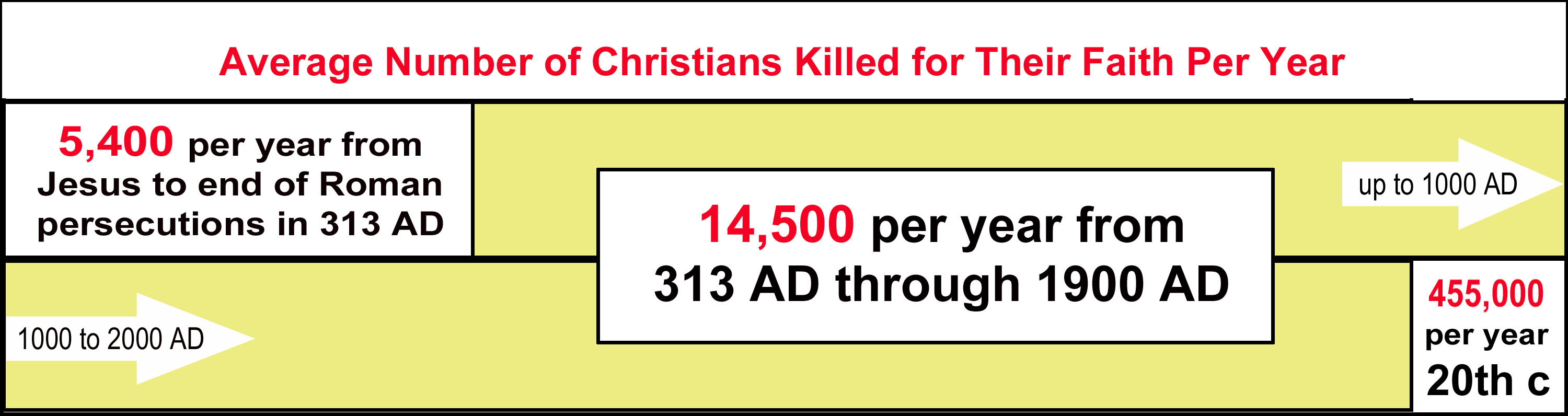
About 70 million Christians have been killed for their faith since Jesus walked the Earth.
- Most of them have been since the Protestant Reformation began in 1517.
- Sixty-five percent (about 45.5 million) were killed just in the 20th century!
Sixth Seal (Rev 6:12-17): The End of the Age of Many Churches (Only God knows the date or hour)
Then I watched while he broke open the sixth seal, and there was a great earthquake; the sun turned as black as dark sackcloth and the whole moon became like blood.
The stars in the sky fell to the earth like unripe figs shaken loose from the tree in a strong wind. Then the sky was divided like a torn scroll curling up, and every mountain and island was moved from its place.
The kings of the earth, the nobles, the military officers, the rich, the powerful, and every slave and free person hid themselves in caves and among mountain crags. They cried out to the mountains and the rocks,
“Fall on us and hide us from the face of the one who sits on the throne and from the wrath of the Lamb, because the great day of their wrath has come and who can withstand it?”
All the way through the first five Letters, Jesus says he will come at some point, but as you read through the Letters, the urgency increases until He says to (6) Philadelphia, “I am coming quickly”, then to (7) Laodicea, “I stand at the door.”
It seems to me that something really dramatic has to happen between Philadelphia and Laodicea, KWIM?
This is when the interlude in the seven Seals occurs. And it’s a BIG interlude … all of chapter 7!
I need to keep working on this, so just let me close with this thought.
I’m trying really hard here to stick to the Scriptures and not impose any denominational bias on what I see in the words. I’ve read up a bit on Catholic teaching about the Rapture. [Summary: “There ain’t gonna be one.”] But I am finding evidence for it in my own Scripture studies that doesn’t include any of the interpretations or citations I’ve found anywhere else. So maybe I’m wayyyyyyy off. Or maybe not. In short … please keep that salt flowing and be assured that I am well aware of the fact that I have to answer to God Almighty for every word I post on this subject.
————
Sources:
- New American Bible online @ http://www.usccb.org/bible/
- Conclusions of Study of Christian Martyrs http://www.ewtn.com/vnews/getstory.asp?number=26402
- History of Christianity http://creationwiki.org/History_of_Christianity








 polination.blog
Pingback: Continuing my study of the Book of Revelation, part two | PoliNation