
Transmission to humans from Ebola’s wild natural reservoirs is rare; outbreaks are often traceable to a single case where an individual has handled the carcass of a host animal. Human-to-human infection primarily has occurred only in individuals who have had contact with infectious patients or with their corpses. The disease has a 21-day incubation period.
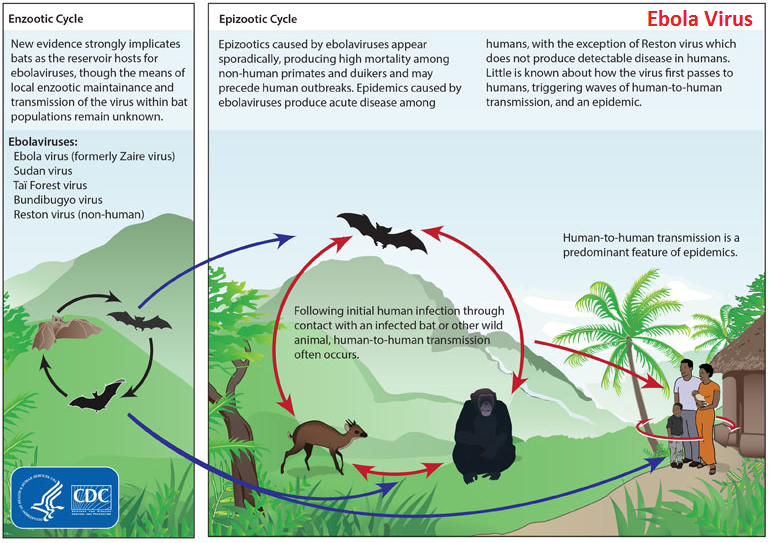
The virus was discovered in 1976; two outbreaks in 1972 were identified later based on antibodies in villagers’ blood and anecdotal evidence of the periods of sickness. Natural Ebola outbreaks prior to 2014 have been restricted to Central Africa.
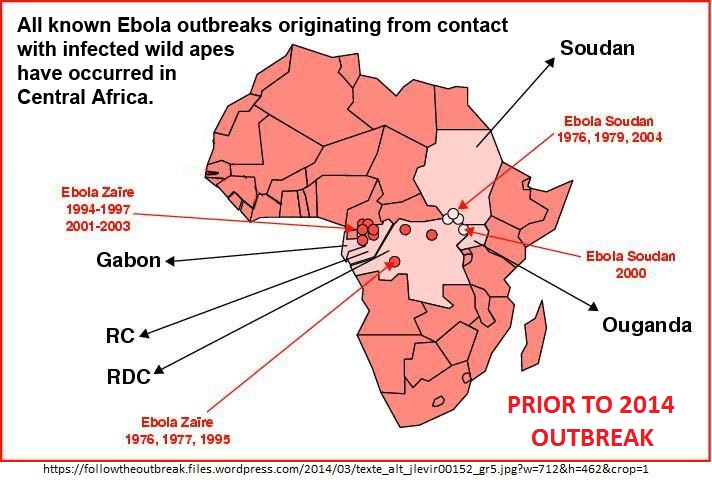
Naturally occurring outbreaks (confirmed cases/deaths among confirmed cases):
Gabon:
- 1994 = 52/31.
- 1996 = 37/21.
- 1996–1997 = 60/45.
Republic of the Congo:
- 2002–2003 =143/128, 35/29 (2 outbreaks)
- 2007 = 264/187.
Gabon/Rep. of the Congo (straddled border):
- 2001–2002 = 122/96.
Dem. Rep. of the Congo [aka, DRC; formerly Zaire]:
- 1976 = 318/280.
- 1977 = 1/1.
- 1995 = 315/254.
- 2008-2009 = 32/14.
- 2012 = 77/36.
- 2014 = 70/42 to date. Outbreak is on-going, but the virus is genetically unrelated to West Africa outbreak.
South Sudan:
- 1976 = 284/151.
- 1979 = 34/22.
- 2004 = 17/7.
Uganda:
- 2000–2001 = 425/224.
- 2007–2008 = 149/37.
- 2012 = 24/17.
Other known Ebola infections have been far less lethal.
- 1980-1990 = 7 people working with infected monkeys in Philippines/U.S. developed antibodies only.
- 1994 in Côte d’Ivoire = 1 scientist working with infected monkey tissue got sick, recovered.
- 1996 in South Africa = A doctor treating Ebola patients and the nurse who treated him got sick. He recovered; she died.
- 2004 in Russia = Lab accident, 1 sick/1 death.
- 2008 in Philippines = Ebola virus found in pig slaughterhouse. 6 workers developed antibodies only.
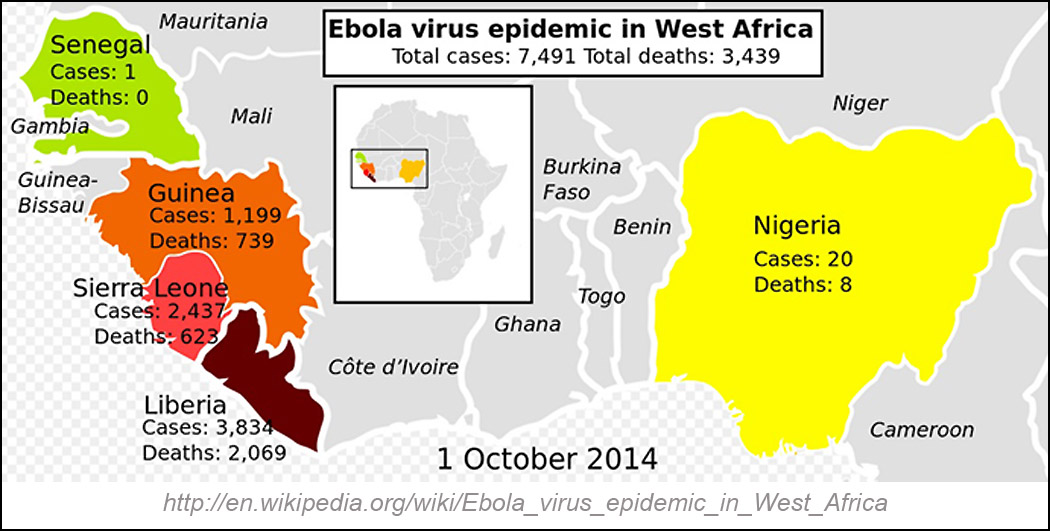
The 2014 Ebola Outbreak in West Africa (EOWV) has not followed the pattern.
- Other outbreaks have all been in CENTRAL AFRICA (Gabon, Republic of the Congo, DRC/Zaire, South Sudan, Uganda).
- EOWV started in Guinea and spread rapidly to four other nations in WEST AFRICA (Liberia, Nigeria, Senegal, Sierra Leone).
- The largest previous outbreak had a total of 425 cases (53% fatality).
- EOWV cases exceeded the sum of all previous known outbreaks in September and is not contained.
- Previous outbreaks were all contained and ended within the areas where they started.
- EOWV has jumped to capital cities and the UNITED STATES.
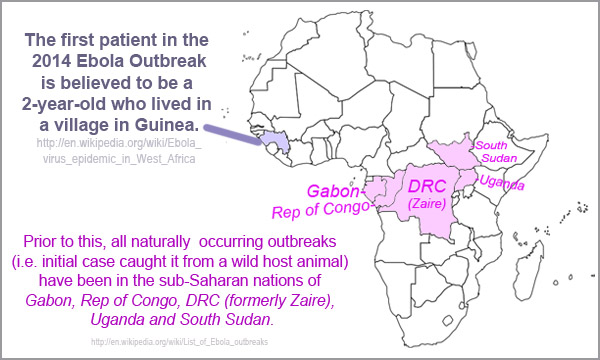
- December 2013: Researchers believe the index case was a 2-year-old boy who died in his home village in Guinea. The disease was misdiagnosed because Ebola had never been seen outside of the sub-Saharan nations listed above.
- March 2014: The outbreak had spread to Liberia and Sierra Leone.
- April 2014: Guinea’s Ministry of Health reported 25 health care workers had caught the disease; 16 had died.
- May 2014: The outbreak had spread to Guinea’s capital city.
- June 2014: The outbreak had spread to Liberia’s capital city.
- July 2014: The outbreak had spread to to Sierra Leone’s capital city and to Nigeria’s former capital city.
- August 8, 2014: EOWV was formally designated as a Public Health Emergency of International Concern.
- August 2014: A single case appeared in Senegal in a Guinea national who recovered.
- September 26, 2014: The WHO said, “The Ebola epidemic ravaging parts of West Africa is the most severe acute public health emergency seen in modern times. Never before in recorded history has a biosafety level four pathogen infected so many people so quickly, over such a broad geographical area, for so long.“
- September 30, 2014: A man who traveled from West Africa to Dallas, TX, is initially mis-diagnosed and sent home. He is currently in critical condition and his contacts are being monitored.
- October 1, 2014: EOWV continues with 7,492 suspected cases (4,108 lab confirmed) and 3,439 deaths (2,078 lab confirmed) to date. Many experts believe that these numbers are much lower than the actual outbreak, due in part to community resistance to reporting cases, and a lack of personnel and equipment to investigate reports of the disease.
- October 2, 2014: An NBC News cameraman helping to cover the outbreak in Liberia tested positive and is being treated.
Sources:
- http://www.ijreview.com/2014/10/183696-contagious-deadly-ebola-virus-compared-5-major-viruses-one-clear-chart/
- http://en.wikipedia.org/wiki/List_of_Ebola_outbreaks
- http://www.ncbi.nlm.nih.gov/pubmed/7441008
- http://en.wikipedia.org/wiki/Ebola_virus_epidemic_in_West_Africa
- http://en.wikipedia.org/wiki/2014_Democratic_Republic_of_the_Congo_Ebola_virus_outbreak
- http://en.wikipedia.org/wiki/Guinea
- http://en.wikipedia.org/wiki/Nzara,_South_Sudan






 polination.blog
Conquest, War, Famine and Death. Didn’t know we’d see the pale horse here so soon.
Really excellent, Chrissy. Thanks!
LikeLike
I had the same thought.
LikeLike