
In The Catechism of the Catholic Church, CONSCIENCE is defined as “a judgment of reason by which the human person recognizes the moral quality of a concrete act.” (CCC 1796)*
It may seem odd, but the Catholic Church actually teaches that the conscience of an individual takes precedence over the teachings of the Catholic Church!
This may sound like “if it feels good, do it”, but it’s not. There are important caveats.
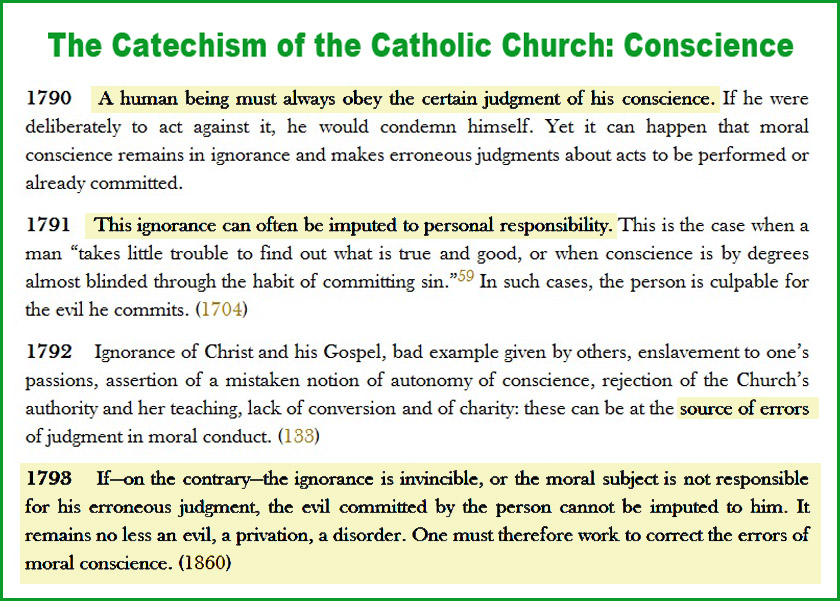
The way I understand it is this:
- God will judge me BOTH for what I did or failed to do AND for what I believed about what I did or failed to do.
- “I was just following orders [Catholic teaching]” won’t cut it at judgment, but neither will “I didn’t know.”
If my conscience is warped as a result of my own actions, then I am culpable for the evil I did or did not do.
If my conscience is ignorant as a result of circumstances beyond my control, then I am not culpable for the evil that results.
EXAMPLE:
If I, having been exposed to the facts of fetal development, procure an abortion anyway, I will be guilty of murder.
But if I have had no opportunity to learn that the “products of conception” are alive and human, I will not be guilty of murder if I procure an abortion.
In both cases, the evil that results (a dead baby) will be the same. What differs is only the degree to which God will hold me responsible for that death.
All of this supposes the individual is free to act on his or her conscience. Incapacity and/or coercion change the equation completely.
*CCC numbers are references to specific paragraphs in The Catechism of the Catholic Church.
** Invincible: too powerful to be defeated or overcome.
Source:








 polination.blog