

Read more @ http://www.culturedfoodlife.com/the-healing-crisis-and-cultured-foods/
Comments Off on Healing Crisis
Filed under Health & Nutrition
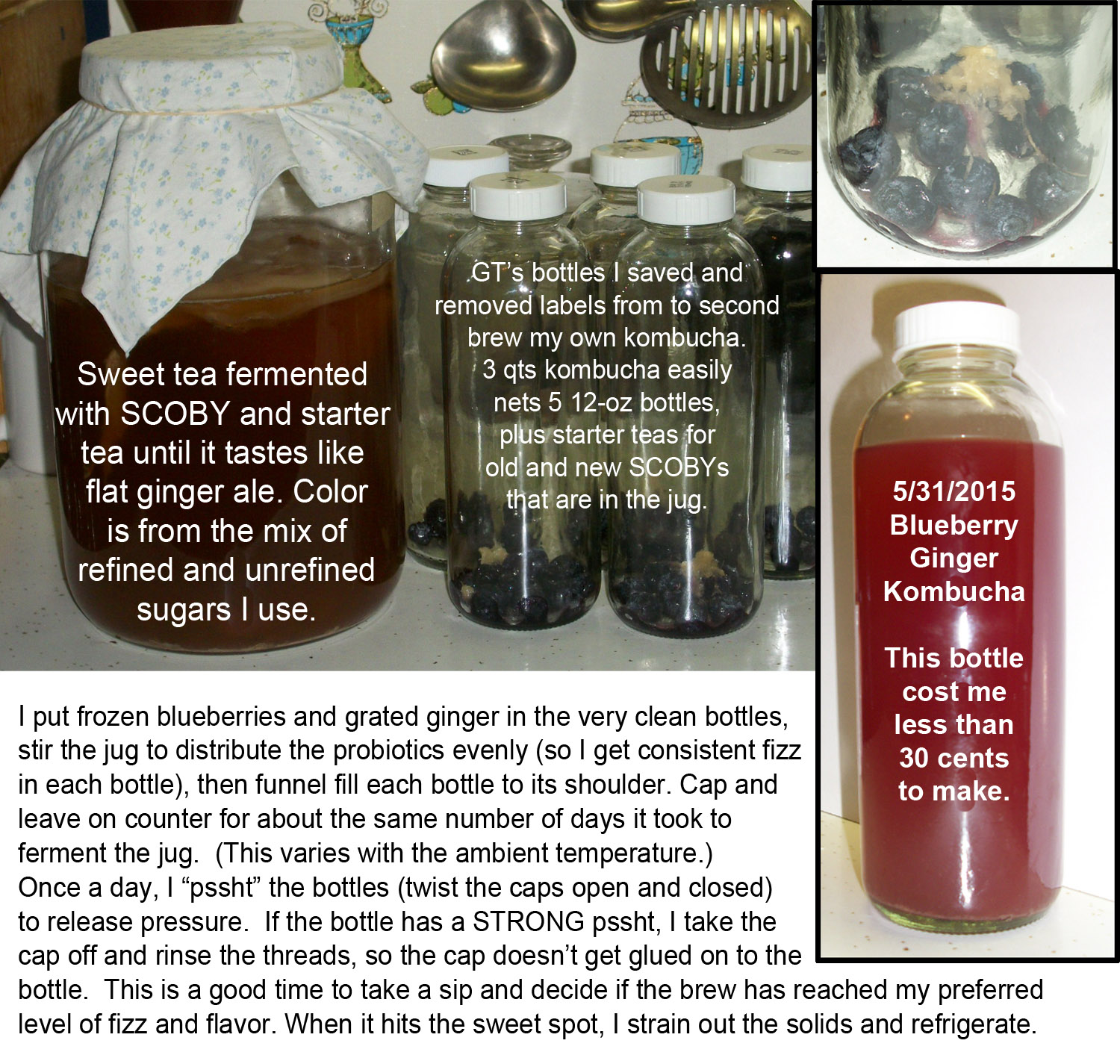
My daughter and I are using the two-brew method.
The first brew is sweet tea in a gallon jug with a SCOBY and some starter tea from the previous batch. The jug is covered with a cloth and rubber band, then left out at room temperature, out of direct sunlight. When the tea has brewed to where it tastes like flat ginger ale, we take the SCOBY and some starter tea out of the jug for next time, then stir the liquid and decant it into bottles that have flavorings added.
The bottles get capped and left out for the second ferment, during which time the drinks develop fizz and extra flavor. Once a day, the caps need to be loosened to pssht out some of the excess CO2. When the brews in the bottles taste fabulous, they go into the fridge for consumption. We’re using empty GT’s bottles with new brew caps from Kombucha Kamp. The black brew caps work much MUCH better than the white ones that come on the GT’s bottles.
There are other ways to make kombucha, or “booch” as we call it here at Casa Hyphen. This is just the way we like to do it. Tastes vary, but I find my first and second brews take pretty much the same amount of time. It’s so hot now, I get the flavor I want in 3 days and 3 days. In mid-winter, it was 7 and 7. In spring, it was 5 and 5.
And hey … aren’t these bottles pretty?! Mama Buzz was so pleased, she sent me pictures of her latest batch. 🙂

Filed under Food, Health & Nutrition
If you’re thinking you maybe, but possibly not sure want to get into fermenting produce, here is a way to do it without buying any special equipment.
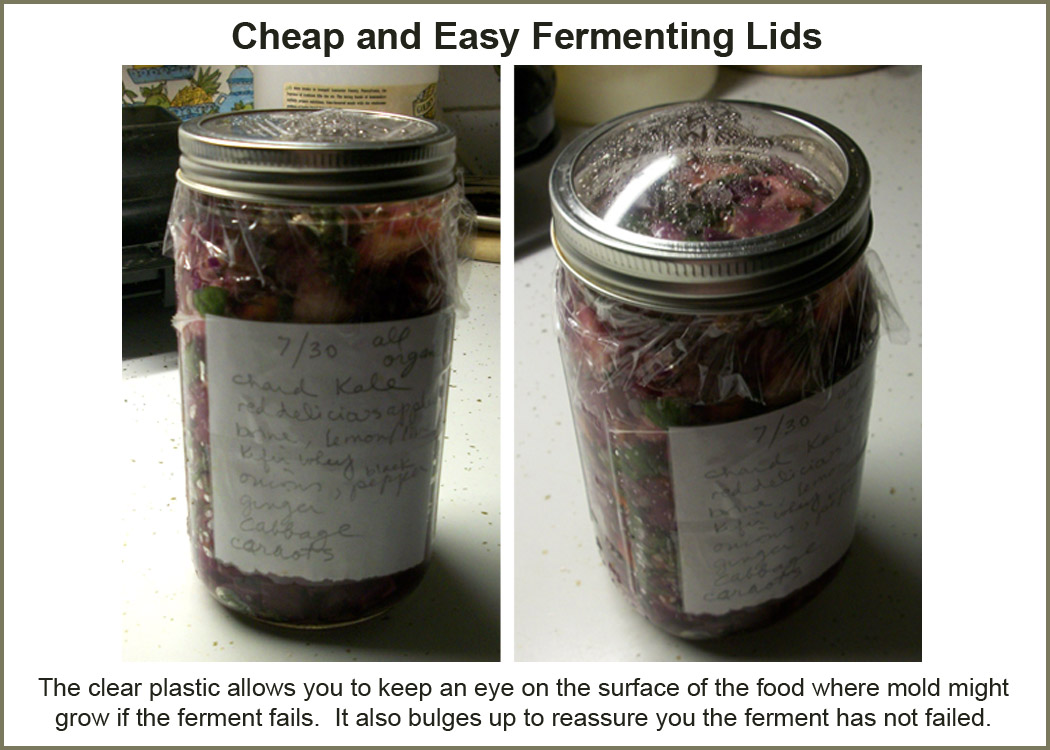
SPOILAGE vs. FERMENTING:
The most common failure for a ferment is mold growing on the surface. If this happens, throw it out. COMMON QUESTION: A bulging can is a sign of botulism. Why is a bulging ferment lid a good thing? SIMPLE ANSWER: Canning destroys all the biotics … pro and con. Botulinus happens to be more heat-tolerant than the other biotics and can be the only survivor in the can if the food doesn’t get hot enough for long enough. Fermenting allows all the biotics to grow. The pro vastly out-number and out-power the con, particularly botulinus, which may be heat tolerant, but otherwise is a weenie that can’t compete unless you kill off all the competition.
The most obvious sign that the ferment has succeeded is gas production. Once the pro-biotics in the food are making that gas, you are assured that the food in the jar will remain edible for months. Let it ferment on the counter until you like the flavor, then put it in the fridge to stall the ferment until you eat it all up. It does continue fermenting very slowly even in the fridge, but you’ll eat it before you notice any increase in tartness.
This salsa recipe is excellent fresh, but even better fermented. It’s my favorite to recommend for beginners. It makes about two quarts; feel free to halve it if you want. Use ORGANIC ingredients only. They come fully stocked with an abundance of natural, healthful pro-biotics and contain no growth-restricting toxins.
Instructions:
Chop everything and toss it all in a bowl to get the produce to release juices to form brine (salt water). If you add chili powder or some other oil-based spices, stir it up well and let it all sit for 20 minutes or longer before taste testing. Salt releases its flavor into the food immediately. Most other additives need time to reveal themselves.
When it tastes great in the bowl, stuff it into sterile glass canning jars, leaving 1″ headroom. Push down on the food to get the brine to come up as far as it’s going to. If the natural liquid does not cover the top of the food, add kefir whey or filtered water. (Do not use tap water! The chlorine and other additives some cities add will kill your pro-biotics.)
The produce likes to float, so the top bits almost always get themselves above the water. This is where mold can take hold. Some folks use a weight; I prefer to coat the produce with a little olive oil. Oil floats, so it stays on top, it works well to keep air away from the food, and when the ferment is ready to eat, I think the oil stirred into the food enhances the flavor.
Cap the jars as shown in the photo above and leave them out on the counter at room temperature to ferment for 2 days or so, avoiding direct sunlight. If your plastic bubble gets big, unscrew the lid to release the gas, then close it up. If your plastic bursts, replace it. You can switch to a solid lid when you refrigerate if you prefer.
Source for original salsa recipe:
http://wellnessmama.com/2643/fermented-salsa/
Comments Off on Cheap and easy fermenting starter
Filed under Food, Health & Nutrition

Earlier today, I heard a lady talk about how some Christian sects teach that Jesus drank grape juice, not wine. I’d heard that before I got interested in fermenting and didn’t think much about it. Today, though, my immediate response was, “Hang on a minute! They had to be drinking wine. Fermenting was the only way to preserve grape juice in the Middle East before canning was invented.”
Food starts to spoil the moment it is harvested. You either eat it quickly or you have to preserve it in some way. Most of the methods for food preservation were discovered in pre-history. But the only methods for preserving fresh grape juice — canning and freezing — were not invented until long after Jesus’ time.
I’m Catholic, so the Jesus and wine issue is not theologically interesting to me. I understand that those who believe in the grape juice theory have a biblical argument that they find compelling. However, from a food preservation history point of view, I don’t see how people in Bible times could have had access to unfermented grape juice outside of grape harvest season, which in Israel is June through September. The Last Supper was in April.
Sources:
Filed under Food, Health & Nutrition
We prefer organic, but sometimes the cost is so much higher, one is left wondering if it’s worth it. I found this list ranking the pesticide residue found on produce. The organization that made the list power washed everything, then tested it for pesticide residue. I decided it would be much more useful in the hot little hand of the grocery shopper, so made up this printable shopping list. After printing, I’ll cut them in half, put them on the fridge and use the blank parts for writing what we need.

Source:
http://www.biodynamic-foods.com/best-and-worse-non-organic-foods-pesticides/
Comments Off on Balancing organic value with organic cost
Filed under Health & Nutrition
Many people call kombucha a “healthy soda-pop.” It contains a high amount of probiotics and beneficial acids you won’t get from any soda-pop, plus a lower sugar content. It’s fizzy and delicious like soda-pop and, if you started with caffeinated tea, it will give you a bit of a caffeine boost.
However, it is NOT true that it is sugar free. A study done by Cornell University showed:

Note: You must use real sugar to brew kombucha. The SCOBY can’t use stevia, xylitol or other artificial sweeteners to create the probiotics and acids that make kombucha so good for you. If you want or need to know the sugar content of your home brew, you can use sugar test strips. Diabetics may be able to brew the sugar out of the kombucha, then sweeten it with something safe. I haven’t tried this, but I don’t see why it wouldn’t work.
Sources:
Comments Off on How much sugar is in my kombucha?
Filed under Health & Nutrition
Kefir whey is a super food which contains a lot of healing properties. In fact, Hippocrates and Galen, two founding fathers of medicine, frequently recommended whey to their patients to heal them. This whey was often referred to as “liquid gold.”

If you make kefir cheese and have lots of whey, you can add this to drinks and salad dressings and anything that calls for water. The gardens love it!
Kefir preserves milk and keeps it safe. It will last as much as 9 months in the fridge. The cold slows fermenting greatly, but it doesn’t stop it, so a long stay in the fridge will net you some very sour kefir.
Sally De Losa says, “The whey is amazing as a stain remover! I used to soak things in milk to remove blood, chocolate, berry stains, etc., but they go really smelly as it takes a day or so; I’ve found that the whey doesn’t get smelly and it does removes all those stains with just by a few hours soak and then into the wash! We have a septic system, so the added bonus is that it doesn’t upset our septic like chemical stain removers do.”
Source:
http://www.culturedfoodlife.com/the-liquid-gold-in-kefir/
Filed under Health & Nutrition

Comments Off on Three Reasons to Prefer Ferments
Filed under Health & Nutrition
Comments Off on Bragging on my latest kombucha brewing success
Filed under Health & Nutrition





 | mindful webworker on Easter Sunday |
 | chrissythehyphenated on Bits & Bytes |
 | bluebird of bitterne… on Bits & Bytes |
| chrissythehyphenated on Good Friday |
| mindful webworker on Good Friday |
| chrissythehyphenated on Bits & Bytes |
| bluebird of bitterne… on Bits & Bytes |
| bluebird of bitterne… on Palm Sunday |
| chrissythehyphenated on Palm Sunday |
| chrissythehyphenated on Palm Sunday |
| bluebird of bitterne… on Palm Sunday |
| bluebird of bitterne… on Palm Sunday |

 polination.blog