
I know the person who posted this. She was on lunch duty on Friday and took the photo herself.

I know the person who posted this. She was on lunch duty on Friday and took the photo herself.
Filed under Health & Nutrition

I have some science to throw at hubby when he’s a grouch and I want him out of the house anyway. “Walk the dogs! You’ll feel better!” ::giggle::
An alternative for this homebound semi-cripple … I lay on my couch and invite my little poodle to get some “sugar” which means she stretches out on my belly while I give her a long, full body massage. I saw in a dog documentary that a good pet cuddle caused oxytocin to be released in both pet and human. Doing this makes us both feel wonderfully warm and lovey dovey, plus oxytocin is great for the immune system.
Filed under Health & Nutrition

My first batch of kombucha (kom BOOCH ah) is ready to decant! I am so excited! It has the same yummy flavor as my favorite store bought (GTS Original Flavor), but not much fizz. As I understand it, I need to decant it into bottles and leave them at room temp for a day or two of additional fermenting to get the fizz I like. But it’s ready to drink, so I probably will have one semi-flat bottle today and “fizz” the rest. When it’s fizzy enough, the bottles I haven’t drunk up will go into the fridge. I’ve already got 3 qts of sweet tea ready and cooling for my second jar of first brew.
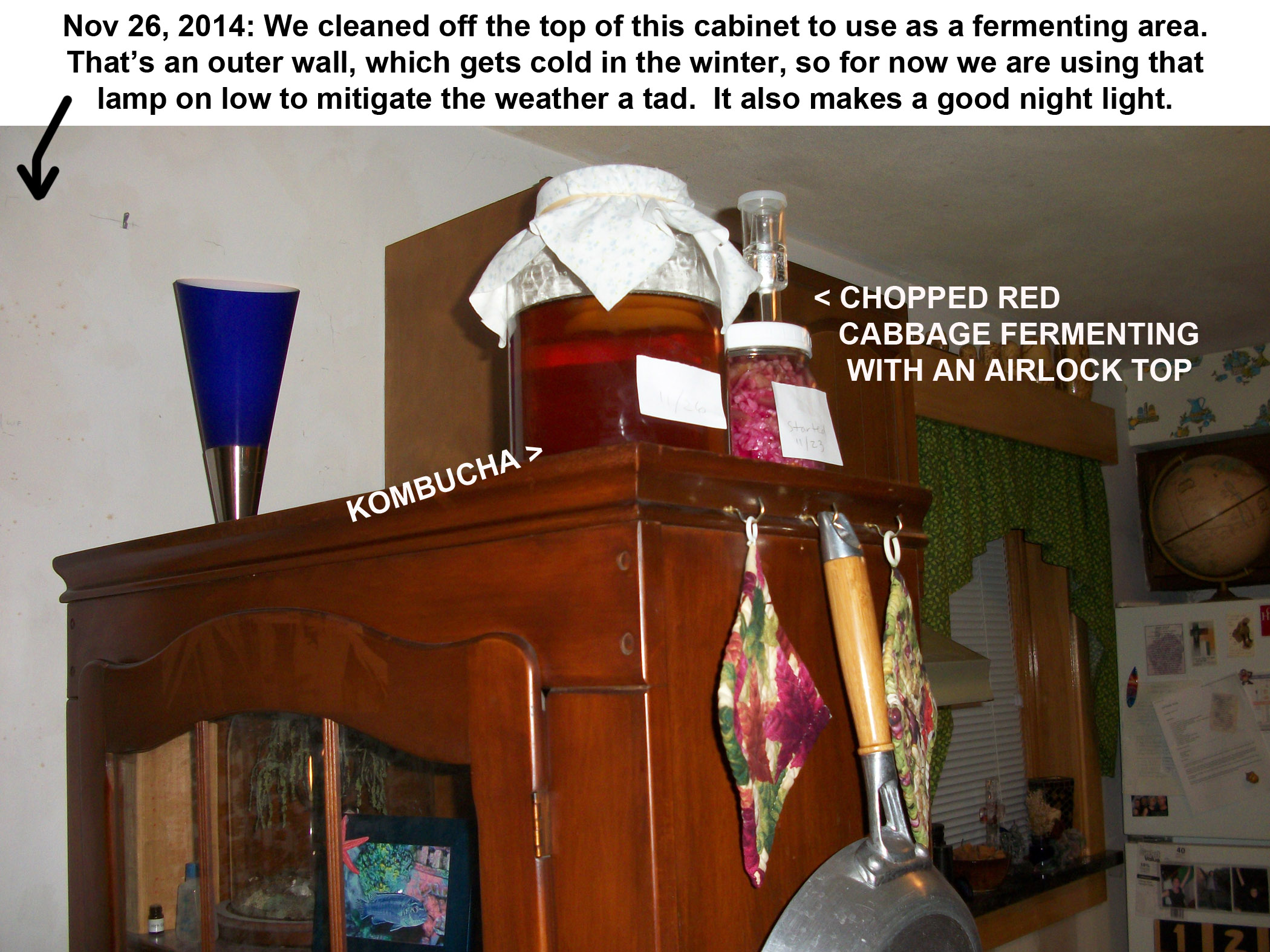
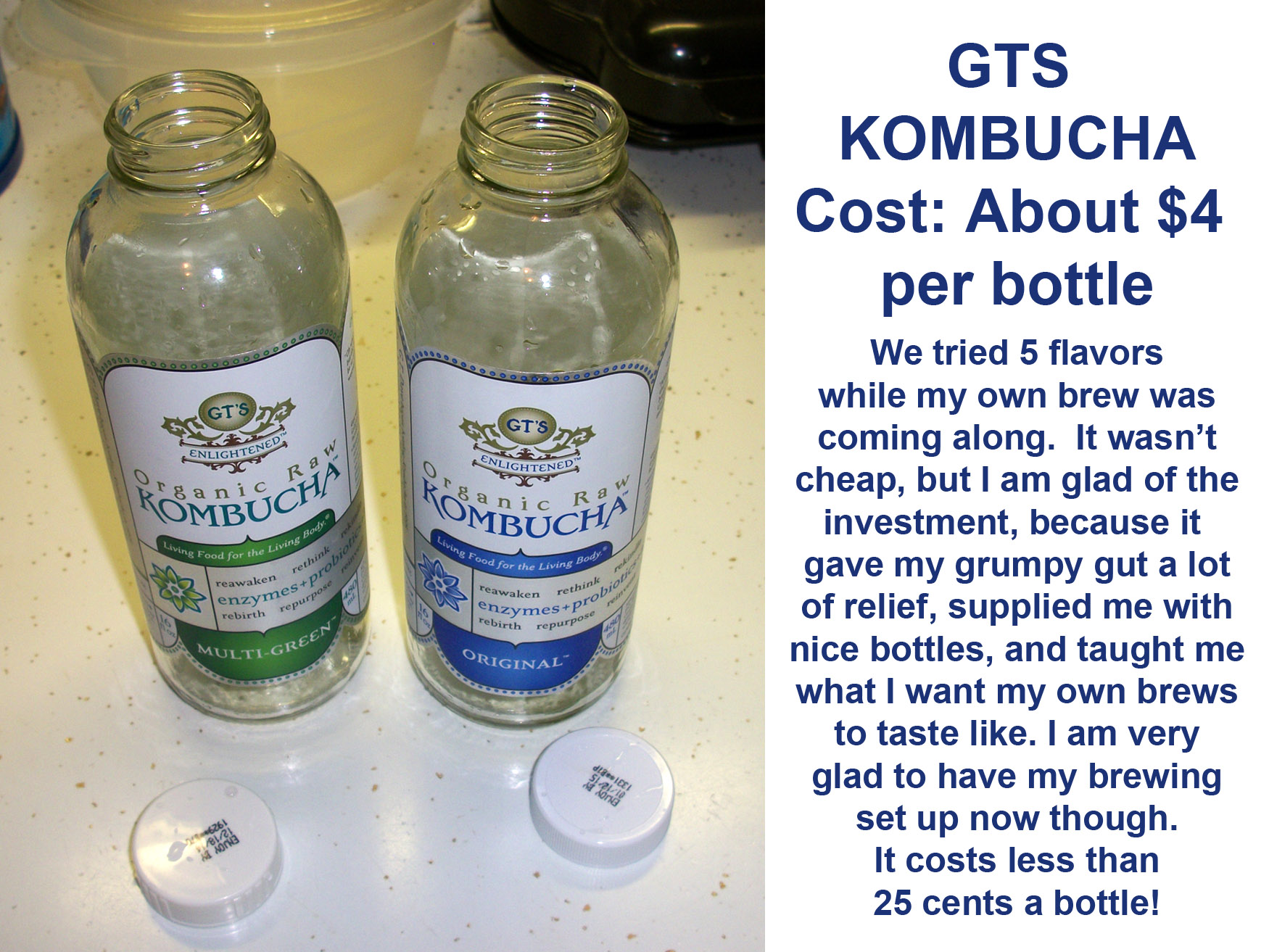
I am hooked on this stuff. It is sooo delicious and refreshing, plus it makes my grumpy gut feel better. The GTS store bought is wonderful … but pricey! Once I knew I could achieve the flavor I want in my own kitchen, I got curious how much I will be saving over store bought. I biased my prices in favor of the store bought by googling for the highest priced brands of teas and sugar. For the GTS Kombucha, I used the price we actually paid in a local store, which is a little lower than the on-line prices.
Supplies I purchased for my first 3 quart (96 ounces) batch of kombucha:
Supplies I will need for my second (and subsequent) 3 quart (96 ounces) batch(es) of kombucha:
AFTER I’ve amortized the initial start up costs,
- 96 ounces = $2.00.
GTS Kombucha costs $4 per 12 oz bottle.
- 96 ounces = $32.00.
Doing it for less $ at the start
If you have a friend with a spare SCOBY and/or a cheaper source for gallon glass jugs, obviously you can save a bundle. You don’t need a lid for the jug either, so if you find one with no top, grab it! Kombucha needs to be brewed with just a clean cloth rubber banded over the top. You can probably also get away without using a strainer, but I didn’t want to and apparently kombucha does something funky to metal that is good for detoxing heavy metals from your body, but bad for your brews and metal kitchen utensils. The PLASTIC strainer I got from Cultured Food Life is really nice.
http://store.culturedfoodlife.com/product-category/kombucha/
Comments Off on Costing out my kombucha
Filed under Health & Nutrition
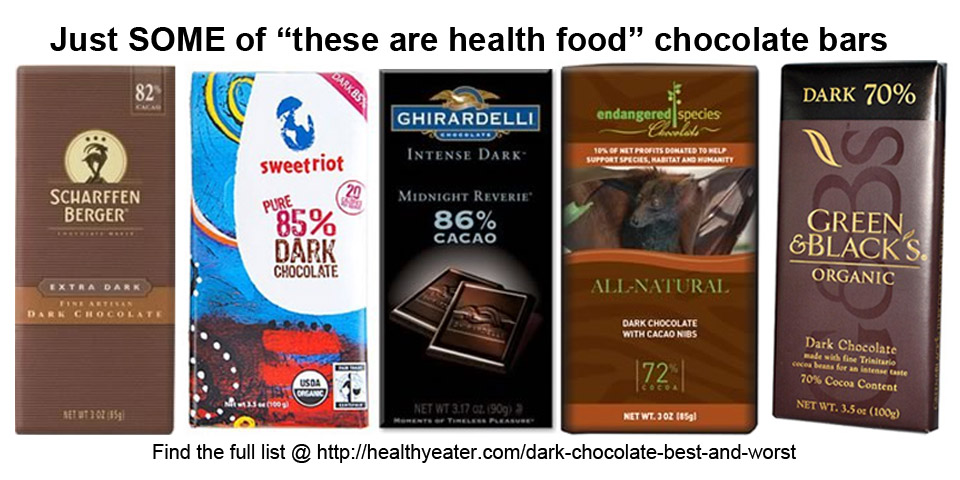
We’re not talking about your average candy bar. You need DARK CHOCOLATE!
They used to think the molecules in cocoa powder were too big to be absorbed, but three cocoa powders tested in a model digestive tract showed that the pro-biotics metabolize the chocolate into easily absorbed anti-inflammatory compounds that multiple studies have shown significantly reduce the risk of disorders such as coronary heart disease, stroke, diabetes, and metabolic syndrome, along with related problems like hypertension, elevated fasting glucose and triglycerides, high cholesterol, and abdominal obesity.
For the gut bacteria, look to naturally fermented foods.
To metabolize the chocolate, you need a good supply of beneficial bacteria in your gut. The culturing process used in naturally fermented foods produces beneficial microbes that will set up housekeeping in your intestinal tract and work hard on your behalf the way God intended. We “first worlders” are often deficient in these good gut buddies, because of antibiotics, chemicals and poor eating habits. But we can easily restore not just gut health, but also overall health simply by ingesting naturally fermented foods on a regular basis. And guess what? They’re delicious AND easy to make! Plus, they produce the feel-good-in-your-brain neurotransmitter, serotonin, AND help rid your body of a wide variety of toxins, including heavy metals.
I mean really … what’s not to like?!
You can make kefir, kombucha and fermented veggies at home. You can also buy kefir and kombucha if you want, but it is far cheaper to make them. Other yummy and healthful fermented foods you can buy (but not make at home) include miso and tempeh. Kimchee is a natural ferment that we buy (dunno if you can make it at home) and I think there are brands of naturally fermented pickles too. You might need to hit the specialty aisles or health food stores to find these. Look in the refrigerator cases, not on the shelves. And check the labels to be sure they are naturally fermented and contain LIVE cultures. If it’s the real stuff, they’ll brag about it on the label.
Fermenting at home is SAFE
In the United States, according to the USDA, there’s never been a single case of food poisoning reported from fermented vegetables. Fermenting vegetables are actually safer than raw vegetables, because the fermenting process destroys bad bacteria, like E. coli that has been known to contaminate fresh veg. It is also safer (and healthier) than canning, since the fermenting process kills off bad bacteria, while canning kills off all bacteria, except sometimes the really hardy bad actor that causes botulism poisoning.
How to get started
I’ve been into this for a whole two weeks now and I can’t believe how much better I feel or how much I LOVE these new foods! I’ve been getting most of my information and all of my fermenting supplies@ http://www.culturedfoodlife.com/. If you’re just interested in learning a little bit without spending any money, go to Cultured Food Life, scroll down a bit and fill in the blank where it says “Free e-Book.” Or email me and I’ll send it to you. If you’re interested in learning more and seeing how kefir, kombucha and vegetables are cultured, buy Donna’s DVD, The Trilogy, at her Store. It is well worth the price.
Dark chocolate to avoid
I found a blog that ranked dark chocolate brands for healthy eating. The WORST ones were put on the list because the chocolate was processed with alkali (destroys the part of the dark chocolate you want) and/or had a lot of added sugar. These brands included: Dove Dark Chocolate, Hershey’s Special Dark, Dark Chocolate M&M’s, Milky Way Midnight, Nestle Dark Hot Chocolate, Cadbury Bournville, and Brookside Dark Chocolate with Pomegranate or Blueberries. See the rest of the good and bad list @ http://healthyeater.com/dark-chocolate-best-and-worst. Here at Casa Hyphen, we favor the Green & Black’s. It’s SO delicious!
Sources:
Filed under Health & Nutrition

My hands are weak and painful (CFS/Fibro/Arthro) which, fortunately, doesn’t affect my typing, but it does make paring difficult-to-dangerous. Good thing, Dearest likes to cook, because I had to give up any food prep that involved sharp knives many, many years ago. Then, Mama Buzz got me an ulu in Alaska and woohoo!! I can cook again!!
That got me wanting to get back into making soups … something I’ve enjoyed since my college days. Dunno why, but baking never appealed to me. My friends thought I was so weird, because I’d much rather make soups and salads than brownies or cookies … but there’s so much room for creativity and all with fresh, edible goodness. What’s not to like?! Unfortunately, our stove’s lowest setting is too hot for the low, low simmer that makes soup go from okay to fantabulous, so I had too many batches of soup that went cold or scorched as I struggled to find the non-existent sweet spot on the knob. Then, a girlfriend found me a used crock pot and I was in business! (I can’t use new appliances, because of the chemical smells.)
I’ve also figured out how to do boiling bath canning again … safely, by myself, weak hands and all. But as brilliant as the ulu is for chopping … peeling apples is a paring knife job I cannot manage. I tried. I wrecked my hands so badly, I couldn’t make a fist for almost a week. Enter … the apple machine! My goodness, but this dandy little gizmo is EASY! Even for me!
So color me all giggly with 4-year-old Me Do happiness! I am making and canning apple sauce ALL BY MYSELF today!! 🙂
Filed under Health & Nutrition
On August 4, I blogged about resistant starch, which I had researched at the urging of a friend who shares my affliction.
https://polination.wordpress.com/2014/08/04/resistant-starch-it-might-be-good-for-what-ails-you/
I was impressed enough to give it a try and today I am here to say, with wide eyes and dropped jaw, that I felt well enough this morning to do part of my old yoga exercises … and I’m talking about for the first time in more than a year!
Since this is the only change I’ve made to my regimen … I try to do only one new thing at a time, so I can assess it … I’m inclined to believe BUT NOT CERTAIN that the resistant starch is doing me some serious good!
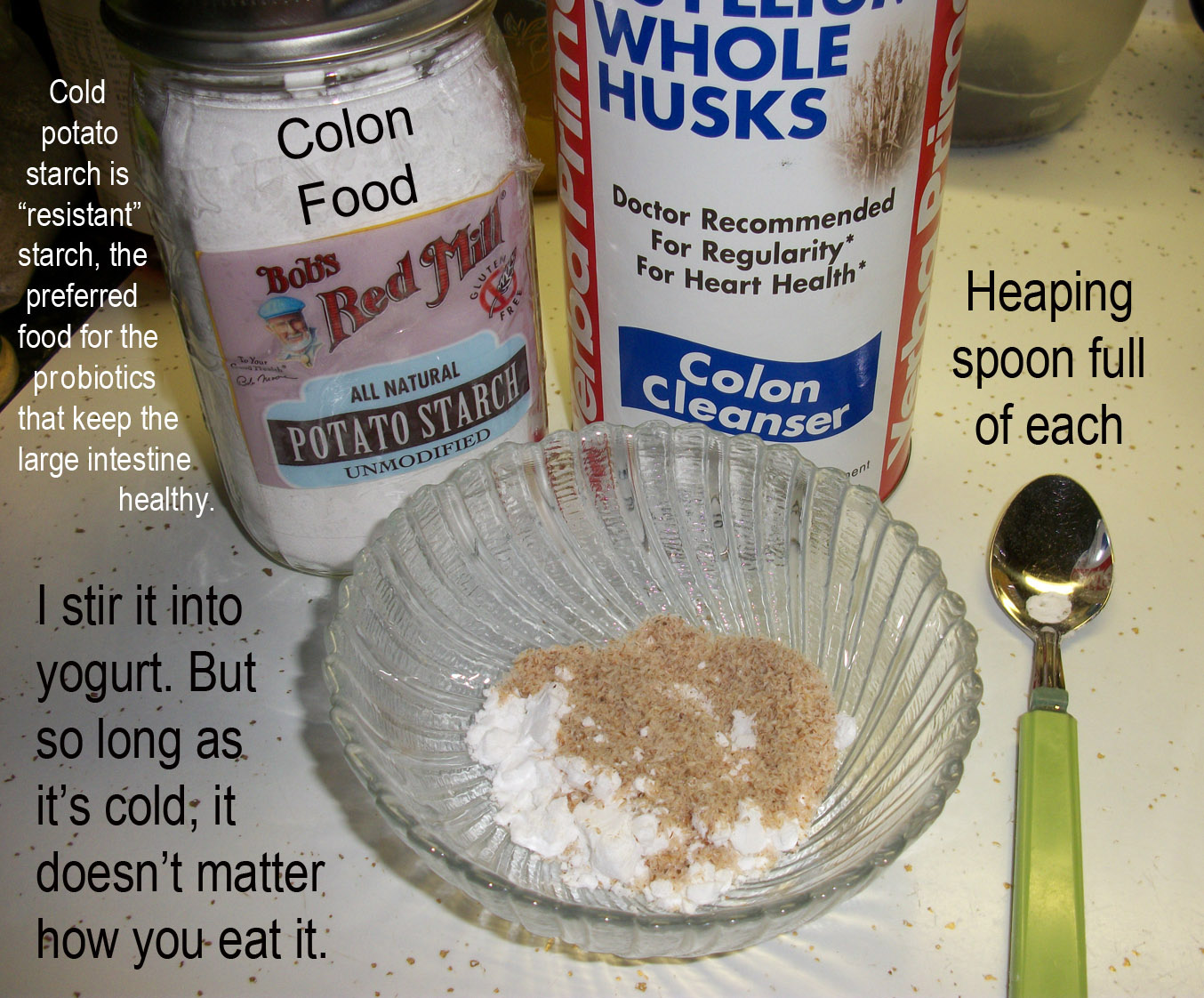
Besides the colon-healthy breakfast pictured above, Dearest and I have also been keeping a bowl full of small, boiled potatoes in the fridge for noshing. It’s amazing how satisfying a little tater can be! And yes, they do need to be not hot, because heat changes the starch back into a non-resistant form that is digested before it gets to the large intestine. That’s what “resistant” means … it resists being digested in the stomach or small intestine.
Plus, BONUS! … resistant starch supposedly has half the calories of non-resistant starch … and a BUNCH less than Dearest’s snack-attack choices (raisins, cashews, chocolate) … so maybe over time we’ll see a little decrease of the middle-aged spread too. 🙂
Note: There are other ways to get resistant starch into your diet. Dearest and I picked cold potatoes because we like them and it was easy. See the blog I linked above for links to articles and videos about resistant starch. Or just google it and see what pops for you.
Diabetics: According to this article, the idea that you shouldn’t eat potatoes is a myth. http://diabetestepsrx.com/should-people-with-diabetes-avoid-potatoes/
Comments Off on Color me impressed
Filed under Health & Nutrition
Dearest and I love our salads, but with only 2 of us, the yummy packages of mixed organic baby greens were getting slimy before we could eat them up. When I saw this on-line, I had to try it and ta da … it works!

Comments Off on Keep salad fresh for a week
Filed under Health & Nutrition

Hundreds of people have experimented recently with adding resistant starch to their diets and seen major improvements in certain health problems. “Resistant” just means it is a type of starch that doesn’t get digested in the stomach or small intestines. It resists digestion until it gets to the large intestines, where it then feeds those super important little critters that live there.
Why resistant starch is good for you [4:03]
Gut flora (the friendly microorganisms that live on your intestinal wall) outnumber body cells 10 to 1, but 90% of what we eat goes to feed the 10%. Resistant starch concentrates on feeding these poor, underfed 90%. [I could make an occupy joke here, but I won’t. Be assured, though, that I AM giggling madly.]
And, in one of those lovely God-incidency things, while those micro-critters are nom-nomming on the resistant starch, they are also producing something called butyrate … which just so happens to be the preferred fuel of the human cells that form the lining of the colon!
Also, eating more resistant starch reduces pH and inflammation, two problems I struggle with all the time.
And, BIG BONUS FOR PISTOL PETE, it also stabilizes blood sugar and improves how body cells respond to insulin. Some studies have found a 33-50% improvement in insulin sensitivity after 4 weeks of consuming 15-30 grams of resistant starch per day.
Eating more resistant starch may also help you to painlessly lose a bit of weight, since it has half the calories of regular starch and seems to increase satiety. (Satiety: When you’re not jonesing for more food.)
There are two ways to add resistant starches to your diet:
FOODS: Some foods naturally have more resistant starch than others. Note: How these foods are prepared can have a major effect on how much resistant starch you swallow. For example, green bananas, which are a rich source until they ripen, then not so much. Also, potatoes and rice need to be cooked and then cooled before eating, since the starch in them only changes into the resistant kind while the food is cooling. Fortunately, I only like bananas when they’re just barely edible. And I really LOVE cold potatoes.
SUPPLEMENTS: The articles below recommend Bob’s Red Mill Raw Potato Starch. (Amazon sells it.) I think I’m going to try this. It is a good thickener for cooked foods, so it’ll be handy for my soups, since I can’t use corn starch. But for maximum resistant starch consumption, it has to be eaten cold and raw. They say to just stir it into water first thing in the morning, but ew … powder stirred into water makes me gag and hurl. However, I really like very thick yogurt, which I eat with fruit for breakfast most days anyway, so easy peasy. (The articles below give amounts and cautions.)
If you’re interested in exploring this in more depth, I suggest you start here:
Resistant Starch 101 – Everything You Need to Know By Kris Gunnars | 2014
http://authoritynutrition.com/resistant-starch-101/
A Gut Microbiome, Soil-Based Probiotic, and Resistant Starch Primer For Newbies
By Richard Nikoley – December 17, 2013
http://freetheanimal.com/2013/12/resistant-primer-newbies.html
List of resistant starches in various foods
Comments Off on Resistant Starch: It (might be) good for what ails you
Filed under Health & Nutrition

Scientists already knew that eating dark chocolate could reduce blood pressure. Now they know how. It seems the good microbes in our guts (e.g., Bifidobacterium and lactic acid bacteria) turn it into a natural anti-inflammatory compound that enters the bloodstream. Among other things, anti-inflammatory agents help protect the heart and arteries from damage. Dark chocolate has more of the good stuff than milk chocolate, making it more effective and good for your health.
Source:
Filed under Funny Stuff, Health & Nutrition





 | chrissythehyphenated on Easter Sunday |
 | mindful webworker on Easter Sunday |
| chrissythehyphenated on Bits & Bytes |
 | bluebird of bitterne… on Bits & Bytes |
| chrissythehyphenated on Good Friday |
| mindful webworker on Good Friday |
| chrissythehyphenated on Bits & Bytes |
| bluebird of bitterne… on Bits & Bytes |
| bluebird of bitterne… on Palm Sunday |
| chrissythehyphenated on Palm Sunday |
| chrissythehyphenated on Palm Sunday |
| bluebird of bitterne… on Palm Sunday |


 polination.blog