
Divine Mercy Devotion – Poland 1930s
From 1931 until 1938, Our Lord Jesus Christ appeared to an uneducated Polish nun named Faustina Kawolska, bringing with Him a wonderful message of Mercy for all mankind. In obedience to her spiritual director, Saint Faustina recorded the revelations she received in a diary that grew to be about 600 pages long.
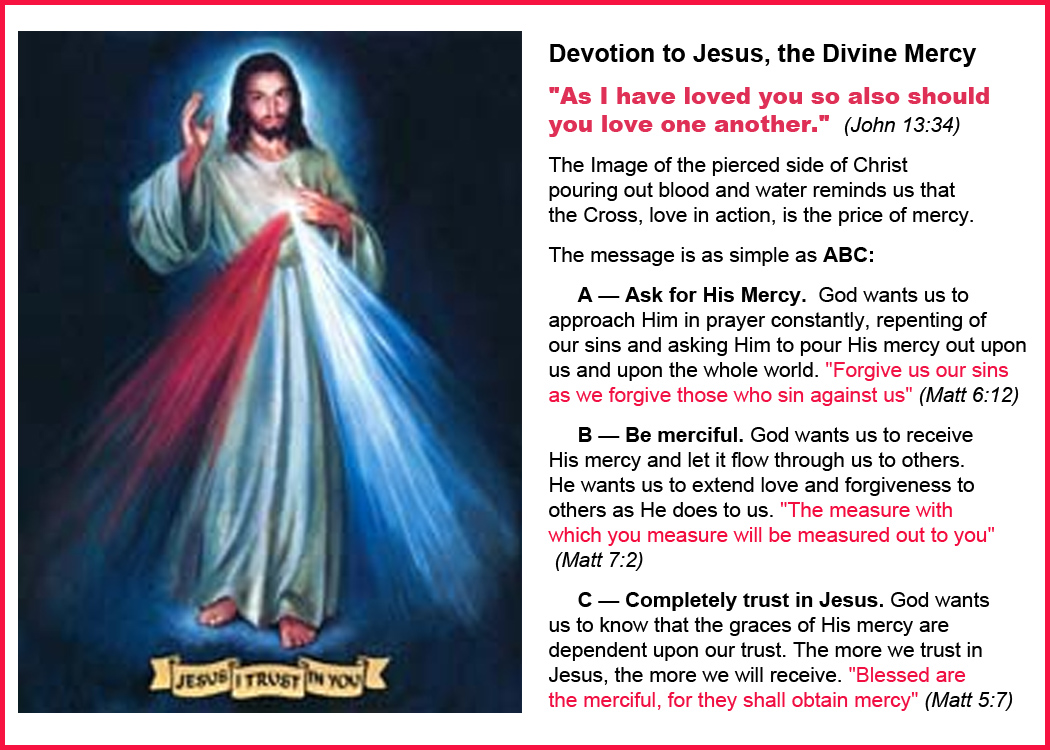
From Saint Faustina’s diary:
“In the evening, when I was in my cell, I became aware of the Lord Jesus clothed in a white garment. One hand was raised in blessing, the other was touching the garment at the breast. From the opening of the garment at the breast there came forth two large rays, one red and the other pale. In silence I gazed intently at the Lord; my soul was overwhelmed with fear, but also with great joy. After a while Jesus said to me, ‘paint an image according to the pattern you see, with the inscription: Jesus, I trust in You.’
“The pale ray stands for the Water which makes souls righteous; the red ray stands for the Blood which is the life of souls. These two rays issued forth from the depths of My most tender Mercy at that time when My agonizing Heart was opened by a lance on the Cross. … Fortunate is the one who will dwell in their shelter, for the just hand of God shall not lay hold of him.”
Jesus asked this image and devotion to the Divine Mercy be spread throughout the world. It proved to be of particular importance in strengthening Poles during the horrors of Nazi occupation.
Saint Faustina’s diary records that Jesus asked numerous times that a feast day be dedicated to the Divine Mercy and celebrated on the Sunday after Easter. Divine Mercy Sunday was officially decreed a Catholic Solemnity by Pope John Paul II on the occasion of the canonization of Saint Faustina on April 30, 2000.
The Warsaw Ghetto Uprising – Poland 1943
The largest single revolt by Jews in World War II occurred April 19 through May 16, 1943 in Warsaw, Poland. The Nazis crushed the resistance after thirty days and completed their plan to send all the Warsaw Jews to Treblinka for extermination.
In 1950, the Jewish community set Holocaust Remembrance Day, or Yom HaShoah, on Nissan 27. This date was chosen because it falls after Passover is over, but before the last day of the Warsaw Ghetto Uprising. It is also eight days before Yom Ha’atzma’ut, or Israeli Independence Day. It was legally inaugurated in in Israel in 1953.
The Jewish community decided Yom HaShoah should not interfere with Shabbat (Sabbath), so if Nissan 27 falls on a Friday or Saturday, Yom HaShoah is moved to the previous Thursday; if it falls on Sunday, it is moved to the following Monday.

On Yom HaShoah, all across Israel a siren blares and everyone comes to a halt to remember for 2 minutes. This video makes me weep.
Yom Hashoah in Tel Aviv 8/04/2013
On the face of it, the Catholic celebration of Divine Mercy Sunday and the Jewish commemoration of Yom HaShoah are totally unrelated. Yet they actually have roots in the most devout religious communities inside the nation that suffered the worst extremes of Nazi oppression.
We often hear about the six million Jews who died in the Holocaust. Few know that the genocidal policies of the Nazis also resulted in the deaths of nine million Gentiles. Three million of the Nazi victims were Polish. Half of these were Jews; half were Gentiles.
- Saint Faustina died on October 5, 1938, in Kraków, Poland.
- The Warsaw Ghetto Uprising started just 4½ years later on April 19, 1943 in Warsaw, Poland.
- Kraków and Warsaw are only 157 miles apart.
Saint Faustina’s death date was Yom Kippur (Tishri 10, 5699) for the Jewish community. Yom Kippur, or the Day of Atonement, is the holiest day of the year for the Jewish people. Its central themes are atonement and repentance.
The Warsaw Ghetto Uprising began on Nisan 14, 5703, or Preparation Day in the Jewish calendar. This is the day when Jews prepare their Passover feast, or Seder, which they will celebrate after sundown when Passover begins. Nisan 14 is also the day when Jesus was crucified.
Jesus picked the date for Divine Mercy Sunday; the Jewish community picked the date for Yom HaShoah. Clearly, men had nothing to do with the fact that these two holidays, which are so closely related in the history and suffering of God’s people, also overlap frequently, despite our two different calendars.
I only went back to 2000, but found coincident holidays in 2004, 2007, 2010, 2011, 2013 and, in the near future, 2014 and 2017.
When Nisan 27 is a Sunday, Yom HaShoah is moved to Monday. But because Jewish holidays begin at sundown, whenever Yom HaShoah is on the Monday after Divine Mercy Sunday, the two Jewish and Catholic communities are actually celebrating both holidays together between sundown and midnight. I can’t help thinking God intended that the overlap would occur only during hours of darkness.
The Divine Mercy: No Escape [46:14] Hosted by Helen Hayes
This movie is worth watching just to see the beauty of the soul of Ms. Hayes. After watching it, I became fascinated with her and from what I learned, it seems she truly was a very devout and beautiful person.
Sources:








 polination.blog
If you watch the movie, you’ll learn the connection to the Marian community in Stockbridge, MA. We were given a spiritual bouquet from there for a wedding present by someone who didn’t even know that Dearest grew up within spitting distance of Stockbridge! 🙂
LikeLike
I love the part at the end where the priest quotes Jesus as told to St. Faustina: “The more someone needs my mercy, the more I need to give it to them.”
It made me think of how loving parents feel about children who have special needs. I was always a passionate mom; even before I met Dearest, I read about parenting and collected books and other resources.
I didn’t skimp my first two and I know from them how being a good mom felt. So I think I can get a glimpse of what Jesus meant, because my third had a rough start in life and I just had such an intense DRIVE to do whatever it took to help her.
LikeLike