
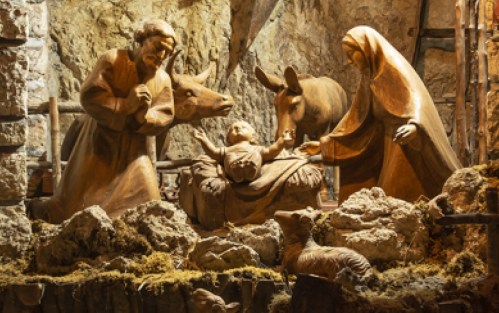
This is the 800th anniversary of the first Nativity scene. In 1223, St. Francis of Assisi set up the first nativity scene to help the faithful to better appreciate the story of Christ’s birth. The story goes that he set it up in a cave just outside Greccio, Italy, using a wax figure of the infant Jesus, costumed people playing the roles of Mary and Joseph, and a live donkey and ox that he had borrowed.

Nativity scenes are also called manger scenes. They are often modeled after the wooden stables and wooden hay troughs common in northern Europe. But in ancient Israel, animals were usually sheltered at night in caves. And they weren’t given hay at night, because they were put out to pasture every day. However, they did need water, so the manger in which Jesus was laid was what we would call a water trough. And it wasn’t made of wood; it was carved out of stone.

The only time a manger is mentioned in Jesus’ birth story is Luke 2:8-12, when an angel of the Lord appeared to some shepherds and told them the Messiah had been born. Bethlehem, being only 5 miles from Jerusalem, was famous for the unblemished lambs it provided to the Temple to be sacrifice for sins. To prevent newborn lambs from random injuries that would render them unfit for sacrifice, they would be wrapped in cloth and laid in a dry manger.

So the shepherds would have immediately understood the significance of the angel’s sign – “a baby wrapped in cloth and lying in a manger.” Jesus was also wrapped in cloth and laid in a stone box after he was crucified.
Stone water troughs were also placed outside, because animals need access to water 24/7. Thus, Baby Jesus’ manger gives us more to think about when pondering John 4:13: “Whoever drinks the water I give them will never thirst. Indeed, the water I give them will become in them a spring of water welling up to eternal life.”
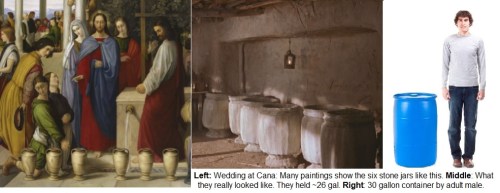
According to the Law of Moses, stone could not become impure; thus, stone vessels were common in Judea for ritual purposes. Likewise, “living water” (water drawn from a fresh, natural, flowing source, such as a spring) was deemed to be pure. Therefore, purification vessels were filled from sources of “living water” to maintain its purity until it was needed for the many cleansing rituals required by the Jewish religion. Remember how, when they ran out of wine at the Wedding at Cana, Jesus ordered the stone purification jars to be filled with water? Like the mangers, purification jars were carved from limestone that had formed when the area was an ocean floor and minerals containing dissolved calcium settled out of the water. Limestone often contains ancient fossils of corals and other sea creatures that lived hundreds of millions of years ago, tying it not only to water, but to the earliest eras of our planet’s history.
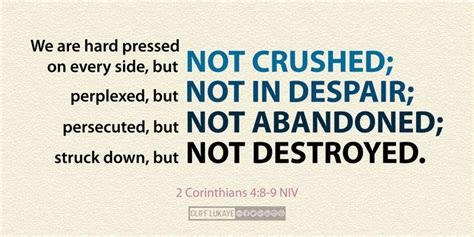
It also speaks to us of the strength we have available to us through our worship of Jesus, the Son of God. While limestone is relatively easy to carve, it is both hard enough to maintain its shape once it has been carved and also immensely strong, with a crushing strength more than 3 times that of concrete.
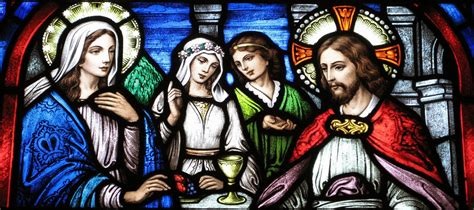
The image of Baby Jesus in a stone watering trough casts us forward not only to when Jesus turned water into wine at the Wedding at Cana, but further when He turned wine into His blood at the Last Supper, the very blood He would sacrifice the next day to save us all from eternal damnation. Hallelujah!
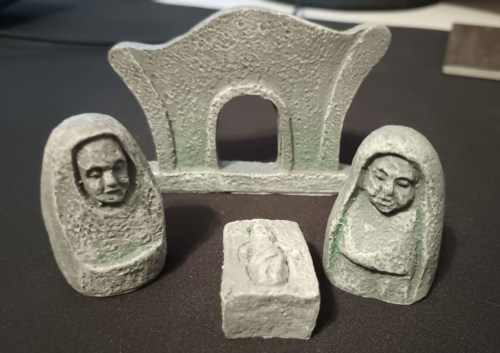
DECEMBER 25 UPDATE: A friend sent me this photo of one of her Nativity sets. I think it is my favorite one EVER!








 polination.blog
Loved this. Thank you for it and have a Happy, Joyful Christmas.
LikeLiked by 2 people