
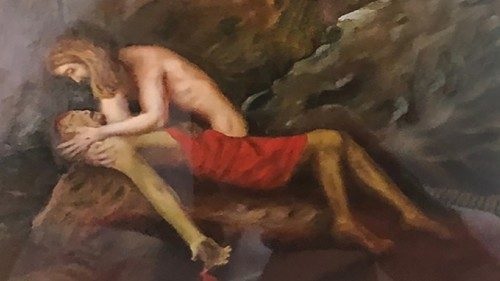
Pope Francis has a special affection for Judas, who he likes to believe repented and was saved from Hell by Jesus. This idea is so dear to him that he keeps the painting above on the credenza behind his desk beside the photo below. The one purports to show Jesus ministering to Judas when He descended to the dead, while the other allegedly shows Jesus as the Good Shepherd rescuing Judas, the “lost sheep” on his shoulders.
I can only wonder what kind of guilty conscience has led the pontiff to embrace an idea that contradicts 2,000 years of consistent church teaching that Judas Iscariot is in Hell. In addition, we have the personal testimony of modern-day exorcists who report that Judas shows up at exorcisms to help the demons!

In Exorcist Diary #234, Msgr. Stephen Rossetti writes about just one of these encounters. “In a very difficult exorcism some time ago, we were faced with hundreds of demons. We went through layers and layers of demonic cohorts, each captained by a different leader. At each point, I demanded to know that cohort leader’s name, which helped in casting them out. When each leader left, his entire cohort left with him. At one point, demanding the name, I was surprised to hear the response, ‘Judas!’ I further inquired, ‘Are you a demon using his name or the real human who betrayed Jesus?’ In a shout filled with shame, he answered that he was truly the man.”
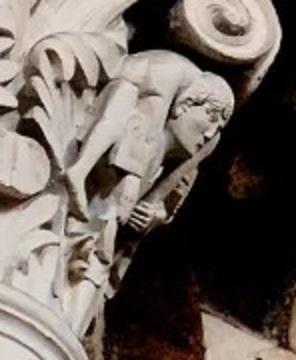
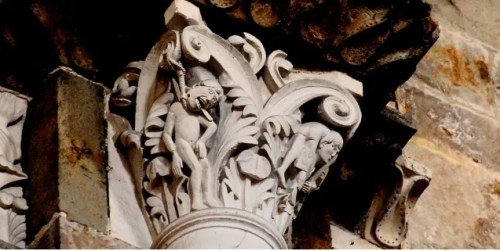
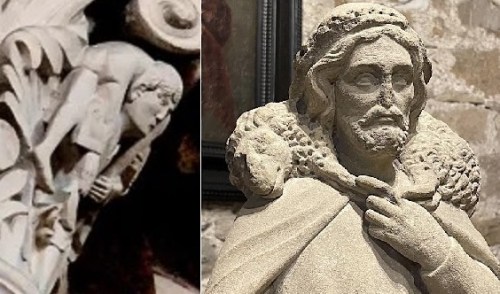
As evidence for his bizarre theology, Pope Francis points not to Scripture, not to the Magisterium, nor to any Church Father, Doctor of the Church, or approved apparition. Nope. He points to a Medieval carving atop a column in the Basilica of St. Mary Magdalene in Vézelay, Burgundy, France. But even here, he has nothing but his own perhaps guilt-ridden fancy to justify the identification. For starters, note in the cropped image above that the figure he would like to claim is Jesus has short hair and is clean shaven.

As you can see in the images above, the earliest Christian illustrations of Jesus’ “99 sheep” parable do show the good shepherd as an adolescent. However, later on, when the Good Shepherd had become not merely an illustration of a parable, but a type for Jesus Himself, He is depicted with long hair and a beard. The statue below is from the same (Romanesque) period as the Vézelay capital.
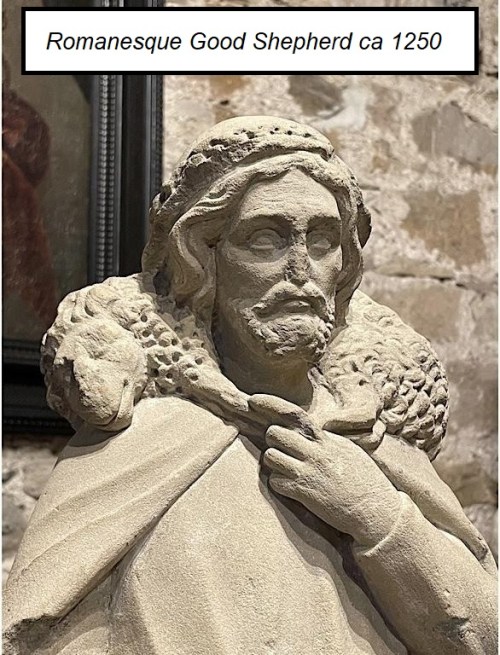
It is unlikely in the extreme that sculptor of the Vézelay capital intended his carving to suggest the opposite of what the church had always taught – i.e., that Judas is in Hell. This is especially apparent when we compare the capital figure with the Romanesque Good Shepherd statue. Jesus the Good Shepherd is standing upright, cradling the sheep on His shoulders; the sheep is relaxed and appears to be smiling. By contrast, the guy hauling Judas is bent over and looks very grim. He appears to be burdened by his task, suggesting he is simply an unfortunate soul who got stuck with hauling the body away for burial.
I did quite a lot of research into the Vézelay basilica, particularly the capital carvings. The original church and capital carvings were constructed in the Romanesque style between 1120 and 1150. The thick walls, round arches, sturdy pillars, barrel vaults, and decorative carvings are all typical of the period.
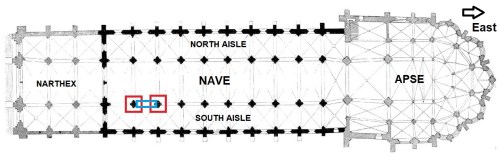
As far as I can discern, the capital the pontiff likes so much is one of the dozens that decorate the tops of the columns that separate the nave from the two side aisles. The red squares are piers; the blue rectangle is an arch.
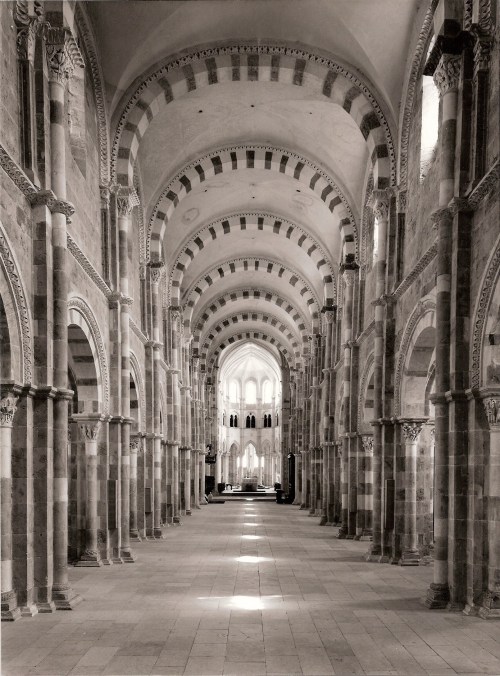
There appear to be three capitals per arcade. (An arcade is a succession of contiguous arches, with each arch supported by a colonnade of columns or piers.) In the photo above, you can kind of see how each arch is supported by two columns, atop of which are carved capitals. Between the arches there is a vertical element that, on the nave side, is relative undecorated. However, on the aisle side, there appears to be a third capital carving.
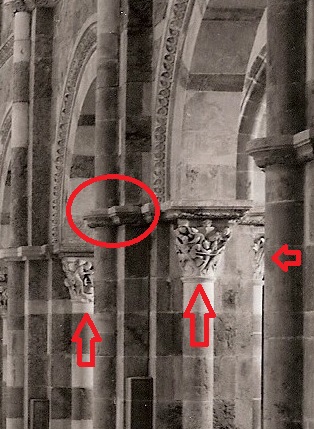
This fits with the photos I found at the University of Pittsburgh site linked below, which show at least some of these capitals in sets of three. Unfortunately, I did not find any photos or information about the capital depicting the death of Judas. I wish I had, because I believe these capitals likely relate to one another thematically, so it would have been instructive to see what else was near that one.
- https://aleteia.org/2017/11/24/pope-what-would-have-happened-if-judas-had-met-our-lady-on-his-way-to-kill-himself/
- https://www.catholicexorcism.org/post/exorcist-diary-234-was-judas-possessed
- https://en.wikipedia.org/wiki/V%C3%A9zelay_Abbey
- https://digital.library.pitt.edu/islandora/search_collection/pitt:collection.138
- https://en.wikipedia.org/wiki/Romanesque_art
- https://en.wikipedia.org/wiki/Romanesque_architecture






 polination.blog