
Bishop James Johnston of the Missouri Diocese of Kansas City-St. Joseph has announced the results of a medical examination of the body of Benedictine Sister Wilhelmina Lancaster. Experts found no signs of decomposition in the body! In addition, there was found nothing abnormal in the soil that could have prevented the body’s decomposition.
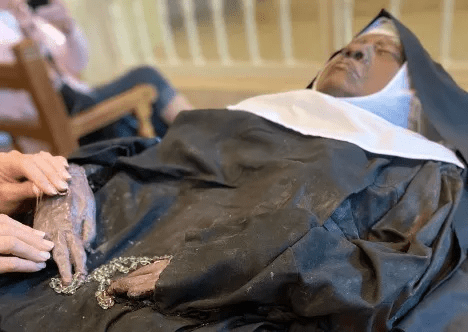
Sister Wilhelmina died on May 29, 2019 and was buried in a plain wooden box. Jack Klein, owner of Hixson-Klein Funeral Home in Gower, Missouri, who was present at Sister Wilhelmina’s burial and issued her death certificate, confirms she was not embalmed and that the wood coffin was not placed into any outer burial container. After four years, her body should have decomposed, possibly down to the bones. Instead, when her body was exhumed (so it could be reburied in a more fitting place), it was found to not only be intact, but to also have no odor.
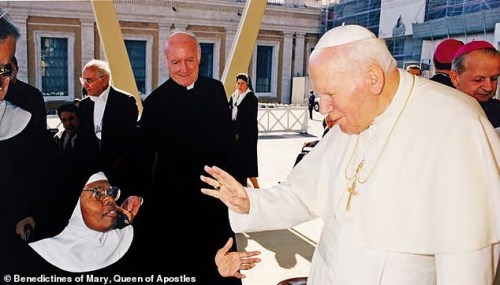
Sister Wilhelmina entered religious life after graduating valedictorian of her high school. After the Second Vatican Council, her order, like many, chose to stop wearing a traditional habit. When Sister Wilhelmina could not convince the order to return to the habit, she founded a new order – the Benedictines of Mary, Queen of Apostles – with the help of the Priestly Fraternity of St. Peter, a priestly society dedicated to the traditional Latin Mass.

Given the Vatican’s attempts in recent years to obliterate the Latin Mass, I can’t help seeing this miracle as a direct message to Pope Francis. Under Pope Benedict XVI, any Catholic priest could celebrate Mass using the rubrics of the Tridentine, or pre-Vatican II liturgy. The basic differences between the ordinary form of the Mass (Vatican II form, which can be celebrated in any language, including Latin) and the extraordinary form of the Mass (Tridentine) are in the focus of the rites.
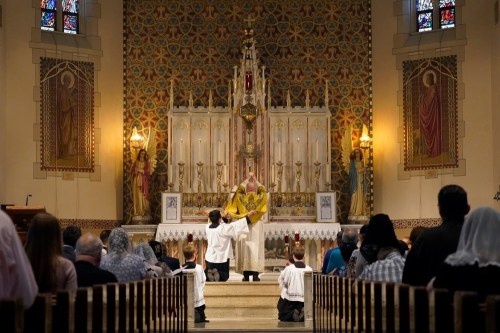
In the extraordinary form, the priest faces east, with his back to the people, and all the prayers (which date back to the 16th century) are said in Latin. Responses are spoken by altar servers who must be male. In some cases, altar servers are “acolytes”, young men who have received a special blessing, because they intend to become priests. The focus here is on worship of the Holy God. The altar is a table of bloodless sacrifice. Everybody faces God and all prayers are directed to Him. The priest and altar servers are separated from the congregation by an altar rail, Holy Communion is received directly on the tongue while kneeling, and many of the women wear mantillas (veils) on their heads.
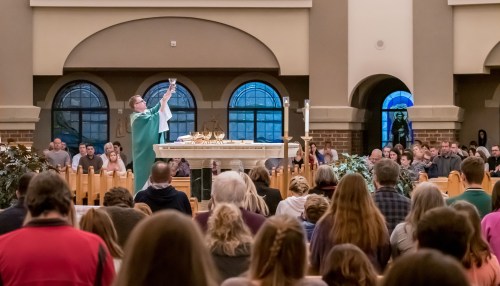
In the ordinary form, the priest faces the congregation and the people participate in the prayers, which were adapted at Vatican II and are usually in the local, or vernacular, language. If there is a community of non-native believers and a priest who speaks their language, priests are free to celebrate in their native language. The focus here is less on pure worship and more on community celebration in the spirit of the Last Supper. Holy Communion is received into the hands, though if you stick your tongue out, the priest will almost always oblige. The dress tends to be more casual and girls can serve at the altar.
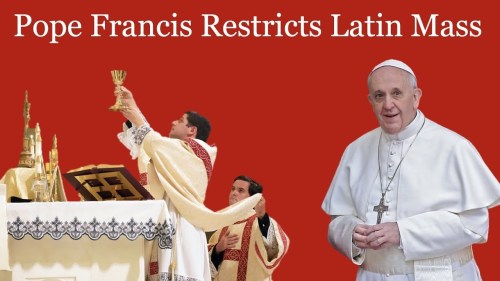
In the summer of 2021, Pope Francis began his assault on the extraordinary form, which he sees as promoting schism within what is supposed to be a universal church. There was a lot of pushback from Catholics who are attached to the extraordinary form, but instead of backing down, in 2023, he doubled down with even more restrictions. I cannot help but see a direct connection between Sr. Wilhelmina’s commitment to the Tridentine Mass, the date of her death, the dates of Pope Francis’ attempts to squash the traditional liturgy, and the date of the exhumation and discovery that God had miraculously preserved her body incorrupt.







 polination.blog