
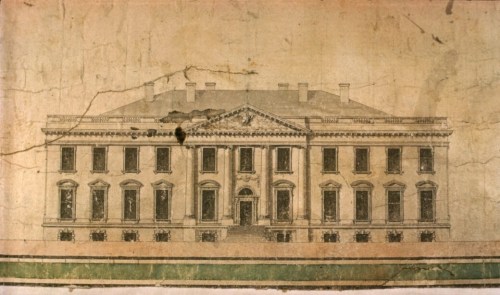
Above is a rendering of James Hoban’s 1792 design for the first presidential home.
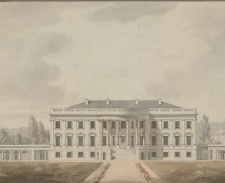
President Thomas Jefferson added colonnades (covered walkways) to the east and west sides of the building to connect the main residence to service buildings. Jefferson’s opponents criticized the cost and design.
On August 24, 1814, British troops torched the building, destroying all but the outer walls.

The South Portico was constructed in 1824 under President James Monroe.

The North Portico was constructed in 1829-1830, under President Andrew Jackson. Again, opponents criticized the cost and design of the additions. Ironically, the design for the North Portico had been done by James Hoban as part of his original design.

This is how the North facade of the building looked in 1860.
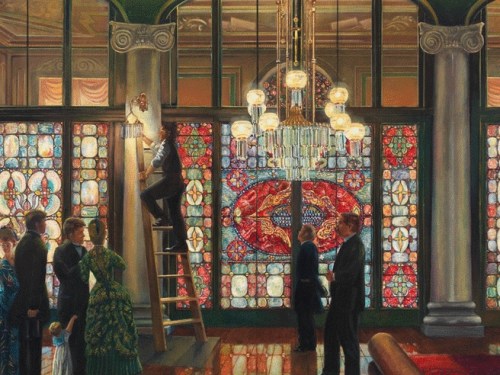
In 1881 to 1883 President Chester Arthur hired Louis Comfort Tiffany to redecorate the worn décor of the interior. Critics accused Arthur of turning the White House into a “palace” unfit for a democratic leader. In Congress, Democrats decried the expenditure as wasteful. The Tiffany decorations were later removed or modified by subsequent presidencies, reflecting shifting tastes.
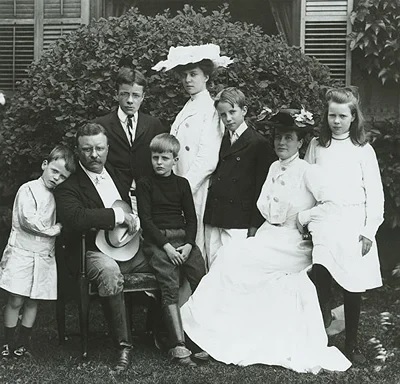
In 1902, President T. Roosevelt expanded the facility to give his large family more living space in the residence. The executive offices were moved to a new West Wing, while a new East Wing was built for social events and guests.

The photo above was taken in 1903. It shows First Son Archie Roosevelt on his pet horse, Algonquin, in front of the new West Wing.

The photo above was taken in 1906, showing the East entrance to the newly expanded Executive Mansion.

In 1909, President William Howard Taft expanded the West Wing. The photo above shows him sitting in the newly built Oval Office.

In 1929, not long after the stock market crashed, a fire damaged the roof, attic, and floors of the West Wing. Renovations were completed in 1930.

In 1934, President Franklin D. Roosevelt had the Oval Office (shown above) moved to its present location in the southeast corner of the building, next to the Rose Garden. To accommodate the expanding presidential staff, the basement was expanded and a second story added.

When President Harry Truman moved into the White House in 1945, he noticed large areas of cracking plaster and unusual popping and creaking noises. Engineers conducted a survey and confirmed that the White House’s structural integrity was compromised. One architect worried the whole building might collapse.
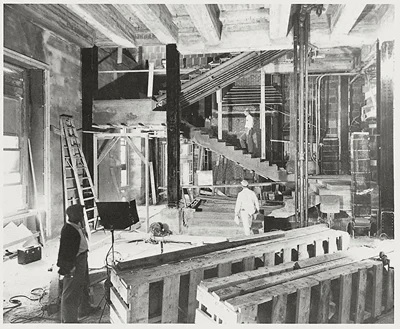
Truman ordered a complete renovation that would retain the original sandstone walls, the Third Floor and the roof, while removing and then rebuilding the interiors on a skeleton of steel structural beams with a new concrete foundation. Two levels of sub-basements under the North Portico were constructed and the Grand Staircase was changed significantly. For three years, President Truman and his family lived in Blair House (aka the President’s Guest House), across from the White House.
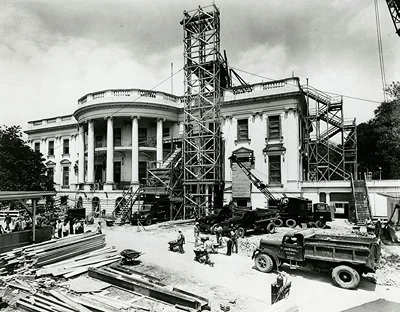
During the renovations, Truman had a second story porch added above the South Portico to allow the First Family to go outdoors directly from the residence. This was the last major exterior renovation until President Trump’s current addition of a ballroom on the East end. But all along the way, there have been interior alterations and improvements. All told, 39 of our 46 presidents have changed the Executive Mansion in some way. Trump is just the latest.
Sources:






 polination.blog
A great recap on the history of the White House, cth.
Should have appended that Hillaryous quote from the B&B.
Another deluded psycho, Hakeem Jeffries angrily declares he’s going to target and investigate President Trump and ANYONE who had a part in building the new White House ballroom.
And on the B&B, you had that pic showing the small amount of the East Wing that’s being renovated, but you didn’t show what the final renovation is going to look like.
😁
LikeLiked by 1 person
“final” ROFLLLLL!!!!!
LikeLiked by 1 person