Category Archives: Bible Prophecy

The Seven Churches of Revelation, part seven

If you’re new to this series, go here to catch up:

Part 6 @ https://polination.wordpress.com/2012/12/19/the-seven-churches-of-revelation-part-six/

Please note that throughout this discussion, I am using “Church” to mean all the people who proclaim Christ, not any of the denominations or sects that have come along. I adhere to the doctrines of the Roman Catholic Church myself, but I do not believe Jesus or any of the Apostles founded a denomination. Nor do I think any denomination has any special corner on the big issues addressed in all seven letters, which are about personal sanctity and individual salvation, not about specific doctrines or practices.

Book of Revelation, Chapter 2, Verses 12-18:

To the angel of the church in Pergamum, write this:

The one with the sharp two-edged sword says this:

I know that you live where Satan’s throne is, and yet you hold fast to my name and have not denied your faith in me, not even in the days of Antipas, my faithful witness, who was martyred among you, where Satan lives. Yet I have a few things against you. You have some people there who hold to the teaching of Balaam, who instructed Balak to put a stumbling block before the Israelites: to eat food sacrificed to idols and to play the harlot. Likewise, you also have some people who hold to the teaching of [the] Nicolaitans. Therefore, repent. Otherwise, I will come to you quickly and wage war against them with the sword of my mouth.

Whoever has ears ought to hear what the Spirit says to the churches. To the victor I shall give some of the hidden manna; I shall also give a white amulet upon which is inscribed a new name, which no one knows except the one who receives it.

Continuing with Pergamum as a type for the church during the Early Middle Ages (roughly 313 AD to 1,000 AD).God’s complaints against his people are familiar ones – i.e., sexual laxity and putting politics ahead of religion.

As to the first complaint:

The Nicolaitans appeared earlier in the letter to Ephesus. For an explanation of the reference there and here, see https://polination.wordpress.com/2012/11/17/who-were-the-nicolaitans/

Eerdman’s Handbook to the History of Christianity sheds light on the problems of sexual laxity (aka, the Nicolaitans) in the Church during the Early Middle Ages.

The idea that the clergy should remain unmarried developed only slowly. … [At first] abstinence from marriage was left a matter of personal choice. … By the third century, celibacy was beginning to be valued as a mark of holiness. … In the fourth century, moves were made to restrict marriage after ordination. … Many so-called celibate clergy in fact lived with women who were not their wives (called subintroductae), a practice repeatedly condemned by church councils and writers. …

In the fifth century and after, two codes of practice evolved. In the Eastern churches, presbyters and deacons were allowed to marry before ordination, but bishops were always chosen from among the celibate clergy (very often they were monks). In the West there was strong pressure for complete clerical celibacy. … Celibacy of the clergy continued to be praised as an ideal, although it was not enforced legally and effectively until the time of Hildebrand (Pope Gregory VII, 1073-85).

[Eerdmans, pages 215-216]

As to the second complaint, putting politics ahead of religion:
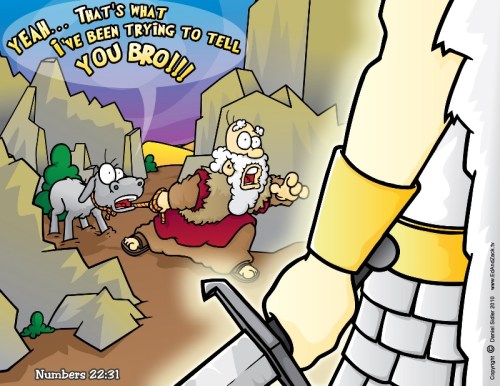
Balaam's donkey

Balaam was an Old Testament dude who was used here and elsewhere in the New Testament (2 Peter 2:15, Jude 11) as short-hand for a religious official who lets God’s work slide to appease political leaders. His story is recounted in Numbers: 22-24, 31. Most of the time, Balaam seems to have been faithful to God, though in one case God has to send an angel and give Balaam’s donkey a voice to get him back on track. (The talking donkey is one of my favorite Bible stories!) However, in Numbers 31:16, Balaam is cited as the instigator of “the Israelites’ unfaithfulness to the Lord in the affair at Peor” as a result of which the people were punished with a plague.

Eerdmans has a great deal to say about relations between Church and State during the Early Middle Ages:

The Balaams in the East were the imperial suck-ups:
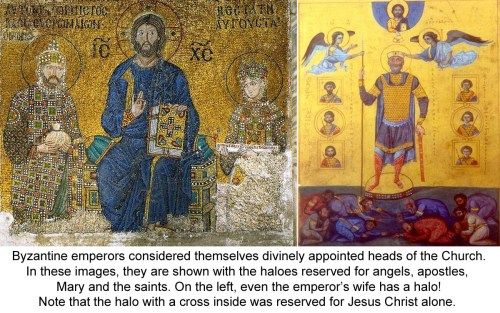
Eastern Emperors seen as God's chosen deputies

“The Emperor, ‘the living image of Christ’, stood at the head of the church. The notion that his office was sacred, a mixture of priest and king, was not originally a Christian idea. Pagan Roman emperorors carried the title of chief priests, and carried out special religious duties as part of their office. Constantine was seen as God’s chosen deputy. The imperial power was an earthly reflection of God’s heavenly sovereignty. The Emperor, as head of the church, presided over certain local synods at Constantinople, and over all general councils. He had the right to approve all candidates for the post of patriarch.” [Eerdmans, page 240]

The Balaams in the West were more about being politically powerful themselves:

“From 400 to 600 the Emperors in the West increasingly relied on bishops to assist in secular matters. The fall in population and the penetration of the German peoples into the interior of the Roman Empire helped create a need for new leaders. It was the Christian bishop who increasingly filled this role. … The bishops of Rome [came] to enjoy great power in Rome and in Italy as a result of the decline and eventual disappearance of the Emperor in the West and through extensive landholdings in and around Rome.” [Eerdmans, page 218]

This situation didn’t last and it works into the theme of the “repent or else” segment of the Pergamum letter. The references to surprise invasion and war are interesting in the context of the politically turbulent Early Middle Ages; likewise, the references to “the sword of my mouth” and “ears … to hear” during this period of history in which the Church assembled and disseminated the New Testament.

It would hardly be out of character for God to use a foreign invader to chastise His people for straying from the revealed truth. And, in fact, He seems to have made good on His threat.

  • By 800 AD, three of the five great centers of Christianity — Alexandria, Antioch and Jerusalem — were under Muslim rule.
  • In the East, Muslims tried, but were unable to conquer Constantinople until the 15th century, which is part of the story for the letter to Thyatira.
  • In the West, Charles Martel stopped the Muslims from crossing the Pyrenees into Gaul in 732. Martel was no friend to the Church, but his heirs, who were raised in the monastery of St. Denis near Paris, stimulated the renewal of religious and intellectual life that is now known as the Carolingian Renaissance. The Carolingian King Pepin went so far as to use his own troops to protect papal lands and to donate to the papacy territory in north-east and central Italy that his forces conquered.

Unfortunately, the Carolingian Empire fragmented before the end of the 9th c. and left the West vulnerable to attacks by Muslims from the south, Magyars (Hungarians) from central Asia, and Norsemen from Scandinavia.

Everywhere church property was either devastated and ransacked by foreign invaders, or fell into the hands of catholic nobility. Noblemen treated bishoprics and monasteries as their private property to dispose of as they wished. The clergy steadily became indifferent to duty, and their ignorance and immorality increased. [Eerdmans, 233-235.]
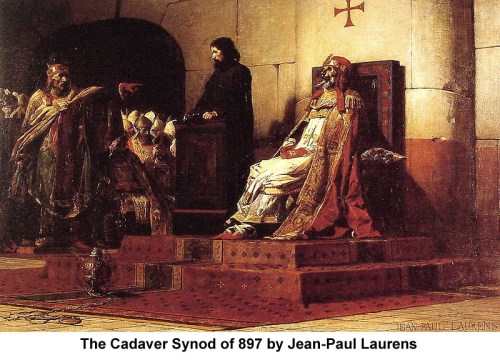
Cadaver Synod of 897 painting

One very famous incident illustrates how bad things got for the Western Church. In 897, Pope Stephen VI had his predecessor’s rotting body disinterred and brought before a synod, where it was propped up in a chair for trial. Following conviction, the corpse was thrown into the River Tiber. A year later, Stephen was deposed, imprisoned and strangled. Incredibly, despite incidents such as this, the Roman Church still managed to operate and even to be respected throughout the West.

But with the near total collapse of civil order and culture in Europe, the end of the world seemed at hand. Not surprisingly, it was seriously expected by many as the year 1000 approached, which perhaps helped fuel the tenth century spiritual renewal that swept through the Western world.

Starting at the monastery in Cluny, it sought to restore purity to the Western Church, to stamp out corrupt practices and to re-establish the celibacy of the clergy.

You’d think I’d be done with Pergamum by now, wouldn’t you? Such a short letter and such a lot of blogging! But the “hidden manna” and “white amulet” stuff is fascinating and will need yet another blog to do them justice. CYL!

Sources:

Eerdman’s Handbook to the History of Christianity [Eerdmans Publishing, 1977]

The New Bible Dictionary [Eerdmans Publishing, 1962]

New American Bible online @ http://www.usccb.org/bible/

Carolingian Renaissance @ http://en.wikipedia.org/wiki/Carolingian_Renaissance

The Siege of Constantinople @ http://en.wikipedia.org/wiki/Siege_of_Constantinople_%28717%E2%80%93718%29

Charles Martel @ http://en.wikipedia.org/wiki/Charles_Martel

Byzantine Empire @ http://en.wikipedia.org/wiki/Byzantine_Empire

Pope Stephen VI @ http://en.wikipedia.org/wiki/Pope_Stephen_VI

3 Comments

Filed under Bible Prophecy

The Seven Churches of Revelation, part six

If you’re new to this series, you can catch up here:

Part 1 @ https://polination.wordpress.com/2012/12/03/the-seven-churches-of-revelation/

Part 2 @ https://polination.wordpress.com/2012/12/09/the-seven-churches-of-revelation-part-two/

Part 3 @ https://polination.wordpress.com/2012/12/13/the-seven-churches-of-revelation-part-three/

Who were the Nicolaitans? @ https://polination.wordpress.com/2012/11/17/who-were-the-nicolaitans/

Part 4 @ https://polination.wordpress.com/2012/12/14/the-seven-churches-of-revelation-part-four/

Part 5 @ https://polination.wordpress.com/2012/12/16/the-seven-churches-of-revelation-part-five/

A Brief Review of History @ https://polination.wordpress.com/2012/12/17/a-brief-review-of-history-313-to-1000-ad/

Book of Revelation, Chapter 2, Verses 12-18:

To the angel of the church in Pergamum, write this:

The one with the sharp two-edged sword says this:

I know that you live where Satan’s throne is, and yet you hold fast to my name and have not denied your faith in me, not even in the days of Antipas, my faithful witness, who was martyred among you, where Satan lives. Yet I have a few things against you. You have some people there who hold to the teaching of Balaam, who instructed Balak to put a stumbling block before the Israelites: to eat food sacrificed to idols and to play the harlot. Likewise, you also have some people who hold to the teaching of [the] Nicolaitans. Therefore, repent. Otherwise, I will come to you quickly and wage war against them with the sword of my mouth.

Whoever has ears ought to hear what the Spirit says to the churches. To the victor I shall give some of the hidden manna; I shall also give a white amulet upon which is inscribed a new name, which no one knows except the one who receives it.

I’ve introduced my idea about the seven churches being periods in church history; I’m not at all sure I’m right so take all this with pounds of salt. Please. That being said …

Pergamum seems to work beautifully as a type for the church during the early Middle Ages (roughly 313 AD to 1,000 AD).

The description of Jesus as “the one with the sharp two-edged sword” refers to the passage shortly before (Rev 1:16) where Jesus is described as having a sharp two-edged sword coming out of his mouth which is a clear references to Hebrews 4:12-16:

Indeed, the word of God is living and effective, sharper than any two-edged sword, penetrating even between soul and spirit, joints and marrow, and able to discern reflections and thoughts of the heart.

No creature is concealed from him, but everything is naked and exposed to the eyes of him to whom we must render an account.

Therefore, since we have a great high priest who has passed through the heavens, Jesus, the Son of God, let us hold fast to our confession.

For we do not have a high priest who is unable to sympathize with our weaknesses, but one who has similarly been tested in every way, yet without sin.

So let us confidently approach the throne of grace to receive mercy and to find grace for timely help.

Consider how apropos are references:

to a sharp sword penetrating joints and marrow for this period when barbarian and Muslim warriors invaded repeatedly;

to Jesus as high priest and to his throne for this period when Christianity became the official state church;

to discerning reflections and thoughts of the heart for this period when the Church developed a sophisticated theology;

to the word of God for this period during which the Church assembled the canon of the New Testament; and,

to holding fast to our confession for this period when the Church formulated a creed.

I was intrigued by the TWO in two-edged sword when considered with the TWO broad strokes of this period in Church history:

1. The struggles for dominance between Church and State.
2. The division of the Church between East and West.

Pergamum was the center of the official pagan religion of the Roman Empire and the site of the oldest temple of the imperial cult. (Cf. The letter’s references to Satan’s throne where Satan lives and where a faithful witness was martyred.)

In 330 AD, the Christianizing Emperor Constantine declared Constantinople the new capital of the Roman Empire. Thus, Pergamum works well as a meaningful type for both religious centers, Rome in the West and Constantinople in the East.

Neat, huh? There’s lots more to talk about with this letter. For now, let me just end with this factoid:

Tradition has it that Antipas was a disciple of John who became Bishop of Pergamum and was burned to death there, ca. 92 AD, in a brazen bull-shaped altar. But there is apparently no surviving record of Antipas apart from this brief mention in Revelation.

Icon Saint Antipas

Sources:

Eerdman’s Handbook to the History of Christianity [Eerdmans Publishing, 1977]

The New Bible Dictionary [Eerdmans Publishing, 1962]

http://www.usccb.org/bible/

http://en.wikipedia.org/wiki/Pergamon – note alt spelling

http://www.catholic.org/saints/saint.php?saint_id=1474

http://en.wikipedia.org/wiki/Constantinople

13 Comments

Filed under Bible Prophecy

A Brief Review of History — 313 to 1000 AD

Before we move on to the Revelation letter to Pergamum, we need a quick history lesson.

In 313 AD, Emperor Constantine ended the persecution of Christians by legalizing the religion. In 395 AD, Emperor Theodosius I, the last to rule over both the eastern and the western halves of the Roman Empire, issued decrees that effectively made Nicene Christianity the official state church of the Roman Empire.

The Nicene Creed was formulated at the Councils of Nicaea and Constantinople in 325 and 381 respectively. In 431, it was ratified as the universal creed of all Christendom by the First Council of Ephesus.

In these centuries following the legalization of the faith and during the decline and fall of the Roman Empire, the church was blessed with a number of eminent Christian teachers and great bishops – known collectively as the Early Church Fathers – whose scholarly works contributed greatly to the theological and spiritual development of the faith.

In the Roman Catholic Church, Saint John of Damascus (died 749 AD) is generally considered the last of the Early Church Fathers. He is also known as Saint John Damascene “the golden speaker.”

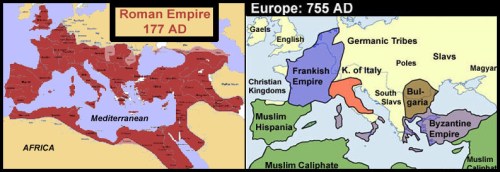
Roman Empire vs Dark Ages maps

Two major centers of Christianity – East and West – emerged as a result of the turmoil caused by barbarian and Muslim invaders.

In the West, civilization pretty much collapsed, leaving the Christian church – under the guidance of the Bishop of Rome (Pope) – struggling to maintain itself. The constant political turmoil, invasions, wars, and repeated interference in church affairs by local political rulers consumed much of the energy of successive popes and often diverted their attention from spiritual matters.

Basically, the Western church survived, but stagnated for about five hundred years, reaching its lowest-point of spiritual prestige and power just as the calendar was approaching the apocalyptically scary 1,000 year mark.

In the East. the Christian church – under the guidance of the Bishop of Constantinople (Patriarch) – was protected by, but also largely subservient to the political rulers of the richer and more stable Eastern Roman Empire.

The Eastern Orthodox Church formally split from the Western Roman Church in 1054. Relations between the two had long been embittered by disputes over the nature of the Trinity, the use of leavened vs. unleavened bread in the Eucharist, and the Roman Pope’s claim to universal jurisdiction.

The rest of the early Christian churches were swamped by Muslim invaders, who conquered the Middle East, central Asia, and North Africa.

The once prominent Christian church in North Africa (Alexandria, Carthage) was overwhelmed and ceased to be a major player in either politics or religion, though I believe the Coptic Church traces its roots back to Apostolic times.

Now that we’re all up to speed on the history, we can better understand the Revelation letter to Pergamum.

Sources:

Eerdman’s Handbook to the History of Christianity [Eerdmans Publishing, 1977]

http://www.worldology.com/Europe/early_dark_ages_2.htm

http://en.wikipedia.org/wiki/Coptic_Orthodox_Church_of_Alexandria

http://en.wikipedia.org/wiki/Theodosius_I

http://en.wikipedia.org/wiki/Christianity

http://en.wikipedia.org/wiki/Church_Fathers

http://en.wikipedia.org/wiki/John_of_Damascus

http://en.wikipedia.org/wiki/East%E2%80%93West_Schism

1 Comment

Filed under Bible Prophecy

The Seven Churches of Revelation, part five

If you’re new to this series, you can catch up here:

Part 1 @ https://polination.wordpress.com/2012/12/03/the-seven-churches-of-revelation/

Part 2 @ https://polination.wordpress.com/2012/12/09/the-seven-churches-of-revelation-part-two/

Part 3 @ https://polination.wordpress.com/2012/12/13/the-seven-churches-of-revelation-part-three/

Who were the Nicolaitans? @ https://polination.wordpress.com/2012/11/17/who-were-the-nicolaitans/

Part 4 @ https://polination.wordpress.com/2012/12/14/the-seven-churches-of-revelation-part-four/

Book of Revelation, Chapter 2, Verses 8-11:

To the angel of the church in Smyrna, write this:

The first and the last, who once died but came to life, says this:

I know your tribulation and poverty, but you are rich. I know the slander of those who claim to be Jews and are not, but rather are members of the assembly of Satan. Do not be afraid of anything that you are going to suffer. Indeed, the devil will throw some of you into prison, that you may be tested, and you will face an ordeal for ten days. Remain faithful until death, and I will give you the crown of life.

Whoever has ears ought to hear what the Spirit says to the churches.

The victor shall not be harmed by the second death.

Continuing with Smyrna as a type for the Roman persecutions of the Church:

A “vital element in the growth of early Christianity was persecution and martyrdom. Early persecution was sporadic and local. The first intensive effort by the state to eliminate Christians came after the burning of Rome during the reign of the Emperor Nero in AD 64. Nero made the Christians the scapegoats for the disaster, and they were savagely tortured and burned, at least in and around Rome.

Empire-wide persecutions came periodically in the third and fourth centuries. Untold numbers of Christians died heroically for their faith; only relatively few recanted. So impressive were the many who died gladly for Christ that they were more than replaced by fresh converts. The Christian writer Tertullian observed: ‘the blood of martyrs is seed.'”

Eerdman’s Handbook to the History of Christianity [Eerdmans Publishing, 1977]: Page xiii

PERSECUTION TIMELINE: Because of the line “you will face an ordeal for ten days”, I was curious to see if there were ten periods of persecution and/or a ten year period of persecution. I found both. (N.b., the colors are just to help you track the text more easily.)

FIRST: 64 AD – In 64, a great fire broke out in Rome, destroying portions of the city and economically devastating the Roman population. Emperor Nero was rumored to have ordered the fire himself and, in order to divert these rumors, blamed and savagely punished the already-detested Christians for the fire. Tradition tells us that the Apostles Saint Peter and Saint Paul were martyred in Rome at this time.

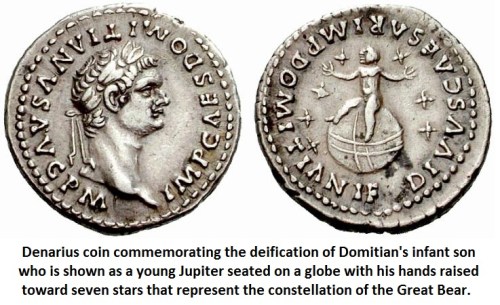
SECOND: 81 to 96 AD – Among the more famous victims in this persecution were Emperor Domitian’s own cousin, Flavius Clemens, and his wife, Flavia Domitilla. It seems likely that the Apostle Saint John was exiled to Patmos as part of this persecution. Domitian was the first of the emperors to deify himself during his lifetime by assuming the title of “Lord and God.” Note the use of seven stars on the coin in connection with Roman power and imperial divinity.

Domitian denarius

THIRD: 109 to 111 AD – Emperor Trajan directed that no steps were to be taken by magistrates to ascertain who were or who were not Christians, but at the same time, if any person was denounced and admitted that he was a Christian, he was to be punished. In Bithynia, it was a capital crime to admit to faith in Jesus.

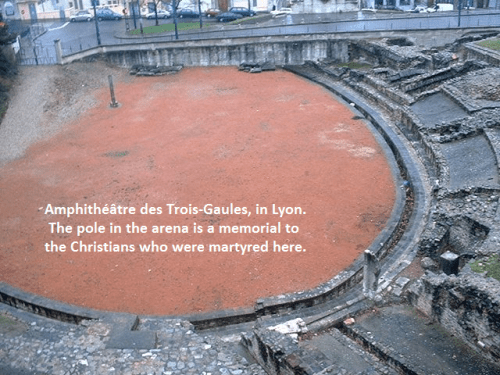
FOURTH: 177 AD – For a long period, it seems the imperial policy was live and let live. As long as Christians weren’t a nuisance, the state left them alone. One notable persecution took place in southern France that apparently started as an unofficial movement to banish Christians from public spaces. Anti-Christian mob violence forced official action, leading to the arrest, imprisonment, torture and execution of Christians.

Amphithéâtre des Trois-Gaules in Lyon

FIFTH: 197 to 211 AD – Emperor Severus outlawed conversion to Christianity or Judaism. Persecution under his rule was particularly severe in Syria, Egypt and Africa. Some of the famous Christians put to death in this period included the martyrs of Madaura, Perpetua and Felicitas, Origen and Origen’s father Leonides.

SIXTH: 235 to 238 AD – Emperor Maximinus Thrax instituted an empire-wide persecution of Christian clergy. It was a tough time to be a bishop, especially in Rome. Pope Saint Pontian was exiled to the Sardinian mines in 235 and died there of privation. Pope Saint Anterus lasted only weeks in office (November 21, 235 to January 3, 236).

SEVENTH: 250 to 251 – In an effort to annihilate Christianity altogether, Emperor Decius issued an edict requiring all citizens to sacrifice to the emperor in the presence of a Roman official and obtain a certificate (libellus) proving they had done so.

EIGHTH: 253 to 260 AD – Under Emperor Valerian, Christians were forbidden to visit their cemeteries and had to offer sacrifice to the Roman gods. Punishments included heavy fines, loss of rank, exile or death.

NINTH: 270 to 275 AD – After a ten year respite, the Emperor Aurelian revived Valerian’s systematic persecution.

TENTH (ten years long) 303 to 313 AD – Emperor Diocletian instigated “The Great Persecution”, ordering the destruction of Christian churches and texts, forbidding Christians from meeting for worship, arresting clergy, requiring all inhabitants of the empire to sacrifice to the gods and punishing those who refused.

Sources:

Eerdman’s Handbook to the History of Christianity [Eerdmans Publishing, 1977]: Page xiii; pages 111-113;

http://en.wikipedia.org/wiki/Persecution_of_Christians_in_the_Roman_Empire

http://en.wikipedia.org/wiki/John_of_Patmos

http://en.wikipedia.org/wiki/Perpetua_and_Felicity

http://en.wikipedia.org/wiki/Maximinus_Thrax

http://en.wikipedia.org/wiki/Decius#Persecution_of_Christians

http://en.wikipedia.org/wiki/Diocletian

http://en.wikipedia.org/wiki/Domitian

http://www.newadvent.org/cathen/05114b.htm

http://www.newadvent.org/cathen/09736b.htm

http://en.wikipedia.org/wiki/Pliny_the_Younger_on_Christians

http://en.wikipedia.org/wiki/Septimius_Severus

http://en.wikipedia.org/wiki/Valerian_%28emperor%29

http://www.newadvent.org/cathen/02108b.htm

1 Comment

Filed under Bible Prophecy

The Seven Churches of Revelation, part four

If you’re new to this series, you can catch up here:

Part 1 @ https://polination.wordpress.com/2012/12/03/the-seven-churches-of-revelation/

Part 2 @ https://polination.wordpress.com/2012/12/09/the-seven-churches-of-revelation-part-two/

Part 3 @ https://polination.wordpress.com/2012/12/13/the-seven-churches-of-revelation-part-three/

Who were the Nicolaitans? @ https://polination.wordpress.com/2012/11/17/who-were-the-nicolaitans/

Book of Revelation, Chapter 2, Verses 8-11:

To the angel of the church in Smyrna, write this:

The first and the last, who once died but came to life, says this:

I know your tribulation and poverty, but you are rich. I know the slander of those who claim to be Jews and are not, but rather are members of the assembly of Satan. Do not be afraid of anything that you are going to suffer. Indeed, the devil will throw some of you into prison, that you may be tested, and you will face an ordeal for ten days. Remain faithful until death, and I will give you the crown of life.

Whoever has ears ought to hear what the Spirit says to the churches.

The victor shall not be harmed by the second death.

I’ve introduced my idea about the seven churches being periods in church history; I’m not at all sure I’m right so take all this with pounds of salt. Please. That being said …

Smyrna seems to work beautifully as a type for the 200 years of Roman persecution following the Apostolic Age.

The Apostolic Age ended with the death of the last apostle, John (ca. 115 AD). The Edict of Milan made Christianity legal (313 AD).

Smyrna had a long history of loyalty to Rome, having dedicated a temple to the goddess Roma as early as 195 B.C. It seems well suited to stand as a type for persecution of Christians who refused to worship the Emperor. It was also a wealthy, beautiful port city, which points up the references in the letter about material poverty and spiritual wealth.

However, there is no record of how Christianity came to Smyrna and, apart from this one mention in the Book of Revelation (written in mid-90s AD), the city is not mentioned at all in the Bible.

About 110 AD: As far as I could find, the earliest record we have is The Letter to the Smyrnaeans written by Saint Bishop Ignatius of Antioch, who had been a student of the Apostle John. It discusses theology and church governance, but does not mention Jews or persecution.

About 153 AD: We do have evidence from some decades later that some Jews in Smyrna had become hostile enough to Christianity that they eagerly joined a mob of pagans in burning Smyrna’s Bishop Polycarp to death.

The New American Bible has footnotes for Revelation 2 saying there was a large Jewish community in Smyrna that was very hostile toward Christians, and that accusations made by Jews in Smyrna occasioned the persecution of Christians. It cites the following passages as evidence:

“Acts 14:2, 19; 17:5, 13.”

But … with all due respect … this makes no sense to me.

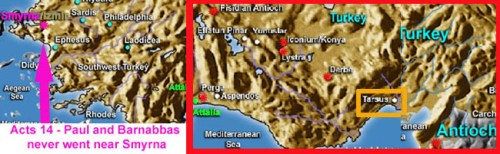
Acts 14 map

Acts 14 tells us that while Paul and Barnabas were at Iconium, their preaching offended disbelieving Jews and divided the city. There was an attempt by both the Gentiles and the Jews, together with their leaders, to attack and stone Paul and Barnabas, causing them to flee to Lystra. Some hostile Jews from Antioch and Iconium followed them and set off another stoning attempt, so they left for Derbe. After preaching in Derbe, they returned to Lystra and Iconium, then went to Pisidia Antioch, Perga and Attalia, then they sailed to Antioch. Smyrna is way to the west of all these cities.

Acts 17 map

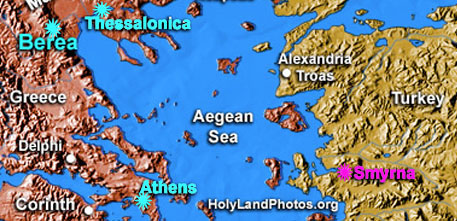
Acts 17 tells us that Paul went to Thessalonica, where the success of his preaching made some of the Jews so jealous that they recruited some worthless men loitering in the public square, formed a mob, and dragged some of the Christians before the city magistrates, accusing them of sedition. The city magistrates fined the Christians and let them go, then Paul and Silas went to Berea. These Jews were more fair-minded than those in Thessalonica; many of them became believers, as did not a few of the influential Greek women and men. When the Jews of Thessalonica heard this, they went to Berea and again stirred up trouble. So Paul went to Athens via the seacoast. Smyrna is way to the east of all these cities.

I can’t find any evidence that Smyrna had a hostile Jewish community at the time John had his vision. In fact, all references to this alleged community are based on the letter to Smyrna in Revelation. However, if the cities in the letters were meant as prophetic types, then it is inappropriate to conclude anything from the letters about the actual conditions in the churches in those cities at the end of the 1st c. AD. To do so is to put the interpretation before the evidence.

I’ll talk more in future about the 2d and 3d century persecutions and the letter to Smyrna. First, I need to do more research about the persecutions themselves and hopefully find some hint of what “you will face an ordeal for ten days” might mean. If anybody has any resources, references or clues, I’d appreciate them!

Sources:

http://www.usccb.org/bible/revelation/2#74002008-2

http://www.biblegateway.com/resources/commentaries/IVP-NT/Rev/Message-Smyrna

http://en.wikipedia.org/wiki/Smyrna#Roman_and_Byzantine_period

http://en.wikipedia.org/wiki/Letter_to_the_Smyrnaeans

http://en.wikipedia.org/wiki/Ignatius_of_Antioch

2 Comments

Filed under Bible Prophecy

The Seven Churches of Revelation, part three

Part 1 @ https://polination.wordpress.com/2012/12/03/the-seven-churches-of-revelation/

Part 2 @ https://polination.wordpress.com/2012/12/09/the-seven-churches-of-revelation-part-two/

Who were the Nicolaitans? @ https://polination.wordpress.com/2012/11/17/who-were-the-nicolaitans/

Book of Revelation, Chapter 2, Verses 1-7: The letter to the church at Ephesus

To the angel of the church in Ephesus, write this:

The one who holds the seven stars in his right hand and walks in the midst of the seven gold lampstands says this:

I know your works, your labor, and your endurance, and that you cannot tolerate the wicked; you have tested those who call themselves apostles but are not, and discovered that they are impostors. Moreover, you have endurance and have suffered for my name, and you have not grown weary.

Yet I hold this against you: you have lost the love you had at first. Realize how far you have fallen. Repent, and do the works you did at first. Otherwise, I will come to you and remove your lampstand from its place, unless you repent. But you have this in your favor: you hate the works of the Nicolaitans, which I also hate.

Whoever has ears ought to hear what the Spirit says to the churches.

To the victor I will give the right to eat from the tree of life that is in the garden of God.

Each of the seven letters follows the same pattern:

  • Address “To the angel of the church in ___;
  • Description of the exalted Christ, author of the letter;
  • Lessons for the church;
  • Exhortation “Whoever has ears ought to hear what the Spirit says to the churches”;
  • Promise to all Christians who endure faithfully to the end.

I’ve introduced my idea about the seven churches being periods in church history; I’m not at all sure I’m right so take all this with pounds of salt. Please. That being said …

Ephesus seems to work beautifully as a type for the Apostolic Age of the history of Christianity.

The Apostolic Age was the period dating from the Resurrection of Jesus (c. ca. 33 AD) until the death of the last apostle, John (ca. 115 AD). This was the time when the church had preachers, teachers and witnesses who had known Jesus personally during His time here on Earth and when the books of the New Testament were composed.

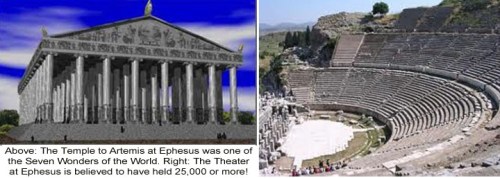
Ephesus was the pre-eminent political, commercial and religious city in the Roman province of Asia, second in population only to Rome itself. And, although it existed for centuries before and after, its peak — during the 1st and 2nd century AD — pretty much coincided with the Apostolic Age.

Ephesus temple and theater

After Jesus commissioned the Apostles, they dispersed from Jerusalem (the pre-eminent political, commercial and religious city in Israel) and founded the first Christian communities.

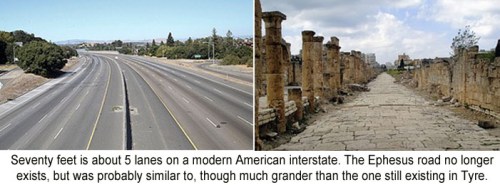
The early church benefited greatly from the Pax Romana and the wonderful system of roads the Romans had built throughout their empire. Ephesus was not only connected to the rest of Asia by these roads, but it also had a great harbor that was served by a magnificent road, 70 feet wide and lined with columns. It must have been really something!

Ephesus imagining the harbor road

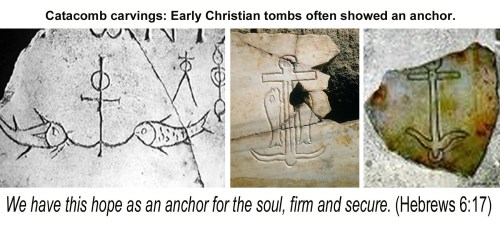
Ephesus as a type for the early Church is so cool. The anchor has been a Christian symbol for hope and steadfastness since the Apostolic Age. Imagine Jesus arriving at this grand harbor, putting down anchor and unloading His cargo of Good News!
Anchors from catacombs
And what a rich symbol is the anchor on the original Good News cargo ship when seen in light of Jesus’ admonition about having “lost the love you had at first.” It’s like … get back to the Word, people. “Realize how far you have fallen. Repent, and do the works you did at first.” I love it!

Speaking of realizing how far you have fallen, getting back to the lost love, etc., check out the image Jesus chose for this letter’s promise!

To the victor I will give the right to eat from the tree of life that is in the garden of God.

When God created the Garden of Eden, He “made grow every tree that was delightful to look at and good for food, with the tree of life in the middle of the garden and the tree of the knowledge of good and evil.” (Genesis 2:9)

After Adam and Eve disobeyed His command and ate of the latter, He said, “See! The man has become like one of us, knowing good and evil! Now, what if he also reaches out his hand to take fruit from the tree of life, and eats of it and lives forever?” (Genesis 3:22)

To prevent human beings from becoming immortal, God expelled us from His garden, “stationing the cherubim and the fiery revolving sword east of the garden of Eden, to guard the way to the tree of life.” (Genesis 3:24)

It’s so perfect!

Sources:
http://www.usccb.org/bible/revelation/2
http://en.wikipedia.org/wiki/Apostolic_Age
http://en.wikipedia.org/wiki/Ephesus
http://www.religionfacts.com/christianity/symbols/anchor.htm
http://en.wikipedia.org/wiki/Interstate_Highway_standards
http://sietske-in-beiroet.blogspot.com/2010/04/on-tyre-roman-roads.html

3 Comments

Filed under Bible Prophecy

The Seven Churches of Revelation, part two

Last week, I introduced my idea that the seven churches and their messages were much more than memos to seven little first century Christian communities.

See intro @ https://polination.wordpress.com/2012/12/03/the-seven-churches-of-revelation/

The whole of the Book of Revelation is introduced as “the revelation of Jesus Christ … to show his servants what must happen soon” and with “blessed are those who listen to this prophetic message and heed what is written in it, for the appointed time is near.” (Rev 1:1-3)

Another puzzler is that the seven letters are each addressed not to the people, but to “the angel of the church.”  And this after we’ve been explicitly told that the seven stars in Jesus’ right hand are “the angels of the seven churches” [Rev 1:20].

Rev 1 Jesus with stars and lampstands

In Scripture, the right hand of God denotes Divine power, which makes me think these angels are specific beings whom Jesus tasked to guard and guide each of the seven churches in the letters. This idea is supported by this passage:

“When I caught sight of him [Jesus], I fell down at his feet as though dead. He touched me with his right hand and said, ‘Do not be afraid.'” [Rev 1:17]

“Do not be afraid” is one of the first things every angel has ever said the minute it appears to someone in the Bible. And angels are immortal, which again suggests the letters have to do with churches in time or through time.

I think they stand for seven, successive periods in church history, starting with the Apostolic 1st c. Church (Ephesus) and continuing on to the End of Time Church (Laodicea).

1st century map Asia Minor - 7 churches in Revelation

For the record, I got the basic idea of the churches as time periods in church history out of a Seventh Day Adventist book called, Thoughts, critical and practical, on the book of Revelation by Uriah Smith.

Since he was convinced Jesus was returning Any Minute Now, he squashed his interpretation into pre-1880 history, with a major emphasis on demonstrating how Revelation proved that the Roman Catholic Church was the Worst Thing That Ever Happened. Like … EVER.

Apparently, the Adventists had a real bug up their butts about denominational churches, particularly the Big Mother of All Denominations based in Rome. It’s kinda funny, since they’ve done what other break-away, holier-than-them, renewal movements have eventually done. They’ve become a denomination.

So you’ll forgive me for getting little else of value from Uriah’s book, though I will say the man could teach modern Leftists a thing or three about spewing anti-Catholic venom. His ranting goes on for pages, all of it with Big Vocabulary Words and zero references to body parts, fluids or functions. It’s almost poetic. If I weren’t Catholic, I might have even enjoyed it.

I can tell you fershure that comparing Smith’s rants with something like Jason Biggs’ tweet to Pope Benedict: “Hey @pontifex since u obvs like the web and shit u should totes peep christianmingle.com lots of great ass ur welcome” is kinda like comparing Shakespeare’s plays to “A recent ex-virgin from Maine … .”  IOW, Christians even do bilious insults better than the godless Left. Ha.

I also got nothing else about this “seven periods of church history” theory from anywhere else. I did consult various Bible study sites and resources in my researches, but never came across any other mention of the idea. It may be out there and I just didn’t see it. I don’t know. Smith mentioned in his book that the “seven periods of church history” idea had held sway in the past, but was now (1881) generally discredited by theologians, though he thought it was true.

I just wanted to point out that I came up with my ideas on my own, but that I have no teaching or preaching credentials from any institution or denomination whatsoever. So please … take what I write about Scripture with a ton of salt. And if you think I’m full of it, that’s fine.

I’m planning to write more later about the letters and periods of history. But again, this has gotten long enough and we all have other stuff to do. 🙂

————————–

Who was Uriah Smith?

http://en.wikipedia.org/wiki/Uriah_Smith

7 Comments

Filed under Bible Prophecy

The Seven Churches of Revelation

I’ve been pondering the section in my Bible called “Letters to the Churches of Asia” [Rev. 1-3]. It’s puzzling in part because there were lots more than seven churches, even in that immediate area.

1st century map Asia Minor - 7 churches in Revelation

Plus, in the Prologue, John says the whole thing is a “prophetic message.” Yet the messages to the seven churches are more like the rest of the Epistles, with some Atta Boys and Clean Up Your Acts and Your Rewards Will Be Great in Heavens.

I found it confusing that Jesus had John make this grand pronouncement about prophecy, only to veer off into a bunch of memos to seven local parishes.

The footnote in my new Bible [New American Revised] says:

Seven is the biblical number suggesting fullness and completeness; thus the seer is writing to the whole church.

http://www.usccb.org/bible/revelation/1

Okay. But if the messages were to the whole church at that time (mid-90s AD), why not just say that? Maybe it’s because “the church” extends not just geographically, but also temporally, and that the “churches” listed were not merely local first century congregations, but also types for future “churches” … whatever that might mean.

There are indications in the text that prophetic time travel is the correct interpretation. For example, the greeting contains THREE references to the future:

“Grace to you and peace from him who is and who was and who is to come … Behold, he is coming amid the clouds. … ‘I am the Alpha and the Omega,’ says the Lord God, ‘the one who is and who was and who is to come, the almighty’.” [Rev 1:4,7,8]

Also, Jesus shows Himself to John walking in the midst of the seven gold lampstands, which we’ve been told represent the seven churches. [See Rev 1:20, 2:1]

Look back at the map where I’ve marked the order in which the letters appear. Ephesus was the major port city in the area with a major road connecting it to Smyrna and Pergamum. From Pergamum, there was another road to Thyatira, Sardis, Philadelphia and Laodicea. The last was a cross-roads trading town, so after arriving there from Philadelphia, you could just hang a right and head back to Ephesus. [Described in The New Bible Dictionary. Eerdmans. 1962.]

It seems as if John was just working his way logically through a kind of “virtual tour” from his prison on Patmos. The only problem is that Miletus had a port too. And it was much closer to Patmos than Ephesus was.  This, and the fact one could actually walk the “lampstands” route, suggests the letters make up a contrived travel itinerary. And travel moves you not just through space, but also through time.

I’ve been researching the seven churches and their messages. I think I’ve cracked the code and it’s pretty darn cool! But I’ll save that for another blog. This one’s gotten long and we all have things to do.

5 Comments

Filed under Bible Prophecy

Blowing chunks of tolerance

Pumpking blowing chunks

Jesus Christ says, “I know your works; I know that you are neither cold nor hot. I wish you were either cold or hot. So, because you are lukewarm, neither hot nor cold, I will vomit you out of my mouth.” [Rev 3:14-16]

Heat is associated with passion and energy. When we’re in that state, our bodies release adrenaline, which increases blood flow, causing us to feel warmer all over while increasing oxygen to our brains and muscles.

Someone who is “on fire” with love for God is deeply engaged in the relationship, devoting every physical, emotional, mental and spiritual resource toward knowing Him, loving Him and serving Him.

People who are “on fire” with hatred for God are just as deeply engaged in the relationship, devoting every physical, emotional, mental and spiritual resource toward knowing Him, hating Him and defying Him.

Rage also comes in a cold variety, one which is just as intense, but a lot more controlled.

Think about what it means to give someone the cold shoulder, that form of body language in which you ignore another person completely. How is such a thing possible? If you truly have no interest in that person, chance will dictate that at least some of the time you will notice him or her. Therefore, in order to ignore another person completely, you must be obsessively aware of that person at all times.

I’m reminded of how much energy it takes to run a freezer or air conditioner. Those things put out a lot of heat keeping stuff cold!

So what’s neither cold nor hot? What does lukewarm-ness toward God look like?

Might it not be the oh-so-famous TOLERANCE that the Left-wingers preach?

The word tolerance means to bear, or to bear with. It is the opposite of respect and is the enemy of both love and hate.

I think of it like the way we all behave when we’re squashed into an elevator. For a time, we have to tolerate what elsewhere would be an intolerable intrusion on our personal space. And how do we accomplish this? By avoiding conversation and eye contact while holding our bodies rigid.

This is the exact opposite of what God says He wants. In the passage above, He says He prefers people who are actively engaged in hating Him. I get that.

Haters are obsessed with Him, which gives Him opportunities to reach them and win them over with His love.

But people who are doing that tolerance thing have shut Him out completely.

It’s no wonder the Left has elevated TOLERANCE to its highest virtue!

Notes:

“Jesus Christ says” … the passage actually says, “The Amen, the faithful and true witness”, but Rev 1:5 tells us “the faithful witness” is Jesus Christ.

“Vomit” … Most translations use either spit or spew here, but the footnote in the New American Bible says the original word literally meant vomit. A number of Bible commentaries cite some allegedly well know “fact” that lukewarm water is nauseating. I’ve never known it to be, so I googled and found: “In between the bouts of vomiting … you should sip lukewarm water from time to time.”

Sources:

http://bible.cc/revelation/3-16.htm

http://www.usccb.org/bible/revelation/3#74003016-1

http://www.buzzle.com/articles/how-to-stop-vomiting.html

1 Comment

Filed under Bible Prophecy

Who were the Nicolaitans?

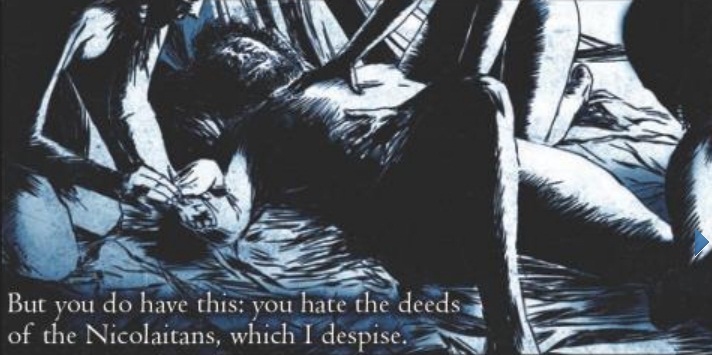
There is a new graphic novel of the Book of Revelation @ http://www.amazon.com/Book-Revelation-every-publishing-incorporate/dp/0310421403/ref. I used the “Click here to look inside” feature and was puzzled by this:

So I googled, “Who were the Nicolaitans?” and found an interesting article, which I’ve drawn from below.

There are only two passages in the Bible that mentions a sect called the Nicolaitans:

But you have this in your favour: You hate the practices of the Nicolaitans, which I also hate. — Revelation 2:5-7

Likewise, you also have those who hold to the teaching of the Nicolaitans. — Revelation 2:14-16

Multiple sources dating back to around the time of the early Church tell us the Nicolaitans were a Gnostic sect, founded by an apostate Church deacon named Nicholas. The early Church historian Eusebius tells us this sect was short-lived. It is likely they held various doctrines about ‘secret knowledge’ being necessary for salvation, as was common among Gnostic sects, but most of the references are about their sexual practices.

  • Irenaeus wrote that ‘they lead lives of unrestrained indulgence.’
  • Venerable St. Bede wrote that Nicolas allowed other men to marry his wife.
  • Thomas Aquinas wrote that Nicholas supported either polygamy or group marriage.

That certainly explains the graphic!

Source:

http://catholicknight.blogspot.com/2012/01/who-are-nicolaitans.html

3 Comments

Filed under Bible Prophecy