Category Archives: Health & Nutrition

80% of your immune system is in your gut

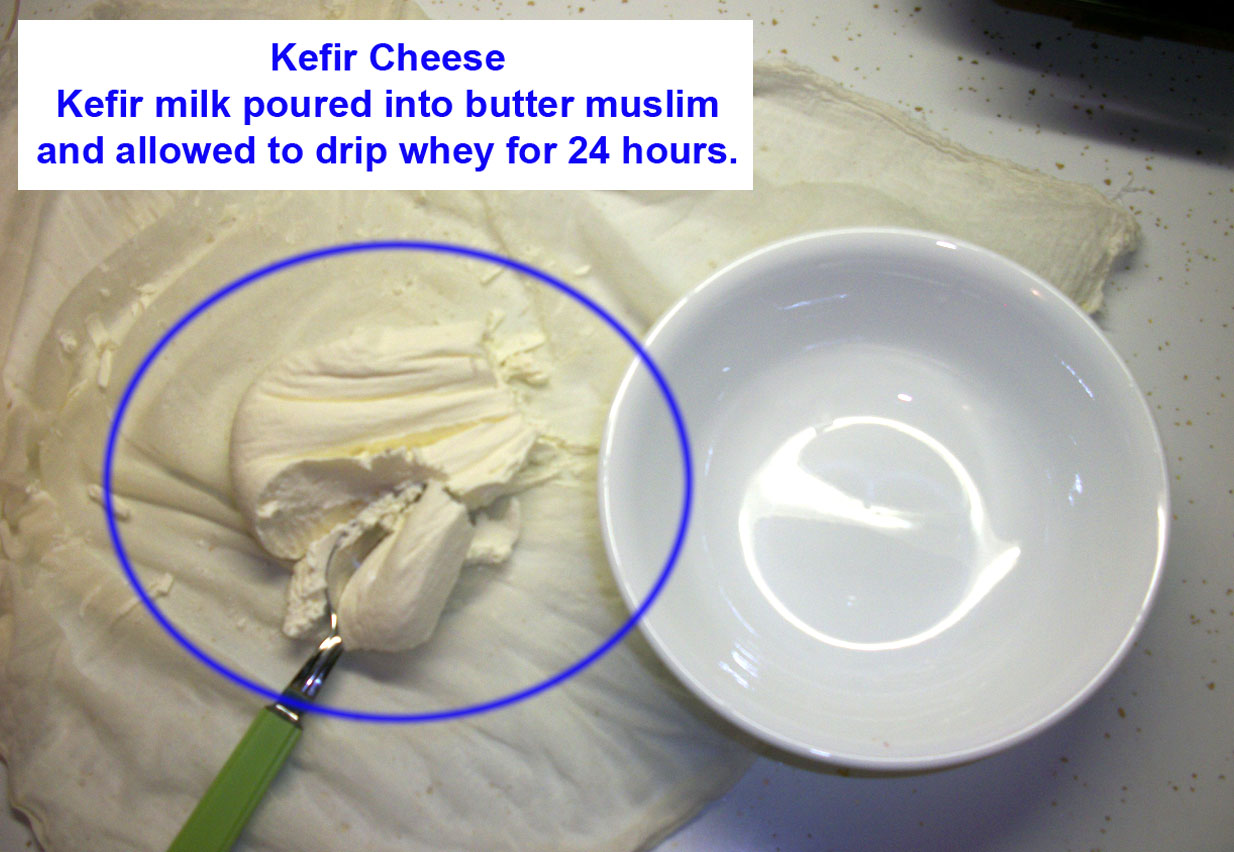
Kefir cheese is quite bland.  Like tofu and quinoa, it absorbs and shows off the flavors you add, making it very versatile and FUN to experiment with.  This batch got mixed with chopped onions and chopped garlic (both fermented), plus some turmeric and ground red pepper.  It turned a pretty yellow and was SO delicious!

Kefir cheese

“One of the things I have noticed (and get a lot of letters about) is how helpful probiotic foods are in preventing colds and flus, and also in eliminating them quickly if they do occur.” ~ Donna Schwenck

Read the rest @ http://www.culturedfoodlife.com/defeat-the-stomach-bug-with-super-veggies/

2 Comments

Filed under Health & Nutrition

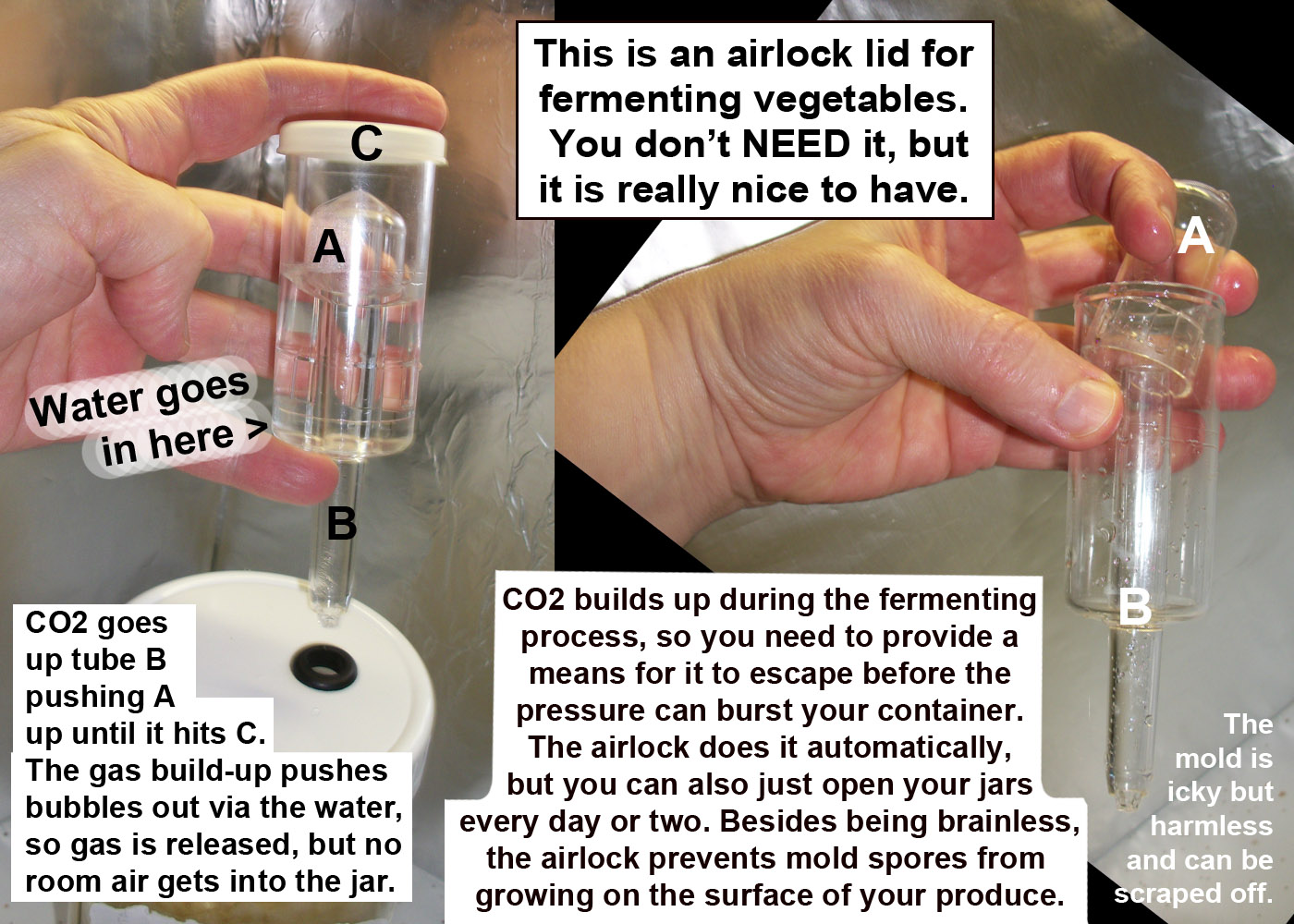
How to use an airlock lid

Fermenting airlock lid

Comments Off on How to use an airlock lid

Filed under Health & Nutrition

What we CHOOSE to eat will change what we WANT to eat

Fat kids at McD's

“Different bacterial species need different nutrients to survive. These bacteria cause cravings based on how many are present and what foods you eat. Because the gut is linked to the immune system, the endocrine system, and the nervous system, those signals could influence our behavior. …

“For instance, some bacteria prefer fat and others sugar. They have a little contest in your gut to see which ones will dominate. So often your cravings and food choices are coming from within you based on your own bacteria. …

“By adding cultured foods and prebiotics (food for bacteria), and by removing highly processed foods and sugar, we cause our bacteria to change; and in turn, they change our desire for certain foods.”

Read the rest @
The Gut Can Make You Crave Sugar Or It Can Set You Free
http://www.culturedfoodlife.com/the-gut-can-make-you-crave-sugar-or-it-can-set-you-free/

5 Comments

Filed under Health & Nutrition

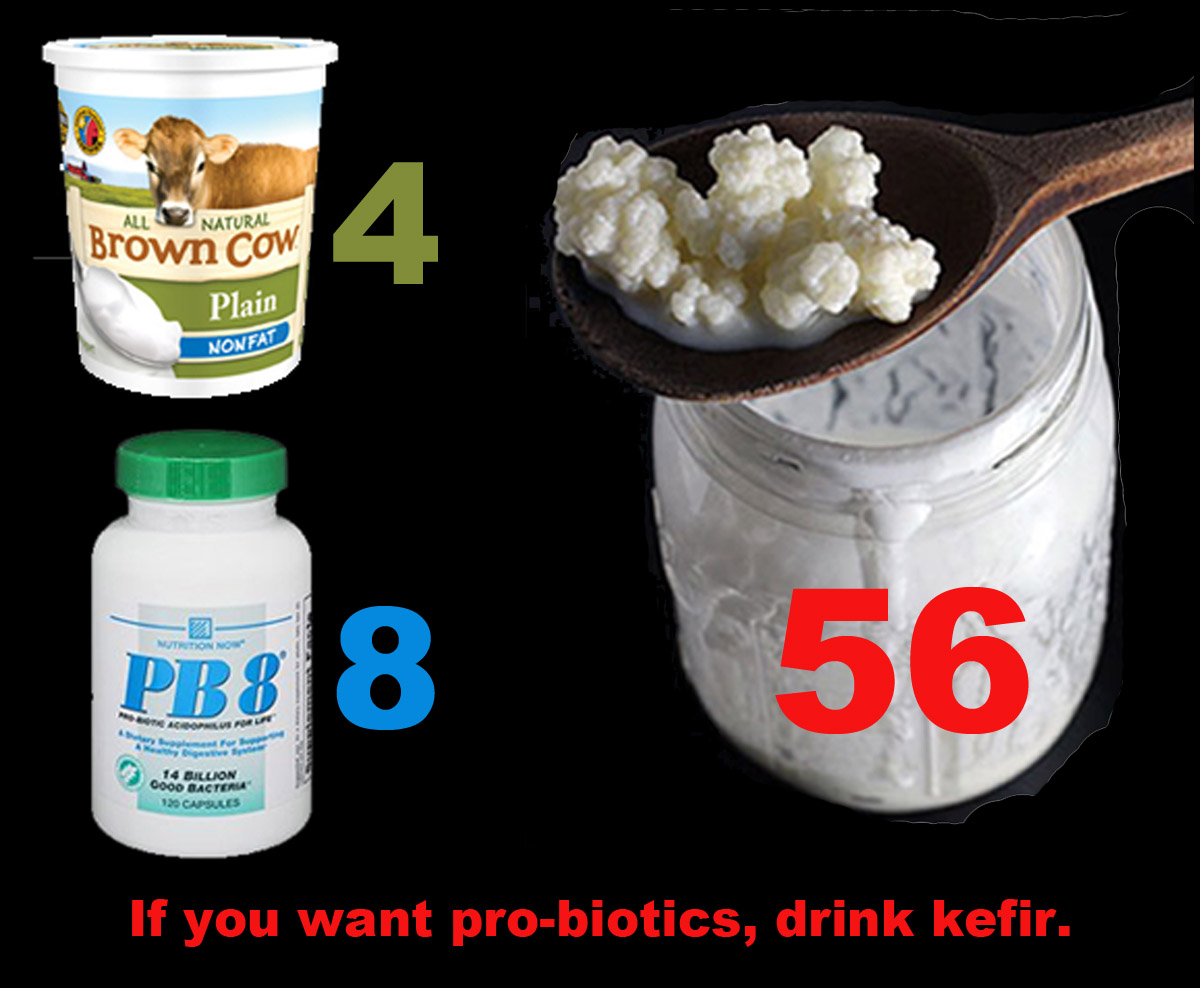
You want pro-biotics? Drink kefir.

Drink kefir

FOUR species in Brown Cow All Natural Yogurt
———————————
Lactobacillus acidophilus (PB8, kefir)
Lactobacillus bificus (B. bifidum, PB8)
Lactobacillus bulgaricus (kefir)
Streptococcus thermophilus (kefir)

EIGHT species in Nutrition Now PB8, ranked Best Value by Lab Door
———————————
Bifidobacterium animalis
Bifidobacterium bifidum (L. bificus, yogurt)
Bifidobacterium longum
Lactobacillus acidophilus (yogurt, kefir)
Lactobacillus casei (kefir)
Lactobacillus plantarum (kefir)
Lactobacillus rhamnosus (kefir)
Lactobacillus salivarius

FIFTY-SIX species in milk kefir made with live kefir grains
———————————
Acetobacter aceti
Acetobacter rasens
(Note: Candida albicans is the bad one)
Candida friedrichii
Candida humilis
Candida inconspicua
Candida maris
Candida rancens
Candida tenuis
Candida Yarrowia lipolytica (Candida lipolytica)
Cryptococcus humicolus
Debaryomyces hansenii (Candida famata)
Debaryomyces [Schwanniomyces] occidentalis
Dekkera anomala (Brettanomyces anomalus)
Enterococcus durans
Galactomyces geotrichum (Geotrichum candidum)
Issatchenkia orientalis (Candida krusei)
Kluyveromyces bulgaricus
Kluyveromyces lactis var. lactis
Kluyveromyces lodderae
Kluyveromyces marxianus (Candida kefyr)
Lactobacillus acidophilus
Lactobacillus brevis [Possibly now Lb. kefiri]
Lactobacillus casei subsp. casei
Lactobacillus casei subsp. rhamnosus
Lactobacillus cellobiosus
Lactobacillus delbrueckii subsp. bulgaricus
Lactobacillus delbrueckii subsp. lactis
Lactobacillus fermentum
Lactobacillus fructivorans
Lactobacillus helveticus
Lactobacillus helveticus subsp. lactis
Lactobacillus hilgardii
Lactobacillus kefiri
Lactobacillus kefiranofaciens subsp. kefiranofaciens
Lactobacillus kefiranofaciens subsp. kefirgranum
Lactobacillus paracasei subsp. paracasei
Lactobacillus parakefiri
Lactobacillus plantarum
Lactococcus lactis subsp. lactis
Lactococcus lactis subsp. lactis biovar. diacetylactis
Lactococcus lactis subsp. cremoris
Leuconostoc mesenteroides subsp. cremoris
Leuconostoc mesenteroides subsp. mesenteroides
Leuconostoc dextranicum
Pichia fermentans (C. firmetaria)
Saccharomyces cerevisiae
Saccharomyces exiguus
Saccharomyces humaticus
Saccharomyces pastorianus
Saccharomyces subsp. torulopsis holmii
Saccharomyces turicensis sp. nov
Saccharomyces unisporus
(Note: Streptococcus pyogenes is the bad one)
Streptococcus paracitrovorus
Streptococcus thermophilus
Torulaspora delbrueckii
Zygosaccharomyces rouxii

Sources:

8 Comments

Filed under Health & Nutrition

Getting started with ferments

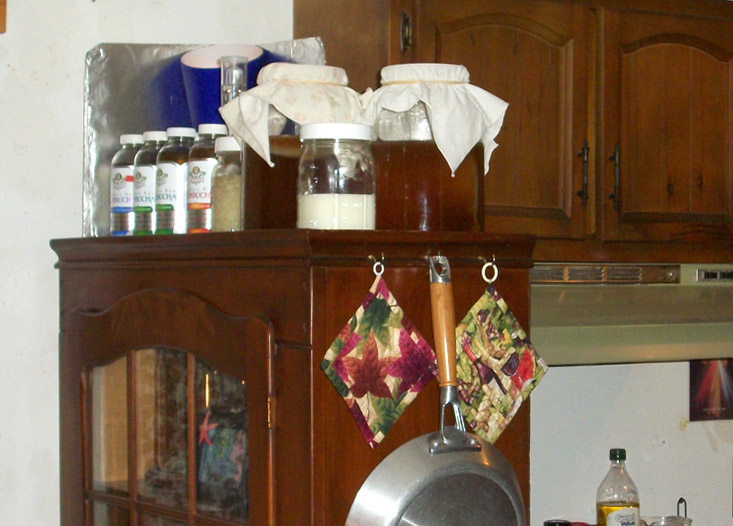
2014_12 31 My fermenting station

This is my fermenting station.  It’s on an outer wall and it’s winter, so I covered some cardboard with foil and put a small lamp up there.  It keeps it a nice temperature.  My two jugs of kombucha brew up 6 quarts in 7 days, then I decant into 10 GT’s bottles for a second brew of 7 days.  My quart jar of kefir ferments 2 cups in 24 hours; I’m alternating liquid days and cheese days.

Besides this stuff, I have room for 4 more quart jars that I bought airlocks lids for.  You can see one jar of onions fermenting between the booch jug and the GT’s bottles.  I’m having so much fun experimenting!  I’ve done a few bean pastes with black beans and chick peas; basically, fermented hummus-y spreads.  So delicious!  I also fermented a big jar of chopped garlic mixed with peppercorns and oregano; that is STRONG tasting, so I only use small amounts as an additive in other things, like the spreads.  But it’ll last 9 months or more in the fridge and I’m enjoying having chopped garlic without chopping garlic, so now I’m doing chopped onions as well.

Dearest just called from Wegman’s about New Year date night dinner and told me he’d found organic beets, carrots and radishes, so that will be next up on my shelf.  I’ve done a bunch of cabbage krauts, which it turns out I LOVE.  Home fermenting makes food taste very different from what I ever experienced before.  I never liked cabbage and I worked at Orange Julius once upon a time and hated even the smell of their sauerkraut.  But I LOVE my kraut and kimchi!

Except now I have learned that fermenting has no affect on the goitrogens in cruciferous vegetables; these must be cooked before someone like me (Hashimoto’s) should eat them.  So I’m going to try cooking the cabbage I’ve got left in the house, then fermenting it using a starter.  You can easily “wild” ferment cabbage; it has plenty of the good bacteria naturally.  But cooking it will kill that off, so I’ll have to add a culture.  I’m interested to see what cooked-then-fermented cabbage tastes like.  (Have I mentioned how FUN this is?!)

I started out with ferments rather by accident.  I joined a Facebook group that was recommended to me  because ferments have been helpful for autism.  Fermenting for Healing Facebook Group @ https://www.facebook.com/groups/362312183834094/.  I had no idea what “fermenting” was, apart from some vague notion about beer and maybe wine.

I am SO glad I stuck around.  The group is really nice about answering newby questions like, “What is a SCOBY?”  [Symbiotic Culture of Bacteria and Yeast … the culture that is used to ferment sweet tea into kombucha.]  When I posted a newby question, one of the members answered by linking to Donna Schwenck’s site @ http://www.culturedfoodlife.com/, noting she had found the site a good resource and had gotten her kefir and kombucha cultures in the store there.

I bought Donna’s DVD, which is very reasonably priced, and liked it enough to buy more copies to give to my girls.  I found another DVD by another fermenting educator at the library and, while I learned some interesting stuff, I thought it was short on the “how to” for newbies.  Plus, when I looked it up at Amazon, I thought it was absurdly overpriced.  As I recall, it cost almost 3x what Donna charges for her DVD that is much better with the “getting started” info.

I bought my cultures for $26 each (kefir and kombucha) from Donna, because I don’t know anyone else who ferments.  They are good, healthy cultures that are busy making me and mine healthier, plus making culture babies.  If anyone here wants to save some money, I will mail my culture’s off-spring for the cost of shipping.  It’ll be first come, first served.  Warrior Princess took half my babies when she visited and I’m sending the rest of what I have at the moment to GP next Monday, so it’ll be a couple weeks before I’ll have more.

1 Comment

Filed under Health & Nutrition

Fermenting is amazeballs!

Giraffe kissy

At 3:30 pm, I noticed I had not taken any pain medication since 9:00 am!  I blame the ferments. 🙂  Also, I got a text from Mama Buzz that, since starting to drink kombucha, she has totally lost all craving for diet soda!

“Amazeballs” has been added to the Oxford English Dictionary. The Bluebird of Bitterness believes this to be yet another sign of the decline of Western civilization.
http://www.oxforddictionaries.com/us/definition/american_english/amazeballs

2 Comments

Filed under Health & Nutrition

Hyphenated Ferments Update

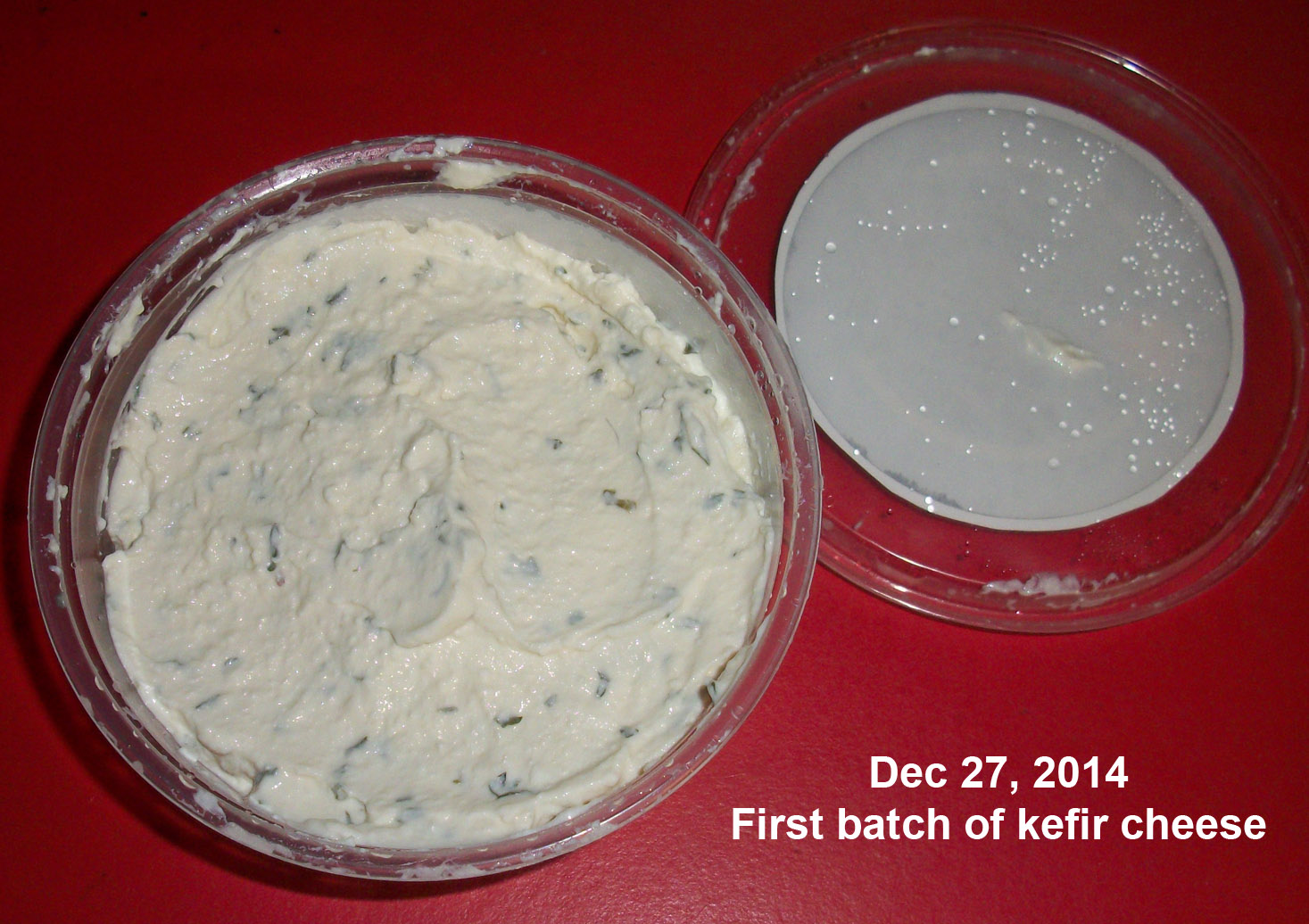
Dec. 27, 2014:  First batch of kefir cheese. It would be hard to imagine how this could be any easier!  I put parsley in this batch.  I’m looking forward to trying other things and seeing if I can make my spreads tasty enough to wean Dearest off some of those expensive brands of hummus he buys for his sammiches.  (The white dots on the lid are water droplets.)

2014_12 27 First batch of kefir cheese

Comments Off on Hyphenated Ferments Update

Filed under Health & Nutrition

Purple Potatoes!

When I learned about resistant starch, we started keeping cold, boiled potatoes in a bowl in the fridge.  They are surprisingly tasty and so easy that they are our go-to choice for quick snacks.

We’ve been trying different types of ‘taters and quickly learned that smaller is better for cold, skin-on snacking.  After that, we found the small brown ones (early harvest baking potatoes) had bitter skins, so ick.  The small red ones (aka, new potatoes) were okay, but nowhere near as sweet and tasty as the little yellow ones.  These latter, which in our store are labeled Pee Wee Golds, quickly became our favorite.

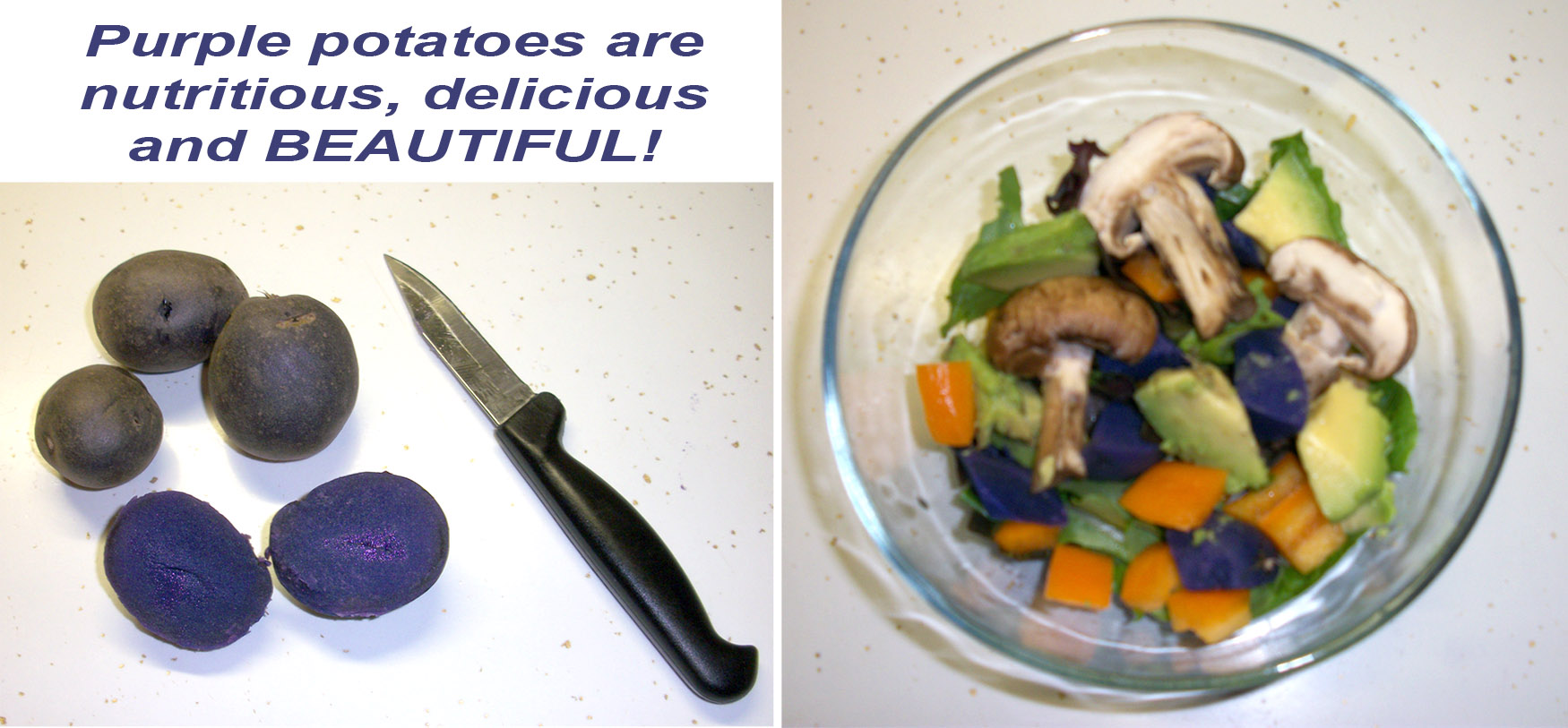
Last week, David found small purples potatoes to try.  Oh my goodness, but are they delicious!  And the color didn’t blanche when I cooked them.  The skins are a dull grayish purple, but the insides are BRIGHT PURPLE, like Harold’s magical crayon. 🙂  Check out the GORGEOUS salad I just made.  Isn’t God so cool, making food nutritious AND delicious AND beautiful?!

2014_12 11 Purple potatoes

I googled to make sure the purple potatoes weren’t GMOs or something.  They’re not.  In fact, it turns out they are not just pretty and delicious.  They are also healthier for you than white ones!

http://www.naturalhealth365.com/nutrition_news/purple-potatoes.html

Comments Off on Purple Potatoes!

Filed under Health & Nutrition

Tea Party Tuesdays

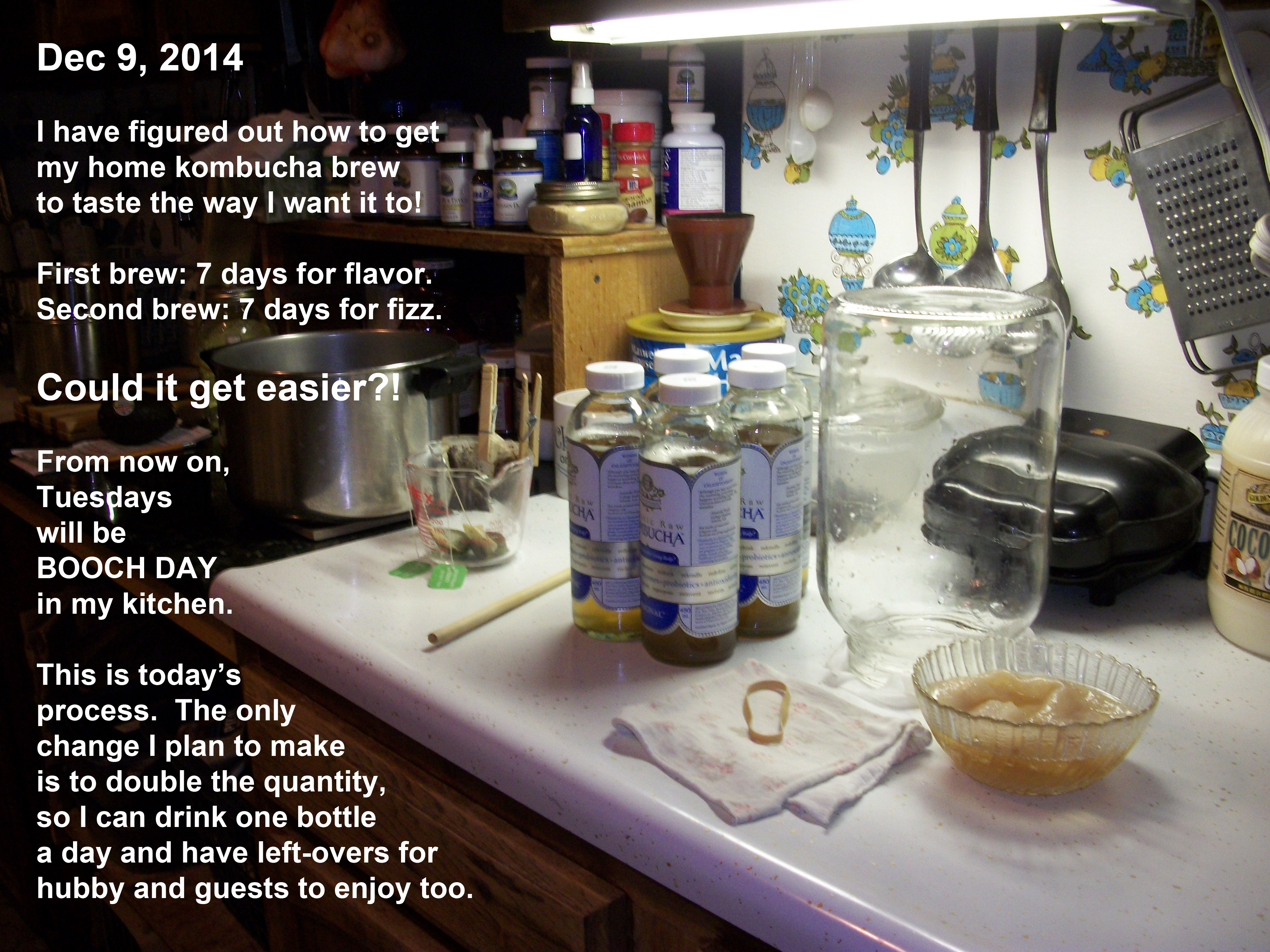
2014_12 09 Booch Tuesdays

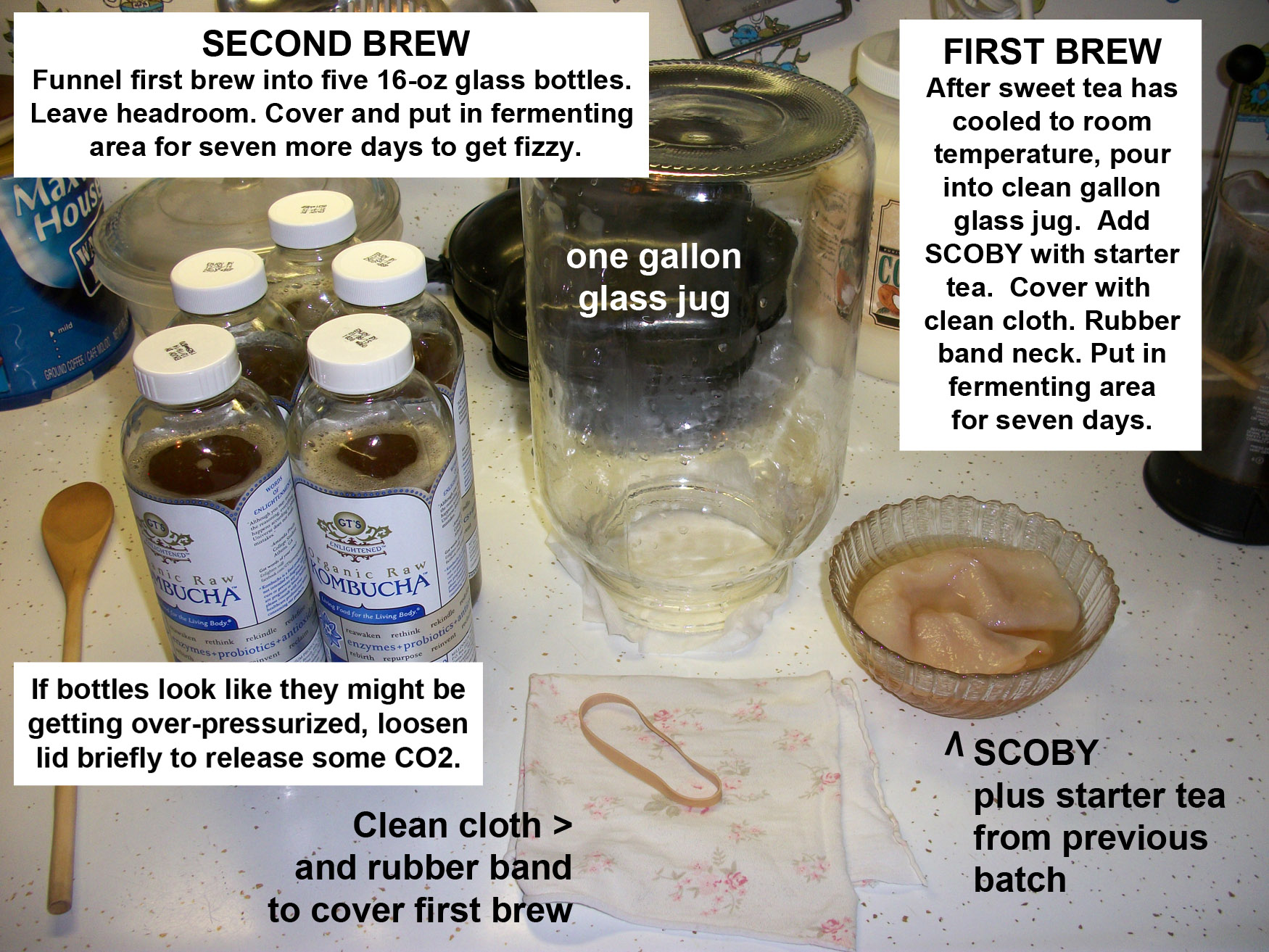
My SCOBY has grown so all I need to double my output is a second glass gallon jug (coming in the mail), five more bottles to decant into (got ’em) and space in my fermenting area (not a problem).

2014_12 09 First and second brew set up

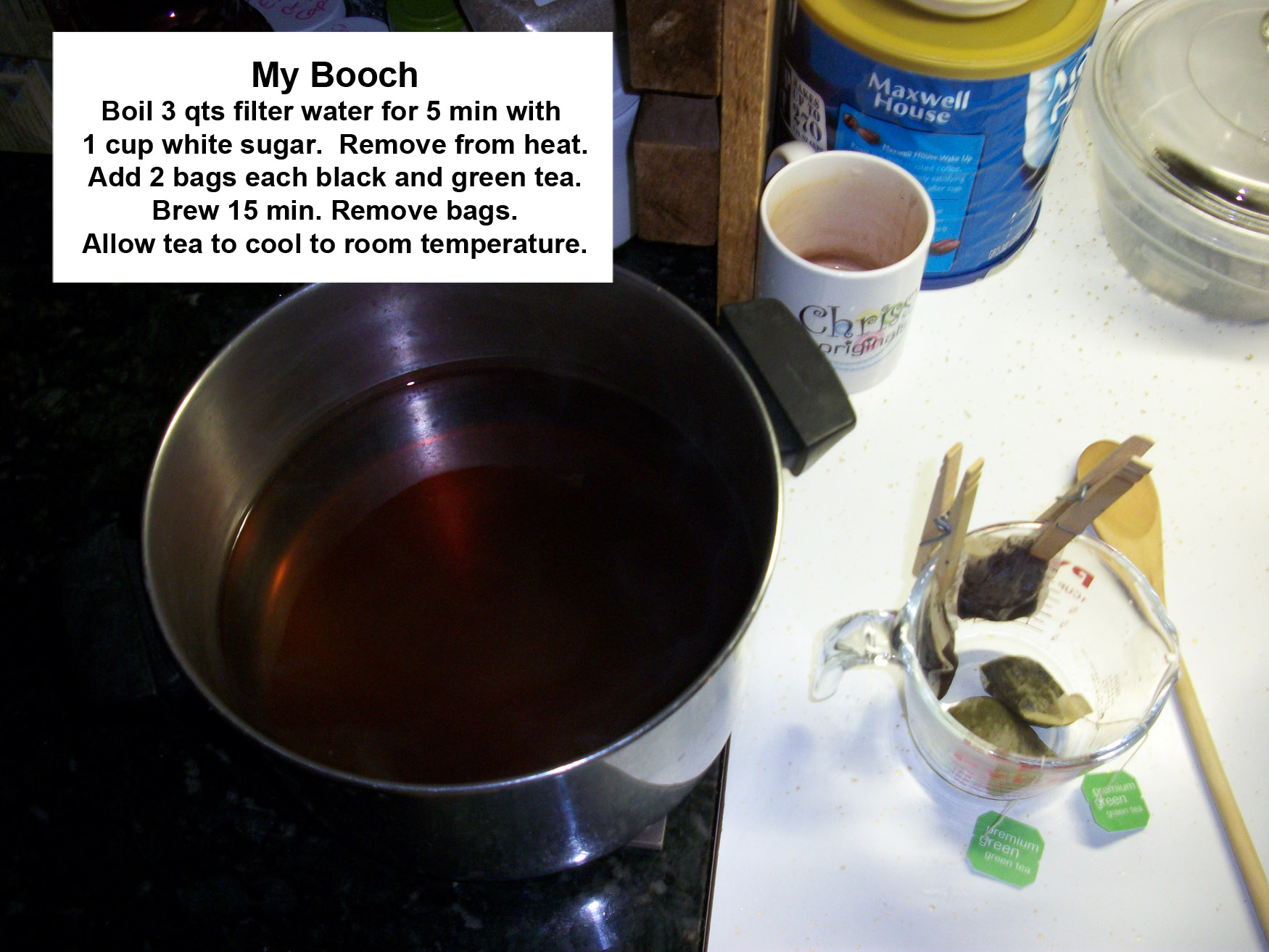
For one cup of sugar and four tea bags, I get about $20 worth of live-culture kombucha.  Most commercial brands of kombucha are pasteurized, which kills the probiotics.  They taste the same, but aren’t as good for you.  GT’s brand is live-culture.  Look for it in the cooler section.  You may need to be of age to buy it, because it’s got a small amount of alcohol in it.

2014_12 09 My booch recipe

Comments Off on Tea Party Tuesdays

Filed under Health & Nutrition

Kombucha: Separating the myths from the reality

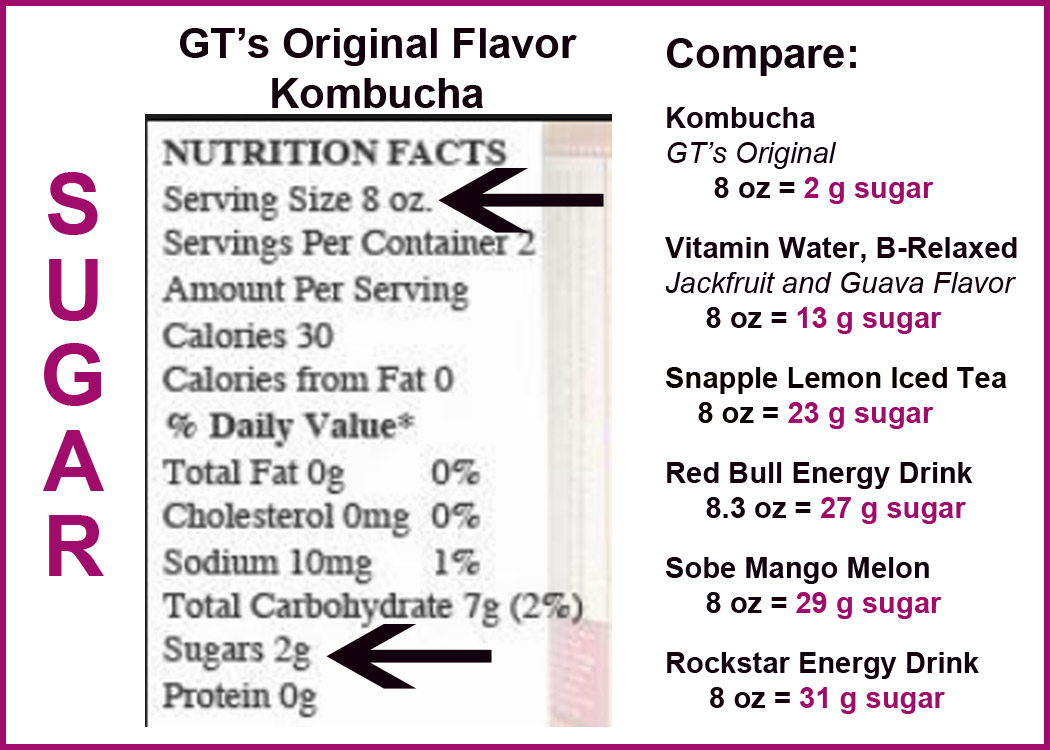
Sugar in kombucha

MYTH: Kombucha is sugar-free.
TRUTH: You cannot make kombucha without sugar to feed the SCOBY. The more days kombucha is brewed, the more of the sugar the SCOBY consumes. But it won’t be sugar free until 30 days or so, by which time it is more sour than most people can like. The usual brew time is 7-12 days, after which time there is sugar, but as you can see in the graphic, it is FAR less than in other drinks. If you need to know the sugar content of your home brew, you can use sugar test strips.

TRUE: Kombucha is an alcoholic drink.
FACT: Yes, but it is a very small amount, usually between 0.5 and 3%, depending on length of fermentation. (Beer contains 4-6%.)

MYTH: Kombucha is caffeine-free.
TRUTH: Kombucha has the same caffeine as the tea you started with. If you want decaff, start with decaff.

TRUE: Kombucha is a powerful detoxifier.
FACT: Kombucha appears to help the body produce glucoronic acid, which is a powerful detoxifier. Kombucha itself does not contain the compound, but people who drink kombucha have a lot of glucoronic acid in their urine.

TRUE: Kombucha is effective at relieving joint pain.
FACT: Although kombucha itself does not contain hyaluronic acid and glucosamine, it appears to help the body produce these joint-helping compounds.

MYTH: Kombucha contains over 50 different kinds of probiotics, organic enzymes, amino acids and vitamins.
FACT: This is a debatable claim, since every batch of kombucha is different. Most batches of kombucha will contain an analgesic (pain reliever), an anti-arthritic compound, an anti-spasmodic compound, a liver-protective compound, and several anti-bacterial compounds. [Note: Kombucha has gluconic acid, but not glucoronic acid.] Every batch will contain at least one beneficial yeast, acetobacter (the beneficial bacteria in the SCOBY), gluconic acid (a pH regulator), and acetic acid (an anti-microbial acid, which also stabilizes blood sugar).

MYTH: Kombucha is dangerous and has been linked to deaths.
FACT: In 1995, two ladies who drank kombucha from the same original SCOBY got sick suddenly and one died. The CDC published a caution that it may have been the SCOBY, but tests proved there were no pathogens or toxin-producing organisms in the SCOBY and no one else who brewed from that same SCOBY had any problems. Whatever made those two ladies sick, it wasn’t the kombucha.

Read more myths and facts @ http://www.phoenixhelix.com/2013/03/25/kombucha-myths-vs-truths/

Comments Off on Kombucha: Separating the myths from the reality

Filed under Health & Nutrition