
By Chrissy the Hyphenated
Click graphics to embiggen for easier reading.
Chrissy’s Site Bites: http://news.webshots.com/photo/2586404970056011884tEayyq

Chrissy’s Site Bites: http://news.webshots.com/photo/2732698800056011884sBgUnH
Chrissy’s Site Bites: http://news.webshots.com/photo/2462910060056011884DQbjSW

Chrissy’s Site Bites: http://news.webshots.com/photo/2579517640056011884xKUKtT
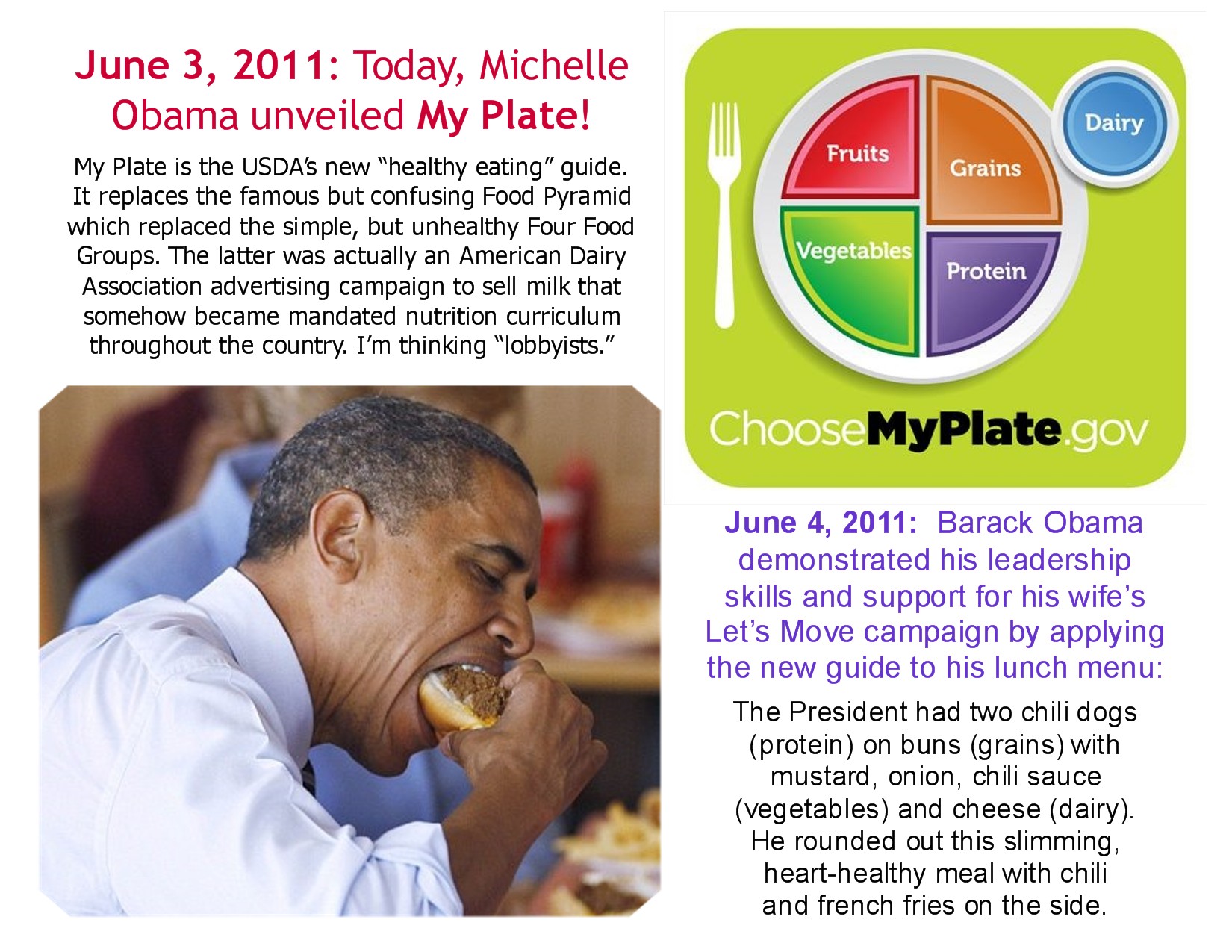
The blogs are ragging on the USDA “wasting” $2 million on My Plate, but I personally think it’s worth it. I hated the Four Food Groups and was delighted when they threw it out. (YOU try raising dairy-allergic kids who are being forced to memorize and regurgitate the “fact” that 25% of their diet should be something they’re not allowed to have.) The Food Pyramid was a nice try, but it was too confusing. This is much better (even if our Smarter Than Gawd president doesn’t seem to get how to use it).








 polination.blog
The original food guide pyramid was great. It wasn’t until the dairy and beef industries forced them to revamp it that it became confusing. I actually minored in nutrition in college and what many people don’t know is that all of our modern food guides have to do with lobbying in one way or another. It’s too bad it’s not just about eating healthy, huh?
I’m not a fan of this MyPlate guide at all. It’s way too vague and the shapes aren’t even the same, so you can’t compare portions acurately. They didn’t include fats at all, which, contrary to what some think, are essential for a healthy diet. When questioned about it, Agriculture Secretary Tom Vilsack said, “we are not telling people what to eat, we are giving them a guide. We are NOT suggesting they should not have a cookie or dessert.” Cookie? Dessert? FAT???
Michelle Obama’s explanation wasn’t any more impressive…”As long as [our plates are] half full of fruits and vegetables, and paired with lean proteins, whole grains and low-fat dairy, we’re golden.” Again, they’re suggesting cutting fat almost entirely out of our diets. There are actually fats that are beneficial to us, and this is really misleading.
Case in point…One of the specific recommendations listed at the MyPlate website (and included in MO’s quote above) is to consume low-fat or skim milk. However, the most recent studies have actually shown that the fat in milk is beneficial and healthy for our bodies, while the processes and additives of the low-fat milk products are actually harmful. So there’s been a major premise shift in the nutrition field which isn’t even taken into account.
If these are the people leading the charge for better nutrition in America, we’ve got a long road ahead of us. Good nutrition is somewhat complex and the only way they’re going to get people to understand it is through education. I think their two million dollars could have been much better spent on explaining the complexities, rather than trying to make it look simpler than it is (because we’re all just too dumn to get it).
LikeLike
Raising kids with multiple food allergies meant learning some things about nutrition, but mostly I relied on experts like you to help me design our eating plans. As you say, it’s complicated.
I think my rah rah for My Plate is based on my experiences with the 4 Food Groups curriculum, which my kids first got shoved at them in Kindergarten. The My Plate is a definite improvement for that age group.
As for lobbyists influencing curriculum…. ARGH!!!!!!!!!!!!!!! We couldn’t get our kids opted out of the 4 Food Groups curriculum, but their individual teachers did agree to teach it with reference to “What about you kids who can’t drink milk? What does your mommy give you instead?”
Also, when we were unemployed with 3 dairy allergic pre-schoolers and qualified for WIC, we had a WONDERFUL WIC nutritionist. She did so much to help me with our diet and went to bat for us with Albany, trying to get the WIC checks modified so we could get more of the foods we needed to replace what we didn’t get from dairy products.
At that time, the WIC checks were “all or nothing” … foods were printed on each check and you had to get exactly what was on the check or else. Well, every single check had MILK on them. What was I supposed to do … dump it out? I know a couple women in my situation who did just that. But I hate waste! Really really hate it.
Albany refused to remove or change the milk to other calcium rich products we did need and use. The nutritionist and I were both so frustrated. She found out we could legally substitute canned for fresh milk, so I did that and dropped it off at the local church-run Kitchen Cupboard.
So far as we could tell, the WIC program was at least as much about tax-payer support for the New York dairy industry as it was about supplemental feeding for at risk, fast growing young children. And they didn’t CARE if the milk went down the drain.
LikeLike
Well, you can see that I’m still bitter over the change from the original pyramid ;), but isn’t it interesting how big of a role political lobbying plays in our lives when you really sit down and look at it? All the more reason that gov’t should be involved in EVERYTHING as LITTLE as possible. I remember when the original pyramid came out and all the cereal boxes, bread bags, anything with grains had it plastered all over the packaging. Meat and dairy were all upset about it, but that marketing was also deceptive. They were basing it purely on the amount of carbs in the product, which lead to this huge binge on carbs, followed by the “carbs are bad” phase (which some people are still going through). I had the hardest time getting my friends to understand that when they said to cut carbs from your diet, they were talking about sugars, not grains. From that perspective, you can see what they were trying to convey with the new pyramid (there are good and bad foods in each group), but it was too complicated on its own, without extensive training to go along with it. I just wish they would stop changing the diagram and do more educating about good carbs/bad carbs, good fat/bad fat, complete vs incomplete proteins, etc. I feel like it’s a process and they’re looking for overnight results. Some of our bad eating habits will take a generation or two to correct.
Milk is a funny thing, because technically it’s baby food. Our bodies aren’t really designed to break down and digest certain components after we reach a certain age. Of course, this is true for other species as well, but we’re the only ones who insist on drinking milk throughout our lifetime. I once took a Food and Culture class, where we looked at the diets of various peoples around the world, and was amazed to discover that somewhere around 75% of the world’s population is lactose intolerant, including American Indians and just about every asian culture. Europeans were really the only ones who tolerated it very well. My husband is 50% Maltese and he’s lactose intolerant, too. Fortunately for me, I’ve never had any issues with milk and I can’t drink enough of it. I love it! I can’t imagine what I would do if I had to cut a lot of dairy from my diet.
LikeLike
I didn’t become lactose intolerant until my fourth pregnancy, when all of a sudden milk made me sick. I thought the problem would subside after the baby was born, but it didn’t. I had to make some serious dietary adjustments, since milk had always been the source for most of the protein in my diet, and I was at risk for protein deficiency.
All these government-sponsored dietary things, whatever shape they take — plate, pyramid, flying saucer, whatever — are bogus. As Rose and Chrissy both point out, it’s much more complicated than they make it appear, and that’s true whether or not you have allergies (although allergies certainly make it more complicated!). I always hated the four food groups thing — according to that model, a Big Mac with fries and ketchup and a strawberry milkshake is a balanced, nutritious meal. I hate the food pyramid because a diet heavy in carbohydrates and low in fat is one of the major causes of obesity in this country. I agree with Chrissy that the plate is an improvement, but it’s still much too simplistic. Whatever else nutrition is, it’s not simple, and any diagram that makes it appear simple is bound to be misleading.
LikeLike
You’ll love this one…
I’m a big fan of the exchange lists, which were created by the American Diabetic Association to help diabetics manage their diet better. Just looking at it from a simplistic standpoint (without understanding all fo the complexities), a beer would count as a fruit. So, we used to joke in college that we were getting more than half of our nutrients from fruit!
LikeLike
As I recall, my Medieval History prof said beer was a MAJOR source of essential nutrients for Europeans in northern climates. Isn’t it loaded with vitamins or something?
LikeLike