




















From The Babylon Bee.
HOLLYWOOD, CA—Kicking off a rousing and emotional monologue on his Jimmy Kimmel Live! late-night talk show Tuesday during which he laid out yet another case for the common-sense nature of his views on policy and the evil barbarism of those who hold different views, host Jimmy Kimmel reached into his desk and produced a document officially declaring himself America’s greatest moral authority.
“I know some people have questioned my impassioned political speeches, so let me just show you this,” Kimmel said before presenting the document for all the world to see. “I guess I assumed it was obvious due to the tone of my lectures and the obvious emotion behind them, but just in case anyone is unclear—I am, in fact, this nation’s highest moral authority.”
The paper, which contained the words “Official Document” in bold at the top, appeared to have read “This document officially certifies James Christian Kimmel as The United States of America’s highest moral authority; furthermore, as the sole arbiter of truth within the land.”
“Go ahead and zoom in on it,” the host said as he held the paper still for a moment. “Take a good look. And check out those asterisks at the top—this is the real deal. I sincerely hope none of you will question my authority again.”
“So whether I’m holding court about nationalized health care, women’s rights, or gun control: I am right, and only right, all the time. And if you disagree with me, you are wrong and you passionately want people to die,” he added.
At publishing time, the document’s origins are unknown, with most experts hypothesizing that Kimmel himself printed it out in his office before the show.
More from The Babylon Bee:
Youths Make Joke About Tim Keller’s Baldness, Immediately Mauled by Bears
Filed under Funny Stuff
From The Babylon Bee.
SEATTLE, WA—After reading several chapters from the gospels over the weekend, local progressive believer Wendy Butler reportedly published a Patheos blog post in which she criticized Jesus of Nazareth for “not being very Christlike.”
The blog post took Jesus to task for His “unloving and problematic” teachings.
“He devotes entire sections of His sermons to ranting about archaic religious concepts like hell and the last judgment instead of just coming alongside the marginalized and affirming their sins,” Butler said. “Very little of what He did on earth I would describe as life-giving. Frankly, I do a better job of being Christlike than Christ Himself.”
The woman was also agitated to find that Jesus didn’t devote any of His time recorded in the Scriptures to advocating for government-subsidized healthcare or women’s abortion rights.
“He had a few good things to say about loving our neighbors, but the bad outweighs the good in Jesus’ teachings, if we’re looking at things honestly here,” her essay continued. “He really needed to ask Himself, ‘What would Jesus do?’ more often, and then He’d have devoted a lot more of His time to social justice, like me.”
At publishing time, a horrified Butler had discovered the description of the Redeemer coming in His wrath in Revelation 19.
More from The Babylon Bee:
Joel Osteen Launches Line of Pastoral Wear: ‘Sheep’s Clothing’
Back Pew Voted Best Spot in Church Fifty-Eighth Year Running
Food Consumed at Church Functions Does Not Count Toward Daily Caloric Intake, Nutritionists Confirm
Archaeologists Discover King David’s Collection of Essential Oils
Planned Parenthood Sentenced to 8 Million Consecutive Life Sentences
Filed under Funny Stuff
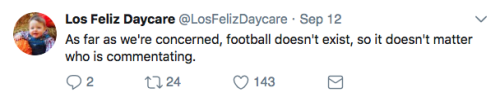
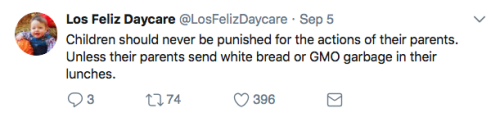
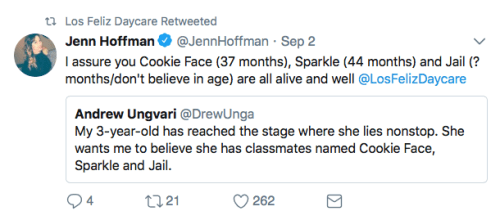
Los Feliz Daycare (motto: “We do not accept immunized children”) is an ultra-progressive child care center in an unspecified affluent neighborhood on the left coast. Some recent tweets:


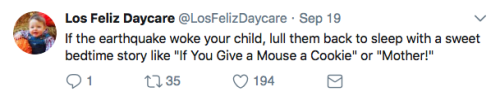

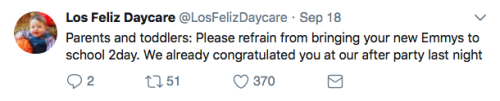

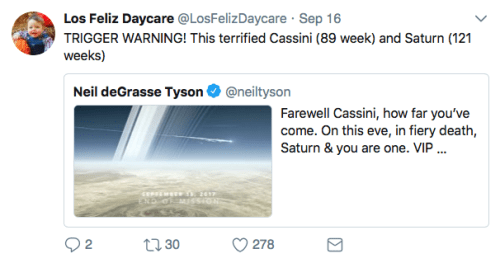
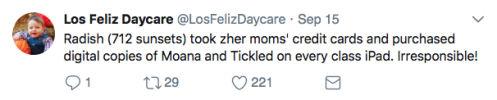








Filed under Funny Stuff
CNN is not the customary locale-of-choice for a catechesis on Catholic social doctrine. But that’s what Paul Ryan, Speaker of the U.S. House of Representatives, offered viewers of a CNN national town hall meeting on the evening of August 21.
Challenged with a semi-“Gotcha!” question by Sinsinawa Dominican Sister Erica Jordan, who not-so-subtly suggested that Ryan’s approach to healthcare reform, tax reform, and welfare reform was in conflict with the Church’s social teaching, the very Catholic Speaker replied that he completely agreed with Sister Erica that God is “always on the side of the poor and dispossessed”; the real question was, how do public officials, who are not God, create public policies that empower the poor and dispossessed to be not-poor and not-dispossessed?
Congressman Ryan then laid out an approach to alleviating poverty and empowering the poor that seemed to me entirely congruent with the core Catholic social ethical principles of subsidiarity and solidarity. Solidarity with the poor is a moral imperative, Ryan agreed, but solidarity should not be measured by inputs—How many federal dollars go into anti-poverty programs?—but by outcomes: Are poor people who can live independent and fruitful lives being helped by our welfare dollars to develop the skills and habits that will enable them to be self-reliant, constructive citizens? The moral obligation of solidarity is not met by programs that perpetuate welfare dependency.
Speaker Ryan is a longstanding advocate of decentralizing and (as he puts it) “customizing” social welfare programs. That means abandoning one-size-fits-all attempts to address poverty and looking to the states, where a lot of the creativity in American government resides these days, for approaches that actually empower the poor, because they treat poor people as men and women with potential to be unleashed, not simply as clients to be maintained. Proposals to decentralize social welfare programs and give the states the funds necessary to conduct all sorts of customized efforts to empower the poor—crafted so that each “fits” the vast array of distinct circumstances we find in impoverished America—strike me as a sensible application of the social doctrine’s principle of subsidiarity. That principle, first articulated by Pope Pius XI in 1931, teaches us to leave decision-making at the lowest possible level in society, closest to those most directly affected by the policy in question. Paul Ryan thinks Washington doesn’t have to decide everything; Pius XI would have agreed.
The fact that poverty remains a serious problem in the United States after the federal government has spent $22 trillion dollars on social welfare programs over the past fifty years should have taught us all something about the complex problems of empowering the poor. No one with any sense or experience imagines that he or she has the silver-bullet answer to poverty in all its social, cultural, economic, and political dimensions; I know my friend Speaker Ryan doesn’t think he does.
But unlike those who insist on measuring an official’s or a party’s commitment to the poor by inputs rather than outcomes (an approach that tends to instrumentalize the poor and render social welfare policy a cash transaction rather than a human encounter), Paul Ryan and reform conservatives like him are willing to face the fact that there is no direct correlation between magnitude-of-dollar-inputs and success-of-human-outcomes when it comes to anti-poverty programs. Inner-city Catholic schools (the Church in America’s most effective social welfare program) demonstrate that time and again: They spend less than the government schools, and their students learn much more—and not just in quantifiable, standardized-testing terms.
America needs many serious conversations in this age of the demagogic tweet and the rabid talk-radio sound-bite. One of them is about the scandal of poverty amidst vast wealth and the empowerment of the poor. That conversation is not advanced when, as happened after the CNN broadcast, smug partisans attack a serious Catholic public official by suggesting that he’s deficient in both his moral commitment to the poor and his understanding of Catholic social doctrine. Paul Ryan is no more the reincarnation of Simon Legree than Sister Erica Jordan and her fellow Sinsinawa Dominicans are the reincarnation of Ingrid Bergman/Sister Mary Benedict in The Bells of St. Mary’s. Keeping that in mind would help foster the thoughtful debate that the Speaker, and the country, would welcome.
George Weigel is Distinguished Senior Fellow of Washington, D.C.’s Ethics and Public Policy Center, where he holds the William E. Simon Chair in Catholic Studies.
Filed under Christianity, Paul Ryan, Poverty, Welfare
From The Barbed Wire.
CUBA – Various torture techniques have become controversial over the years for prisoners incarcerated at Guantanamo Bay’s (Gitmo) famous prison. Waterboarding, electric shock and other methods have been criticized for being inhumane.
As of today, President Trump has authorized what many feel could be the most sinister torture method ever used at the facility. All prisoners, regardless of their crimes, will have to endure listening to Hillary Clinton recite her endless list of excuses for losing the 2016 election from the audiobook version of her latest literary flop, What Happened.
The audiobook version of What Happened clocks in at 16 Hours and 50 minutes, which means that prisoners are subjected to her screeching for all hours of the day, except when sleeping.
“Like a voice from the shadows, she haunts my darkest nightmares.” – an unnamed detainee
Every prisoner has pleaded with guards and prison officials to only make them read the book instead. Hearing Hillary’s voice in your own head as you read What Happened is horrifying enough, but having to actually listen to her drone on for hours on end is unbearable. Prison guards are equipped with ear plugs and headphones to block out Hillary’s voice when the recording is played.
Some Senate Democrats, and even Bernie Sanders, have petitioned the White House to back away from the new torture plan. Minority leader Chuck Schumer said the book was one thing, but that “listening to the audio version is clearly a violation of the cruel and unusual punishment clause.”Intel reports from the Middle East confirm that when a number of ISIS militants received word of the new torture method, they dropped their weapons and fled the battlefield.
Filed under Funny Stuff





 | bluebird of bitterne… on Siblings Day |
 | mindful webworker on Siblings Day |
| mindful webworker on Bits & Bytes |
 | chrissythehyphenated on Easter Sunday |
| mindful webworker on Easter Sunday |
| mindful webworker on Easter Sunday |
| chrissythehyphenated on Bits & Bytes |
| bluebird of bitterne… on Bits & Bytes |
| chrissythehyphenated on Good Friday |
| mindful webworker on Good Friday |
| chrissythehyphenated on Bits & Bytes |
| bluebird of bitterne… on Bits & Bytes |














 polination.blog