Category Archives: Catholic Church

An extraordinary God-incidence – Divine Mercy Sunday & Yom HaShoah

Divine Mercy Devotion – Poland 1930s

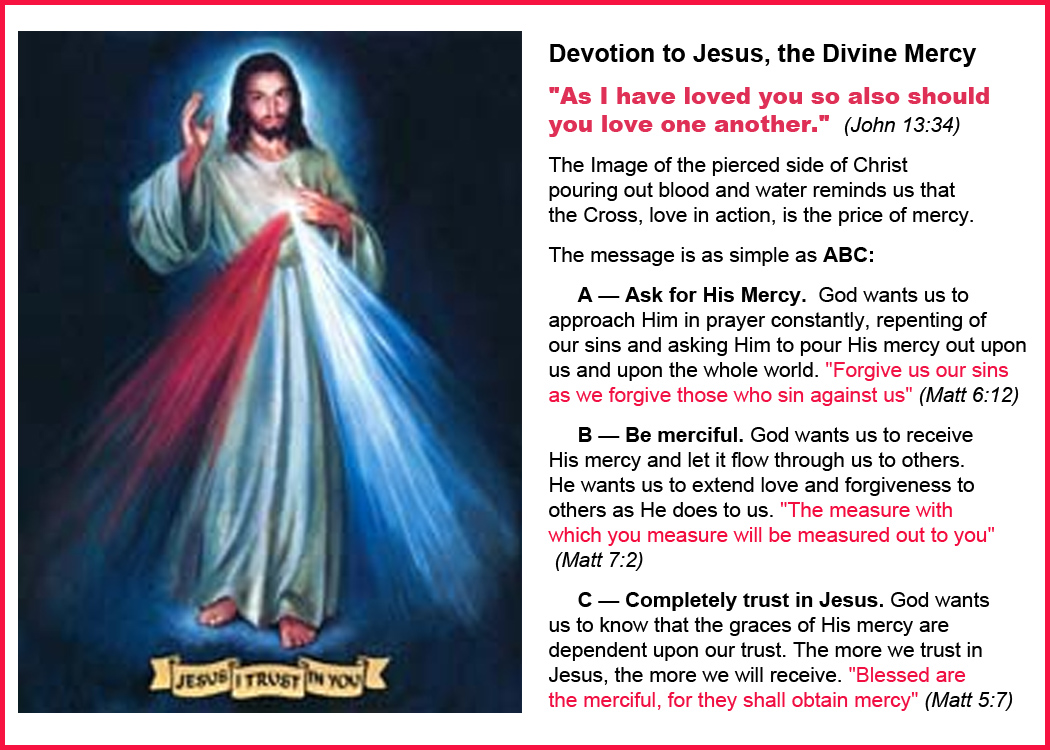
From 1931 until 1938, Our Lord Jesus Christ appeared to an uneducated Polish nun named Faustina Kawolska, bringing with Him a wonderful message of Mercy for all mankind. In obedience to her spiritual director, Saint Faustina recorded the revelations she received in a diary that grew to be about 600 pages long.
Divine Mercy Devotion

From Saint Faustina’s diary:

“In the evening, when I was in my cell, I became aware of the Lord Jesus clothed in a white garment. One hand was raised in blessing, the other was touching the garment at the breast. From the opening of the garment at the breast there came forth two large rays, one red and the other pale. In silence I gazed intently at the Lord; my soul was overwhelmed with fear, but also with great joy. After a while Jesus said to me, ‘paint an image according to the pattern you see, with the inscription: Jesus, I trust in You.’

“The pale ray stands for the Water which makes souls righteous; the red ray stands for the Blood which is the life of souls. These two rays issued forth from the depths of My most tender Mercy at that time when My agonizing Heart was opened by a lance on the Cross. … Fortunate is the one who will dwell in their shelter, for the just hand of God shall not lay hold of him.”

Jesus asked this image and devotion to the Divine Mercy be spread throughout the world. It proved to be of particular importance in strengthening Poles during the horrors of Nazi occupation.

Saint Faustina’s diary records that Jesus asked numerous times that a feast day be dedicated to the Divine Mercy and celebrated on the Sunday after Easter. Divine Mercy Sunday was officially decreed a Catholic Solemnity by Pope John Paul II on the occasion of the canonization of Saint Faustina on April 30, 2000.

The Warsaw Ghetto Uprising – Poland 1943

The largest single revolt by Jews in World War II occurred April 19 through May 16, 1943 in Warsaw, Poland. The Nazis crushed the resistance after thirty days and completed their plan to send all the Warsaw Jews to Treblinka for extermination.

In 1950, the Jewish community set Holocaust Remembrance Day, or Yom HaShoah, on Nissan 27. This date was chosen because it falls after Passover is over, but before the last day of the Warsaw Ghetto Uprising. It is also eight days before Yom Ha’atzma’ut, or Israeli Independence Day. It was legally inaugurated in in Israel in 1953.

The Jewish community decided Yom HaShoah should not interfere with  Shabbat (Sabbath), so if Nissan 27 falls on a Friday or Saturday, Yom HaShoah is moved to the previous Thursday; if it falls on Sunday, it is moved to the following Monday.

Holocaust Remembrance Day

On Yom HaShoah, all across Israel a siren blares and everyone comes to a halt to remember for 2 minutes. This video makes me weep.

Yom Hashoah in Tel Aviv 8/04/2013

On the face of it, the Catholic celebration of Divine Mercy Sunday and the Jewish commemoration of Yom HaShoah are totally unrelated. Yet they actually have roots in the most devout religious communities inside the nation that suffered the worst extremes of Nazi oppression.

We often hear about the six million Jews who died in the Holocaust. Few know that the genocidal policies of the Nazis also resulted in the deaths of nine million Gentiles. Three million of the Nazi victims were Polish. Half of these were Jews; half were Gentiles.

  • Saint Faustina died on October 5, 1938, in Kraków, Poland.
  • The Warsaw Ghetto Uprising started just 4½ years later on April 19, 1943 in Warsaw, Poland.
  • Kraków and Warsaw are only 157 miles apart.

Saint Faustina’s death date was Yom Kippur (Tishri 10, 5699) for the Jewish community. Yom Kippur, or the Day of Atonement, is the holiest day of the year for the Jewish people. Its central themes are atonement and repentance.

The Warsaw Ghetto Uprising began on Nisan 14, 5703, or Preparation Day in the Jewish calendar. This is the day when Jews prepare their Passover feast, or Seder, which they will celebrate after sundown when Passover begins. Nisan 14 is also the day when Jesus was crucified.

Jesus picked the date for Divine Mercy Sunday; the Jewish community picked the date for Yom HaShoah. Clearly, men had nothing to do with the fact that these two holidays, which are so closely related in the history and suffering of God’s people, also overlap frequently, despite our two different calendars.

I only went back to 2000, but found coincident holidays in 2004, 2007, 2010, 2011, 2013 and, in the near future, 2014 and 2017.

When Nisan 27 is a Sunday, Yom HaShoah is moved to Monday. But because Jewish holidays begin at sundown, whenever Yom HaShoah is on the Monday after Divine Mercy Sunday, the two Jewish and Catholic communities are actually celebrating both holidays together between sundown and midnight.  I can’t help thinking God intended that the overlap would occur only during hours of darkness.

The Divine Mercy: No Escape [46:14] Hosted by Helen Hayes

This movie is worth watching just to see the beauty of the soul of Ms. Hayes. After watching it, I became fascinated with her and from what I learned, it seems she truly was a very devout and beautiful person.

Sources:

2 Comments

Filed under Catholic Church, Christianity, Israel

Pope Francis tweets

2013_05 01 Pope tweets

Comments Off on Pope Francis tweets

Filed under Catholic Church, Pope Francis

That’s a good question

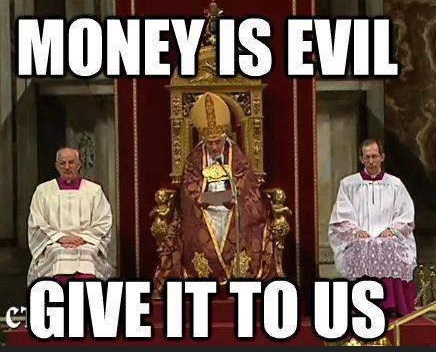
Why doesn’t the Catholic Church sell off her riches and give the money to the poor?

RCC and Money

  1. Selling off the Church’s wealth would harm more than help the poor by decreasing the Church’s ability to serve them. Most of the Church’s assets are tied up in real property – the buildings used for worship, education, health care, etc. and the land those buildings sit on. The Catholic Church already does more to help people than any other organization on the planet. How would it help the hungry to have a soup kitchen sold to a developer who would tear it down and build a parking garage?
  2. Many of the portable treasures are specific to Catholic worship and are used regularly for the benefit of all. The rest is mostly art that has been donated or willed to the Church with the intention that it be protected by her and made available to all. It would be a violation of that trust for the Church to sell off these pieces to the highest bidders.
  3. Selling off stuff would also impoverish the poor in a way few seem to consider. Poor people may live thread-bare lives, but even the most destitute can worship and celebrate life milestones in majestic spaces, surrounded by beautiful art and music the likes of which only the very wealthy can afford for themselves.

The value of America’s national treasures, monuments, parks and wildlife preserves far exceeds any imagined wealth the Roman Catholic Church allegedly hoards.  Should we sell the Washington Monument or Independence Hall to the highest bidder? How about Yellowstone National Park or all those antiques cluttering up the White House?

The Vatican has an annual operating budget of under $300 Million, while Harvard University, arguably the Vatican of elite secular opinion, has a budget of $3.7 Billion, meaning it’s ten times greater.

The Vatican’s “patrimony,” what other institutions would call an endowment, is around $1 Billion. In this case, Harvard’s ahead by a robust factor of thirty, with an endowment of $30.7 Billion.

http://ayjay.tumblr.com/post/45757925249/the-vatican-has-an-annual-operating-budget-of

3 Comments

Filed under Catholic Church, Christianity

Habemus Papam!

Pope descends Popemobile to bless disabled man before Inaugural Mass [1:37]

I love the part where one of his security guys lifted a baby over the gate so Pope Francis could bless it. 🙂

Dominican Sisters first hear about Pope Francis [1:50]

Check out how many YOUNG sisters there are in this group!

2 Comments

Filed under Catholic Church, Pope Francis

Things that Leftists are BAD at

Governing

Tweet – Obama Care will cost $2.6 Trillion but will reduce the number of uninsured from 36 to 30 million. That’s $433,333 per policy.

2013_03 11 Obamacare regs pic

The Constitution

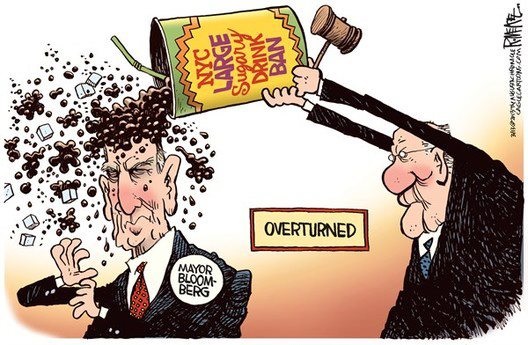
Tweet – I’d like to think that the judge who spoiled @MikeBloomberg’s fun did so on principle. But more likely, he was acting out of Sprite.

2013_03 Bloomberg overturned

Tolerance

Tweet – People flipping out that the Pope supports traditional families…you are actually upset that the Pope is, in fact, Catholic.
Tweet – Libs: “The Pope is letting his Catholicism get in the way of progress! How dare he?! PROG RAGE!”
Tweet – Dear MSM: We Catholics cannot change the dogma we have received from Christ and the Apostles to suit your personal sin preferences.

Respect Our President

Getting the planks out of their own eyes

Tweet – Has Obama congratulated the new Pope yet with a picture of himself?
Tweet – Someone made a joke about the Pope? Let’s burn down an embassy! <- Things that never happen.

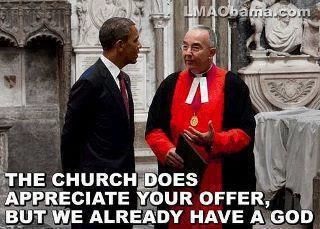
2012 We already have a God

Consistent moral values

Biden: Garden Variety Slap [:33]

Tweet – “Garden variety” slapping?!? That is a thing? If that doesn’t make abuse of women sound benign, I don’t know what does.
Tweet – It wasn’t a slap-slap, just a #gardenvariety slap.
Tweet – You’d think Biden’s casual familiarity with “garden variety” domestic abuse would concern people.
Tweet – If Dick Cheney had ever uttered the phrase “garden variety slap across the face,” it would still be on the front page of the New York Times today.

5 Comments

Filed under Barack Obama, Catholic Church, Constitution, Joe Biden, Michael Bloomberg, Obamacare

The official Catholic answers to some BIG questions

Question 159: What is purgatory?

Purgatory, often imagined as a place, is actually a condition. Someone who dies in God’s grace (and therefore at peace with God and men) but who still needs purification before he can see God face to face is in purgatory. When Peter had betrayed Jesus, the Lord turned around and looked at Peter: “And Peter went out and wept bitterly”—a feeling like being in purgatory. Just such a purgatory probably awaits most of us at the moment of our death: the Lord looks at us full of love—and we experience burning shame and painful remorse over our wicked or “merely” unloving behavior. Only after this purifying pain will we be capable of meeting his loving gaze in untroubled heavenly joy.

Question 160: Can we help the departed who are in the condition of purgatory?

Yes, since all those who are baptized into Christ form one communion and are united with one another, the living can also help the souls of the faithful departed in purgatory. When a man is dead, he can do nothing more for himself. The time of active probation is past. But we can do something for the faithful departed in purgatory. Our love extends into the afterlife. Through our fasting, prayers, and good works, but especially through the celebration of Holy Eucharist, we can obtain grace for the departed.

Question 161: What is hell?

Hell is the condition of everlasting separation from God, the absolute absence of love. Someone who consciously and with full consent dies in serious sin, without repenting, and refuses God’s merciful, forgiving love forever, excludes himself from communion with God and the saints. We do not know whether anyone at the moment of death can look absolute Love in the face and still say No. But our freedom makes that decision possible. Jesus warns us again and again not to separate ourselves definitively from him by shutting our hearts against the need of his brothers and sisters: “Depart from me, you cursed … As you did it not to one of the least of these, you did it not to me” (Mt 25:41, 45).

Question 162: But if God is love, how can there be hell?

God does not damn men. Man himself is the one who refuses God’s merciful love and voluntarily deprives himself of (eternal) life by excluding himself from communion with God. God yearns for communion even with the worst sinner; he wants everyone to convert and be saved. Yet God created man to be free and respects his decisions. Even God cannot compel love. As a lover he is “powerless” when someone chooses hell instead of heaven.

Question 163: What is the Last Judgment?

The Last Judgment will take place at the end of the world, at the second coming of Christ. “All who are in the tombs will hear his voice and come forth, those who have done good, to the resurrection of life, and those who have done evil, to the resurrection of judgment” (Jn 5:29). When Christ comes again in glory, his full splendor will shine upon us. The truth will come plainly to light: our thoughts, our deeds, our relationship to God and to other men—nothing will remain hidden. We will recognize the ultimate meaning of creation, comprehend God’s marvelous ways for the sake of our salvation, and finally receive also an answer to the question of why evil can be so powerful if God is in fact the Almighty. The Last Judgment is also our day in court. Here it is decided whether we will rise to eternal life or be separated from God forever. Toward those who have chosen life, God will act creatively once again. In a “new body” (see 2 Cor 5) they will live forever in God’s glory and praise him with body and soul.

Question 164: How will the world come to an end?

At the end of time, God will create a new heaven and a new earth. Evil will no longer have any power or attractiveness. The redeemed will stand face to face with God—as his friends. Their yearning for peace and justice will be fulfilled. To behold God will be their blessedness. The Triune God will dwell among them and wipe away every tear from their eyes; there will be no more death, sorrow, lamentation, or trouble.

4 Comments

Filed under Catholic Church, Christianity

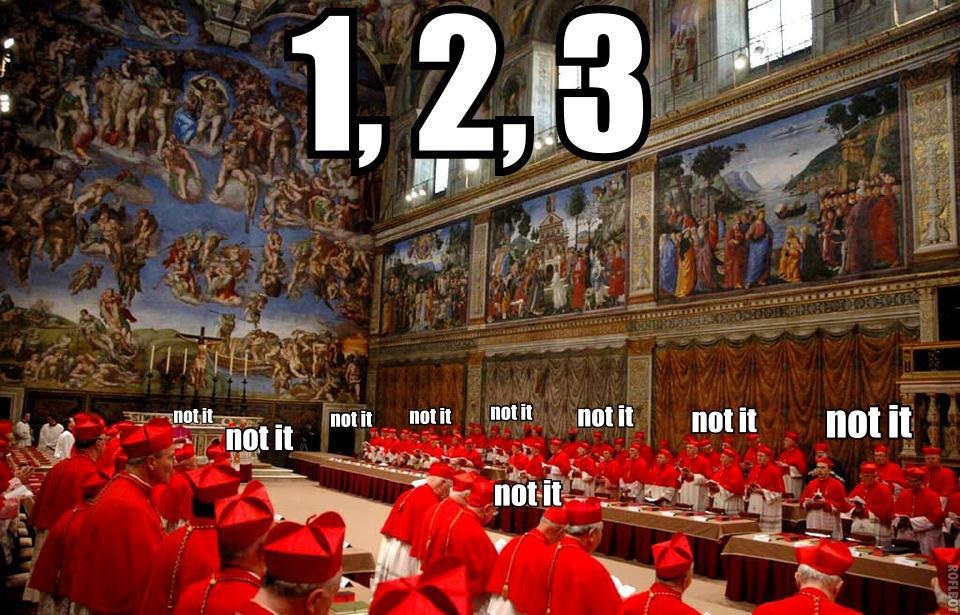
Catholics do good pomp :)

2013 Papal conclave

Comments Off on Catholics do good pomp :)

Filed under Catholic Church, Christianity

Newt Gingrich: Personal Reflections on Pope Benedict XVI

Let me say up front that I have a very personal feeling about Pope Benedict XVI’s retirement.

The Holy Father’s visit to Washington, D.C. in 2008 changed my life.

It was seeing him at the Basilica of the National Shrine of the Immaculate Conception which changed my curiosity into my becoming Catholic.

Let me explain.

For years, I would attend church with Callista (who was born and raised Catholic and is a longtime member of the Choir of the Basilica). As a non-Catholic I supported her deep commitment to the Church.

Further, Callista and I made a movie about Pope John Paul II and his pilgrimage to Poland in 1979. Nine Days that Changed the World is a remarkable film about this historic visit, which created a revolution of conscience that transformed Poland and fundamentally reshaped the spiritual and political landscape of the 20th Century. In producing this movie, I became even more intrigued with the amazing life of Pope John Paul II.

I gradually became more and more interested in the Catholic Church as an institution and in the Eucharist as the centerpiece of Catholic worship.

Of course, as a historian, I had studied the Church over the centuries including its strengths and weaknesses.

Having grown up Lutheran, serving as a Protestant acolyte in military chapels while my dad was in the Army, and becoming a Baptist in graduate school, I was pretty steeped in the history of the Reformation and the Protestant approach to God.

It was the weekly experience of the Catholic Church which had a steadily growing impact on me. The sense of community and reaffirmation of Christ’s sacrifice and love every Sunday — strengthened by my study of the extraordinary leadership and evangelism of Pope John Paul II drew me closer to the Church.

And yet the intellectual curiosity had not converted into an emotional bond — until Pope Benedict XVI came to Washington, D.C. in 2008.

During this visit, the Bishops gathered at the Basilica of the National Shrine of the Immaculate Conception for Vespers with the Holy Father

The Choir of the Basilica was invited to sing for Vespers. As a spouse of a choir member, I was invited to come to the Basilica. Spouses were allowed to sit in the large Upper Church while the Choir, the hierarchy, and the Pope were in an intimate Crypt Church below (which was good for the Choir because the Crypt Church is both beautiful and has extraordinary acoustics). Here, we watched the Vesper Service on large screen televisions.

To our surprise, the Holy Father, came through the sanctuary and visited with guests in the Upper Church. There was clearly joy in his eyes – it was absolutely stunning. His theme for the visit was “Christ our Hope” which I certainly thought captured the heart of Christianity in three words. His interaction with people was joyous as he communicated God’s love.

I was really surprised by the intense personal happiness Pope Benedict XVI conveyed. I had previously seen him as an intellectual German theologian (one of the greatest theologians of the 20th century) but not as an emotional evangelist like Pope John Paul II.

Yet here the Holy Father was visibly enjoying, indeed thrilled, by his chance to bring Christ’s message of salvation to the United States.

That night at dinner I told Monsignor Walter Rossi, the Rector of the Basilica and our good friend, that I wanted to become Catholic.

So you can see why I was deeply moved by the announcement that for the first time since 1415, a Pope would resign (and that occasion involved a political solution to having multiple Popes during the Avignon period) and for the first time since 1294 (and to the best of our knowledge only the second time in history) a Pope would resign because of age and energy.

In his last meeting with the Cardinals, Pope Benedict XVI noted “One of you is the future Pope, whom I today promise my unconditional reverence and obedience.”

This is a unique historic moment for the Catholic Church.

It is also a deeply personal moment for me.

Last night the Choir of the Basilica, led by Dr. Peter Latona, offered “Truth and Beauty: A Musical Tribute to Pope Benedict XVI.” Their wonderful music was interspersed with quotes from the Holy Father. (It was broadcast by EWTN).

Allow me to close with one example of his deep faith: “Love is the light — and in the end, the only light — that can always illuminate a world grown dim and give us the courage needed to keep living and working. Love is possible, and we are able to practice it because we are created in the image of God. To experience love and in this way to cause the light of God to enter into the world — this is the invitation I would like to extend.”

Pope Benedict may have retired, but his words will live on forever.

Your Friend,

Newt

2 Comments

Filed under Catholic Church, Newt Gingrich, Pope Benedict

Catholics and the Rapture

I believe the Scripture contains hints that a Rapture will occur as part of the Sixth Seal events and that these events, plus all of Revelation Chapter Seven, will mark the end of the Ages of the Christian Church on Earth.

I further believe the texts of Seal Seven and Letter Seven (Laodicea) predict a six month period of calm following the Rapture, when the Left Behind “who have ears to hear” will have time to respond to Jesus’ knocking on the doors to their hearts. This may involve them first breaking into the houses of the “religious fanatics” who suddenly disappeared in order to get hold of all the Bibles, books and DVDs we collected but that’s another story!

In the interests of not giving scandal, I thought that before I came right out and said in public, “I think the Bible predicts a Rapture event,” I had better check what the Roman Catholic Church does and does not teach about this stuff. I located two articles by Catholic theologians that each had serious enough bona fides that I felt I could print them out and give them a good deal of my attention.

1. Catholic Answers Tract: The Rapture @ http://www.catholic.com/tracts/the-rapture

This article carries the important NIHIL OBSTAT and IMPRIMATUR stamps of approval.

2. Raptured or Not? A Catholic Understanding @ http://www.americancatholic.org/Newsletters/CU/ac1005.asp

This article was authored by a Franciscan professor of Old Testament, Semitic languages and biblical spirituality.

N.b., If you see stuff purporting to present Catholic teaching, please Please PLEASE check the bona fides before accepting it as definitive. I’ve seen some out-and-out lies presented in this “straw man” way. 

The pertinent section in the Catholic Catechism for our purposes is:

RCC Catechism 676

Millenarian doctrines have been kicking around for centuries. They come in different varieties, but are all based in Revelation 20:1-10. Today’s Christians are familiar with two forms:

  • Christian Millennialists who interpret these verses to mean that Jesus will return at end of the Great Tribulation, then rule here on Earth for a long time (usually 1000 years, hence the term millennialism), after which the dead will be raised, all souls will be judged, and God will inaugurate the new Heaven and the new Earth.
  • Social Justice Christians who interpret these verses to mean that human society can and should be perfected not through God’s grace, but through natural, usually political, means – e.g., Communism, Socialism. There are bucket loads of these folks in my church. They pay about as much attention to the Scriptures and the Catechism as they and their comrades on the Left pay to the Constitution. (Big names include Joe Biden, Nancy Pelosi, Kathleen Sebelius and, of course, their now-deceased “Lion of the Senate” Ted Kennedy.)

For Catholics, teachings about the Rapture tend to get thrown out with the bathwater, because they are included in many religious millennial interpretations. But the two things are actually quite separate and the Catholic Church only condemns the “Jesus will rule on Earth for a long time between the Second Coming and the Final Judgment” part. The Catholic Answers article says,

With respect to the rapture, Catholics certainly believe that the event of our gathering together to be with Christ will take place, though they do not generally use the word “rapture” to refer to this event (somewhat ironically, since the term “rapture” is derived from the text of the Latin Vulgate of 1 Thess. 4:17—”we will be caught up,” [Latin: rapiemur]).

Granted, this ingathering is usually understood to refer only to the one described at the Second Coming / Final Judgment, but there’s nothing inherent to the idea of an earlier ingathering that is condemned. What is problematic for Catholics is any interpretation that says:

  • Jesus will come back here more than once and/or that
  • His Second Coming will not be followed soon after by the Final Judgment.

The Rapture event I am seeing in the Sixth Seal and Chapter Seven avoids both of these problems. More on all this in my next installment.

Comments Off on Catholics and the Rapture

Filed under Bible Prophecy, Catholic Church, Christianity

We could have a new Pope before Easter

Pope Benedict XVI

Pope Benedict XVI announced Monday he will resign on February 28, because his health makes it too difficult for him to perform the duties. He is 85 years old. It’s the first time in more than 600 years that a Pope has resigned.

8 Comments

Filed under Catholic Church, Pope Benedict