
Category Archives: Christianity
The Unreported Revolution
Protests have raged for days throughout Iran, as people rebel against an oppressive regime that rules with an iron fist. This is not the first time the people have risen up, resulting in rivers of blood among those craving freedom.
What’s going on in Iran? – June 2009 – Green Revolution
Fact Check: Was Obama ‘silent’ on Iran 2009 protests?

On June 13, 2009, Iran announced that incumbent President Mahmoud Ahmadinejad won a landslide victory. His main opponent, Mir Hossein Moussavi, had already alleged blatant violations. After the announcement, angry crowds of Moussavi supporters took to the streets.
SOUNDS LIKE THE DEMOCRATS AFTER 2016, ONLY WE’RE NOT SAVAGES LIKE THE MULLAHS ARE
June 15, Obama gave remarks on the situation. He said he was watching the news from Iran. It is “up to Iranians to make decisions about who Iran’s leaders will be,” he said, adding that “we respect Iranian sovereignty and want to avoid the United States being the issue inside of Iran.”
Asked why he would not spell out potential consequences for Iran over its behavior, the president replied, “Because I think that we don’t know yet how this thing is going to play out. I know everybody here is on a 24-hour news cycle. I’m not.”
[CtH: He was fast enough with condemning COPS, without having ANY of the facts. What a hypocrite.]
His silence validated the mullahs, despite the blood on their hands and the nuclear centrifuges in their tunnels,” presidential hopeful Tim Pawlenty alleged last year in the race for the Republican nomination.
THE MEDIA CONTINUES TO SCREAM THAT THIS STINKING PIG IS A CHRISTIAN. HE’S NEVER GIVEN ANY INDICATION HE WAS ANYTHING BUT A MUSLIM MAGGOT.
http://www.cnn.com/2012/10/08/politics/fact-check-romney-iran/index.html
Anti-Regime Protests Break Out Across Iran
The crowds drilled to chant ‘death to America’ went off the script and demanded the end of the Islamic regime instead. Videos show Iranians chanting ‘Death to the dictator’ and ‘Death to Rouhani’.
President Obama, busy cementing his ‘legacy’ with a Nuclear Deal with the Iranian regime, refused to show any support for the pro-democracy movement in Iran. He even threw a lifeline the Iranian regime at a time when international sanctions were finally beginning to show results.
As columnist Eli Lake explained, writing for the Bloomberg, “Obama wasn’t just reluctant to show solidarity in 2009, he feared the demonstrations would sabotage his secret outreach to Iran.”
“Obama from the beginning of his presidency tried to turn the country’s ruling clerics from foes to friends,” Lake added.
President Obama’s Nuclear Deal allowed Iran access to assets frozen in the US to the tune of $100 billion. The Obama administration even shipped $1.7 billion in cash to the regime, described as ‘settlement of old legal claim.’
With President Trump in office, those cash payments seem to have stopped. Buoyed by the cash flow thanks to Obama-Kerry Nuclear Deal, regime overstretched itself militarily, funding and manning pro-Iranian militia in Syria, Yemen and Lebanon. Tehran even resumed aid to the Gaza-based Islamist terror outfit Hamas — Hezbollah’s estranged evil Sunni twin, patching up ties strained by Iran’s intervention in the Syrian conflict.
https://legalinsurrection.com/2017/12/anti-regime-protests-break-out-across-iran/
Iran cuts social media access as unrest turns deadly
 Iran cut access to social media on Sunday in a bid to head off further protests after days of unrest that saw two people killed and dozens arrested.
The interior minister warned protesters will “pay the price” as footage on social media showed thousands marching across the country overnight in the biggest test for the Islamic republic since mass demonstrations in 2009.
[CtH: The whiners who “protest” in the U.S. of A. should be kissing the Constitution in gratitude that they can do so with virtual impunity.]
http://www.dailymail.co.uk/wires/afp/article-5224151/Iran-warns-protesters-pay-price.html
#NeverTrump National Review Licked ‘the Mud Off of George W. Bush’s Boots’ While He Allowed Iraq’s Christians to Be Ethnically Cleansed
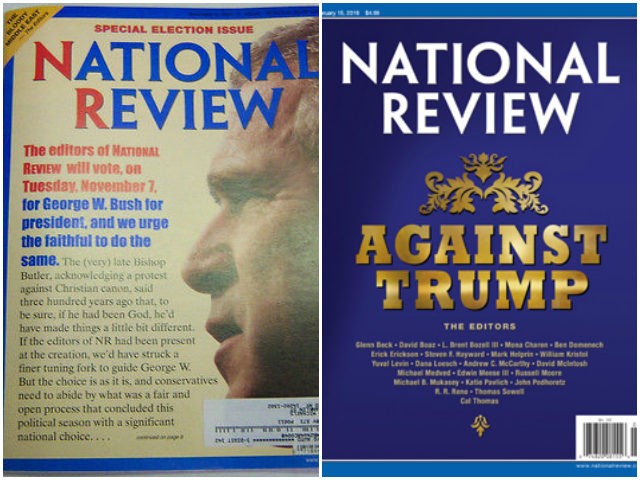 The Bush administration showed absolutely zero concern for the Christian communities of Iraq,” said Zmirak. “And we’re not talking five or six hundred people; 1.3 million Christians lived in Iraq when the Iraq War started, and they have lived there for two thousand years. They were some of the earliest Christian communities in the world. Way before there were Catholics in Rome, or before Constantinople existed, there were Christians in Iraq.”
“Seventy-five to eighty percent of [Iraq’s Christian communities] were ethnically cleansed while George Bush was president, while he was commander-in-chief, while he ruled that country as absolutely as Kim Jong-un rules North Korea. He didn’t care,” Zmirak stated
Some call Trump’s Iran protest tweets striking turnabout from Obama era
Those protesters are being buoyed by messages from the Trump administration, says the National Council of Resistance of Iran (NCRI), a coalition of democratic Iranian groups and personalities.
 In two tweets earlier Saturday, President Donald Trump offered up a message of hope to the protesters: “The entire world understands that the good people of Iran want change, and, other than the vast military power of the United States, that Iran’s people are what their leaders fear the most…”
Trump added: “Oppressive regimes cannot endure forever, and the day will come when the Iranian people will face a choice. The World is watching!”
US ‘strongly condemns the arrest of peaceful protesters’ in Iran
 Iran’s leaders have turned a wealthy country with a rich history and culture into an economically depleted rogue state whose chief exports are violence, bloodshed, and chaos,” the department said in a statement. “As President Trump has said, the longest-suffering victims of Iran’s leaders are Iran’s own people.”
“We urge all nations to publicly support the Iranian people and their demands for basic rights and an end to corruption,” the statement added.
CNN Caught Sharing Iranian Regime Propaganda
The Iranian regime also decided to hold their own rallies in support of the corrupt ruling class. Protesters were bused in for the rallies.
 The pro-regime protesters were carrying ‘down with Israel’ signs. This photo was taken from Tasnim News Agency in Iran from their protest shots today.
 Later today CNN reported on the rallies. CNN took their photos from the Tasnim News Agency. They are literally spewing the pro-regime propaganda in their news reports
 http://www.thegatewaypundit.com/2017/12/disgusting-cnn-caught-sharing-iranian-regime-propaganda/
Supreme Leader Tweets About Jesus, But Iran is One of World’s Worst Persecutors of Christians
 Iran is also one of 10 countries currently designed “countries of particular concern” under U.S. law for egregious violations of religious freedom. Iran carries out more executions each year than any country apart from China, applying the death penalty for offenses including apostasy, insulting Mohammed and other “grand prophets,” moharebeh (enmity against Allah) and “corruption on earth.”
Just two weeks before Christmas, however, the independent Iranian Christian news agency Mohabat News reported that security forces raided six houses in Karaj, Iran’s fourth-largest city, where Christians hold house church services.
It said four converts to Christianity were arrested and that shops owned by two of the men were also raided. Four of the Christians received ten year prison sentences, after being convicted of engaging in missionary activities and “conducting activities against national security,” Christian Solidarity Worldwide reported at the time.
“The charges and sentences against these four men are unwarranted and unjustifiable, given the paucity of the evidence against them,” said CSW chief executive Mervyn Thomas.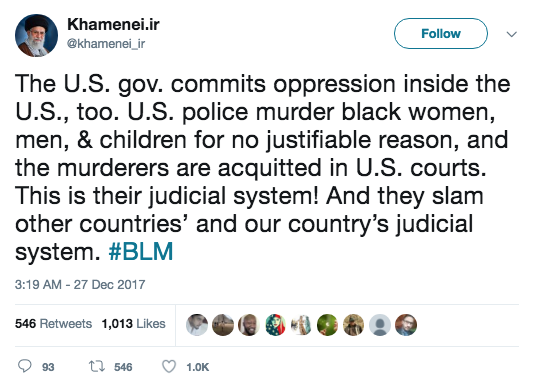 https://www.cnsnews.com/news/article/patrick-goodenough/supreme-leader-tweets-about-jesus-iran-one-worlds-worst-persecutors
Iran Starts Killing Protesters, ABC Ignores While CBS and NBC Downplay
 IF THIS SURPRISES YOU, YOU’RE NOT PAYING ATTENTION.
Disgustingly, the deaths didn’t trigger much air on the three major American networks. ABC’s Good Morning America had a blackout of the deaths and protests all together while NBC only found 24 seconds for them. CBS finally discovered the protests, as they continued into their fourth day, dedicating a meager 16 seconds.
Instead of allowing serious time for the brutal murders of Iranian civilians and the protests, whose marchers have been chanting “Death to Rouhani” and “We don’t want an Islamic republic,” NBC’s Sunday Today ran a four minute and 37 seconds long highlight reel of the media slamming and smearing President Trump from this past year.
MOST OF YOU WILL GET THIS:
[CtH: I don’t get it. :0/]
FEMINISTAS, THERE AND HERE



Filed under Barack Obama, Christianity, Donald Trump, George W. Bush, Iran, Islam, Israel, News Media
Filling the “God-Shaped Hole”
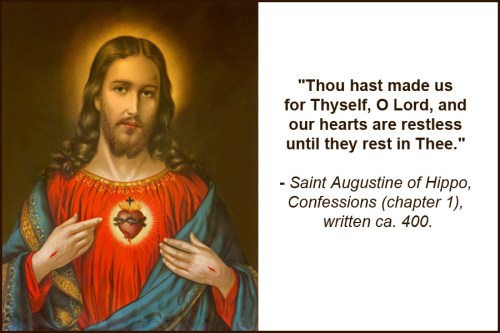
Studies show there is a strong correlation between lack of religious attendance and illicit drug use and that religion also plays a strong role in effective drug treatment programs.
Sources:
Comments Off on Filling the “God-Shaped Hole”
Filed under Christianity
I believe in God
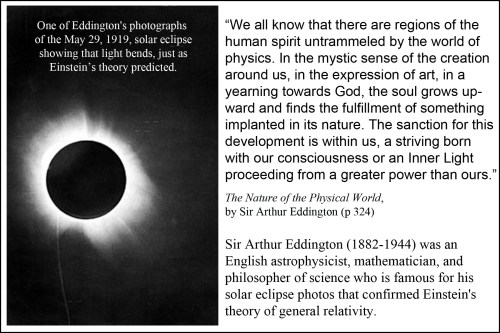
The End of Prayer Shaming: Posted by East Catholic High School, Dec 22, 2015
Comments Off on I believe in God
Filed under Christianity, Prayer, Science
Speaker Ryan Invites a Social Doctrine Conversation
CNN is not the customary locale-of-choice for a catechesis on Catholic social doctrine. But that’s what Paul Ryan, Speaker of the U.S. House of Representatives, offered viewers of a CNN national town hall meeting on the evening of August 21.
Challenged with a semi-“Gotcha!” question by Sinsinawa Dominican Sister Erica Jordan, who not-so-subtly suggested that Ryan’s approach to healthcare reform, tax reform, and welfare reform was in conflict with the Church’s social teaching, the very Catholic Speaker replied that he completely agreed with Sister Erica that God is “always on the side of the poor and dispossessed”; the real question was, how do public officials, who are not God, create public policies that empower the poor and dispossessed to be not-poor and not-dispossessed?
Congressman Ryan then laid out an approach to alleviating poverty and empowering the poor that seemed to me entirely congruent with the core Catholic social ethical principles of subsidiarity and solidarity. Solidarity with the poor is a moral imperative, Ryan agreed, but solidarity should not be measured by inputs—How many federal dollars go into anti-poverty programs?—but by outcomes: Are poor people who can live independent and fruitful lives being helped by our welfare dollars to develop the skills and habits that will enable them to be self-reliant, constructive citizens? The moral obligation of solidarity is not met by programs that perpetuate welfare dependency.
Speaker Ryan is a longstanding advocate of decentralizing and (as he puts it) “customizing” social welfare programs. That means abandoning one-size-fits-all attempts to address poverty and looking to the states, where a lot of the creativity in American government resides these days, for approaches that actually empower the poor, because they treat poor people as men and women with potential to be unleashed, not simply as clients to be maintained. Proposals to decentralize social welfare programs and give the states the funds necessary to conduct all sorts of customized efforts to empower the poor—crafted so that each “fits” the vast array of distinct circumstances we find in impoverished America—strike me as a sensible application of the social doctrine’s principle of subsidiarity. That principle, first articulated by Pope Pius XI in 1931, teaches us to leave decision-making at the lowest possible level in society, closest to those most directly affected by the policy in question. Paul Ryan thinks Washington doesn’t have to decide everything; Pius XI would have agreed.
The fact that poverty remains a serious problem in the United States after the federal government has spent $22 trillion dollars on social welfare programs over the past fifty years should have taught us all something about the complex problems of empowering the poor. No one with any sense or experience imagines that he or she has the silver-bullet answer to poverty in all its social, cultural, economic, and political dimensions; I know my friend Speaker Ryan doesn’t think he does.
But unlike those who insist on measuring an official’s or a party’s commitment to the poor by inputs rather than outcomes (an approach that tends to instrumentalize the poor and render social welfare policy a cash transaction rather than a human encounter), Paul Ryan and reform conservatives like him are willing to face the fact that there is no direct correlation between magnitude-of-dollar-inputs and success-of-human-outcomes when it comes to anti-poverty programs. Inner-city Catholic schools (the Church in America’s most effective social welfare program) demonstrate that time and again: They spend less than the government schools, and their students learn much more—and not just in quantifiable, standardized-testing terms.
America needs many serious conversations in this age of the demagogic tweet and the rabid talk-radio sound-bite. One of them is about the scandal of poverty amidst vast wealth and the empowerment of the poor. That conversation is not advanced when, as happened after the CNN broadcast, smug partisans attack a serious Catholic public official by suggesting that he’s deficient in both his moral commitment to the poor and his understanding of Catholic social doctrine. Paul Ryan is no more the reincarnation of Simon Legree than Sister Erica Jordan and her fellow Sinsinawa Dominicans are the reincarnation of Ingrid Bergman/Sister Mary Benedict in The Bells of St. Mary’s. Keeping that in mind would help foster the thoughtful debate that the Speaker, and the country, would welcome.
George Weigel is Distinguished Senior Fellow of Washington, D.C.’s Ethics and Public Policy Center, where he holds the William E. Simon Chair in Catholic Studies.
Filed under Christianity, Paul Ryan, Poverty, Welfare
Liberal Hypocrisy

One of Trump’s nominees for appeals court is Amy Coney Barrett, a Notre Dame Law School professor and a Roman Catholic. Democrats Feinstein, Hirono, and Durbin made her religious convictions an issue during her confirmation hearing.
Republican Sen. Ben Sasse noted that this line of questioning violated the Constitution’s religious test clause.
Durbin said that, because Barrett has been “outspoken” on the topic of “how a person with strong religious beliefs becomes a judge and looks at American law”, the questions were legitimate.
I think it’s more to the point to say that Democrats can’t stand conservative Christians, especially not the Catholic ones, and that they have zero qualms about making religion an issue when it suits them. You KNOW they’d be screaming bloody murder if Republicans asked a Muslim jurist how his faith would influence his judicial conduct.
Remember when long-time Leftist Sonia Sotomayor said she’d be a good SCOTUS judge, because she was a “wise Latina”?
Obama et al. didn’t care that she had never issued any important decisions, made a name for herself as a legal scholar or particularly respected jurist, and that 60% of her lower court decisions had been overturned on appeal. They only cared that she could be relied on to ignore the law in favor of promoting Progressive causes.
Barrett herself said, “It is never appropriate for a judge to apply their personal convictions, whether it derives from faith or personal conviction. My own personal church affiliation or my religious belief would not bear on the discharge of my duties as a judge.”
Not that they believed her. Personally, I think they assume everyone is as willing to prostitute themselves for politics as they themselves are.
Sources:
- http://dailycaller.com/2017/09/06/nominees-religious-faith-dominates-senate-judicial-confirmation-hearing/
- https://www.catholicvote.org/a-reprehensible-attack-on-a-catholic-judicial-nominee/
- http://www.washingtontimes.com/news/2009/may/27/60-reversal-of-sotomayor-rulings-gives-fodder-to-f/
- http://www.cnn.com/2009/POLITICS/05/27/shapiro.scotus.identity/index.html
http://www.washingtontimes.com/news/2009/may/27/60-reversal-of-sotomayor-rulings-gives-fodder-to-f/
Filed under Ben Sasse, Christianity, Constitution, Democrats, Dick Durbin, Sonia Sotomayor


Don’t mess with God’s saints!
St. Katharine Drexel was the first person born a U.S. citizen to be made a saint. And what a saint she was!
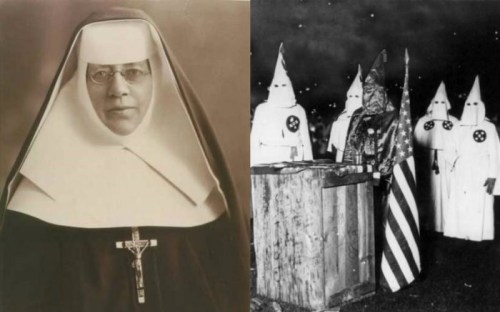
Born into a wealthy family in 1858, when St. Katharine got older she took a vow of poverty, founded a new order of religious sisters, and devoted her great wealth to serving those discriminated against in the U.S., namely Native Americans and African Americans.
In the early 20th century, this got her into a lot of trouble, especially with the Ku Klux Klan (KKK). The KKK was not only notoriously anti-black, but also anti-Catholic. So you can imagine how they felt about Catholic sisters helping blacks!
One thing that St. Katharine’s order did was open up schools for Native American and African American children.
In 1922, a local KKK group turned against one of their schools in Beaumont, Texas and “threatened to tar and feather the white past[or] at one of Drexel’s schools and bomb his church.”
So what did the sisters do? They prayed, of course!
And here’s what happened, according to one telling of the story: “The nuns prayed and days later, a tornado came and destroyed the headquarters of the KKK killing two of their members.”
The result? “The Sisters were never threatened again.”
Source:
Comments Off on Don’t mess with God’s saints!
Filed under Christianity, KKK, Prayer
Paganism Does Not Fulfill

Facebook co-founder and CEO Mark Zuckerberg wants his social network to fill the role that churches and social clubs once did in communities.
Uhhhhhhhhhhh … only if you think churches are just social clubs. Sheesh.
For an interview with Pastor Robert Jeffress about Zuckerburg’s ideas, see embedded video @ http://insider.foxnews.com/2017/06/30/mark-zuckerberg-facebook-can-fill-churches-role-bring-people-together-communities
Comments Off on Paganism Does Not Fulfill
Filed under Christianity








 polination.blog