
This video is important.
If the president can ignore provisions of immigration law, marijuana law, mandatory minimum sentencing law, and the “Affordable Care Act,” then what prevents the president from ignoring election laws?
This video is important.
If the president can ignore provisions of immigration law, marijuana law, mandatory minimum sentencing law, and the “Affordable Care Act,” then what prevents the president from ignoring election laws?
Filed under Constitution, U.S. Congress
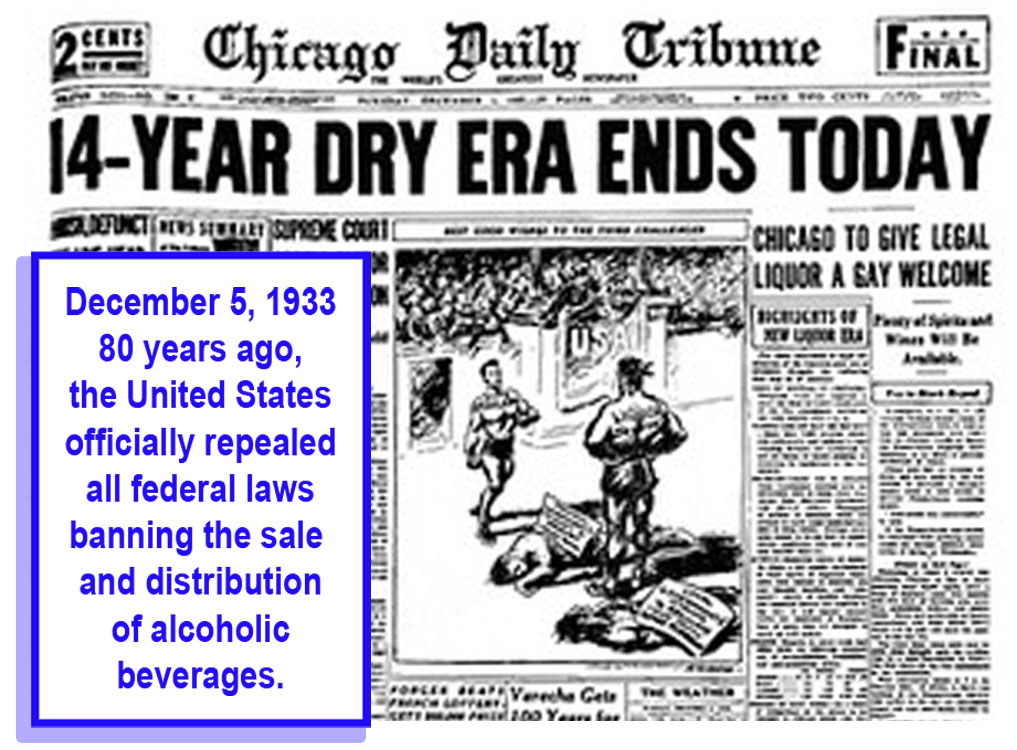
1919: The requisite number of State legislatures ratified the Eighteenth Amendment to the United States Constitution, enabling national Prohibition to become the law of the land.
Supporters of Prohibition believed banning alcoholic beverages would reduce or even eliminate many social problems, particularly drunkenness, crime, mental illness, and poverty.
1925: Journalist H.L. Mencken noted that five years of Prohibition had succeeded in completely disproving the Prohibitionists’ favorite arguments.
“There is not less drunkenness in the Republic, but more. There is not less crime, but more. There is not less insanity, but more. The cost of government is not smaller, but vastly greater. Respect for law has not increased, but diminished.”
Support for Prohibition eroded among voters and politicians. Against expectations, many women also supported repeal, again because of seeing the destructiveness of the law itself.
Even John D. Rockefeller Jr., a lifelong nondrinker who had contributed hundreds of thousands of dollars toward getting Prohibition passed, switched sides after seeing the widespread problems it caused.
1932: Democrats, including their presidential candidate, Franklin D. Roosevelt, campaigned on repealing the Eighteenth Amendment to the United States Constitution.
The next year, both chambers of Congress and the requisite number of State legislatures ratified the Twenty-first Amendment, which repealed Prohibition.
Please note: Prohibition was both passed and repealed by amending the Constitution, which can be done in only one of two ways:
- Two-thirds of the House of Representatives, two-thirds of the Senate and three-fourths of the various State legislatures must all agree to vote for the amendment. This is the method used to both pass and repeal Prohibition and is, in fact, the only one used to date.
- Congress can be by-passed if two-thirds of the State legislatures call for a Constitutional Convention, then amendments proposed at the Convention are ratified by three-fourths of the State legislatures.
Sources:
Comments Off on Prohibition: Law of the land for 14 years
Filed under Constitution, U.S. Congress
My dear friend, Angelaisms, has written a brilliant essay about the fundamental difference between the Left and the Right in our society today.
It all boils down to pottage. You know … like in Esau and Jacob? I’ve been hearing that story my whole life, but never saw it like this.
I call this piece “brilliant” because it’s so SIMPLE. Clear, accessible writing about complex, multi-layered subjects is the hardest thing to do and she’s done it here … well, brilliantly.
Excerpt to whet your appetite:
We all like rights. We all talk about them. And we like to think that we all have a common definition for the term.
Unfortunately, we don’t. When you boil it down, there are two different schools of thought on what the proper synonym is for “rights:” it’s either “authority” or “stuff.”
They are mutually exclusive.
Read the rest @ http://misfitpolitics.co/2013/11/much-more-than-semantics/.
I promise you won’t be sorry.
Filed under Constitution
Under the Constitution, we’re all supposed to be equal under the law.

Within months after Obamacare was passed, Obama was handing out exemptions to people and organizations that had supported his election and helped push the bill through.
Obama had no legal right to grant anyone an exemption.
Period.
He did it anyway.
Source:
Here are 341 reasons why Democrats and unions that support Obamacare want exemptions for themselves
Filed under Barack Obama, Constitution, Democrats, Unions
Filed under Barack Obama, Constitution, Obamacare, Piers Morgan, U.S. Congress

During the raid, the agents confiscated registered firearms, as well as documents and notes for which they had no warrant. While they ransacked the home, the armed agents held Hudson and her husband in the kitchen.
One of the agents asked Hudson if she was the person who had written a series of Washington Times stories critical of the Federal Air Marshal program in the mid-2000s. She was. And the documents the agents seized … surprise, surprise (NOT) … were all related to those stories. Agents also took the reporter’s personal, handwritten notes and accessed her personal Facebook page.
The Washington Times is suing.
Sources:
Filed under Constitution, First Amendment, Government Tyranny, Second Amendment
The federal government is shoving the “Common Core” curriculum into schools. Below is a real assignment from a 6th grade class in Bryant School District in Arkansa. The assignment says, “You have been selected to work on a National Revised Bill of Rights Task Force. You have been charged with the task of revising and editing the Bill of Rights. .. You will have to prioritize, prune, and add amendments.”

These students have not been taught what the Constitution or the Bill of Rights mean or how they came to be. They have not been taught to appreciate their remarkable and extraordinary place in the history of world governments or how well they have worked for more than two centuries. They have also not been taught the mechanism provided by the Constitution for properly amending the Constitution.
The child whose mother posted this assignment said her daughter had no idea what the amendments meant or why the class had been assigned to throw out two old ones and invent two new ones. She only knew she’d been told to do it, so she had to do it. Oddly, the assignment reassures students that it’s okay to disagree; however, they cannot complete the assignment unless and until every single person assigned to their committee agrees!
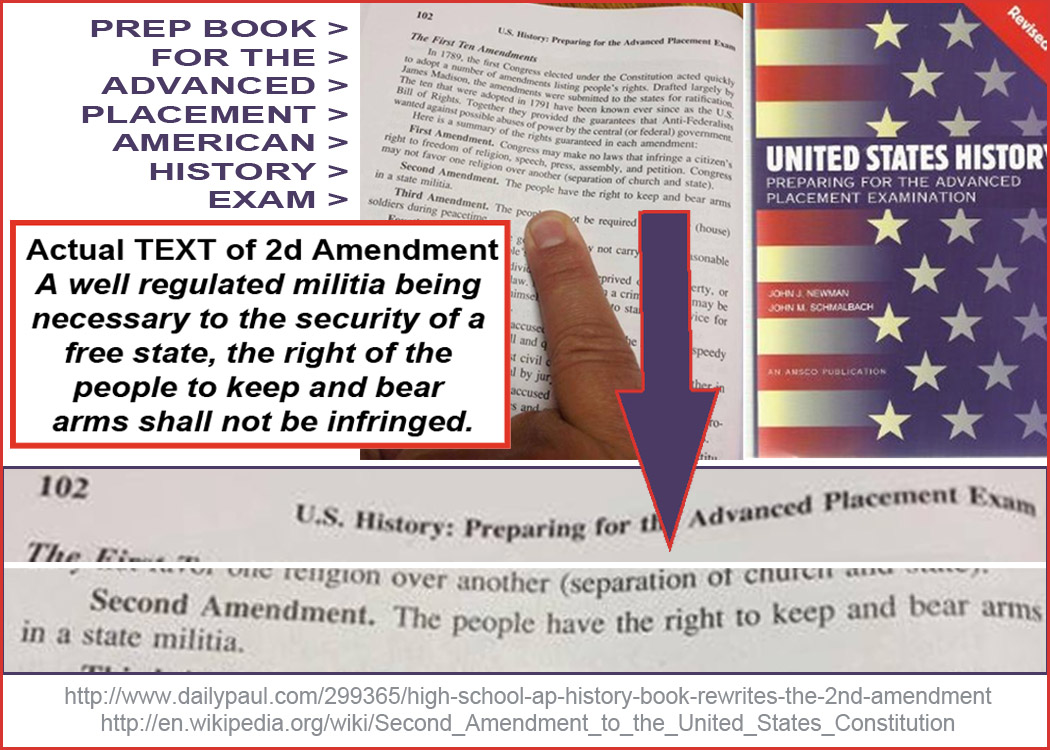
Meanwhile, an AP American History review book presents a faux version of the Constitution.
Source:
Comments Off on Lefting the hearts and minds of your kids
Filed under Common Core, Constitution, Education, History
August 28: Syria
Obama said the White House will brief top congressional leaders this afternoon about Obama’s plans for a possible military strike.
Democrat and Republican members of Congress reminded Obama that just consulting with or informing Congress is not good enough to make military action legal.
Under the provisions of the War Powers Resolution (WPR), the President is required to notify Congress within 48 hours of the onset of US military involvement. They then have 60 days to get formal authorization from Congress and if they fail to do so must cease operations within 30 days.
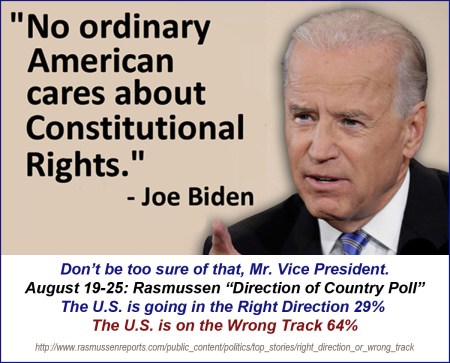
Obama is unlikely to give a crap what Congress thinks or the Constitution says. In 2011, he ordered American warplanes into action over Libya without seeking authorization from Congress before or after.
The New York Times, the usual leakhole of Obama Inc, quoted officials describing a limited one or two day campaign that would degrade Assad’s ability to launch chemical weapons, without forcing him out of power. That might be true, but then again no less a figure than Barack H. Obama had promised that the Libyan intervention would last “days, not weeks”. It lasted months, not weeks, let alone days.
Meanwhile, Obama reportedly told several mayors that he would by-pass Congress to get more gun control.

Sources:
Filed under Barack Obama, Constitution, Democrats, Joe Biden, Syria, U.S. Congress, United Nations


Comments Off on The Democrat war on US
Filed under Barack Obama, Ben Carson, Civil Rights, Constitution, Democrats, Race Relations, Republicans, Slavery




 | chrissythehyphenated on Bits & Bytes |
 | bluebird of bitterne… on Bits & Bytes |
| chrissythehyphenated on Good Friday |
 | mindful webworker on Good Friday |
| chrissythehyphenated on Bits & Bytes |
| bluebird of bitterne… on Bits & Bytes |
| bluebird of bitterne… on Palm Sunday |
| chrissythehyphenated on Palm Sunday |
| chrissythehyphenated on Palm Sunday |
| bluebird of bitterne… on Palm Sunday |
| bluebird of bitterne… on Palm Sunday |
| mindful webworker on Palm Sunday |
| bluebird of bitterne… on Bits & Bytes |



 polination.blog